
I Replaced My Morning Standup With an AI Agent Swarm
How I use multi-agent orchestration to replace my morning standup. 4 specialized agents pull from Linear, GitHub, and Slack automatically.
Reading about AI agents? RapidClaw gives you one that lives in Telegram & Discord, remembers everything, and runs your day — live in 60s, from $19/mo.
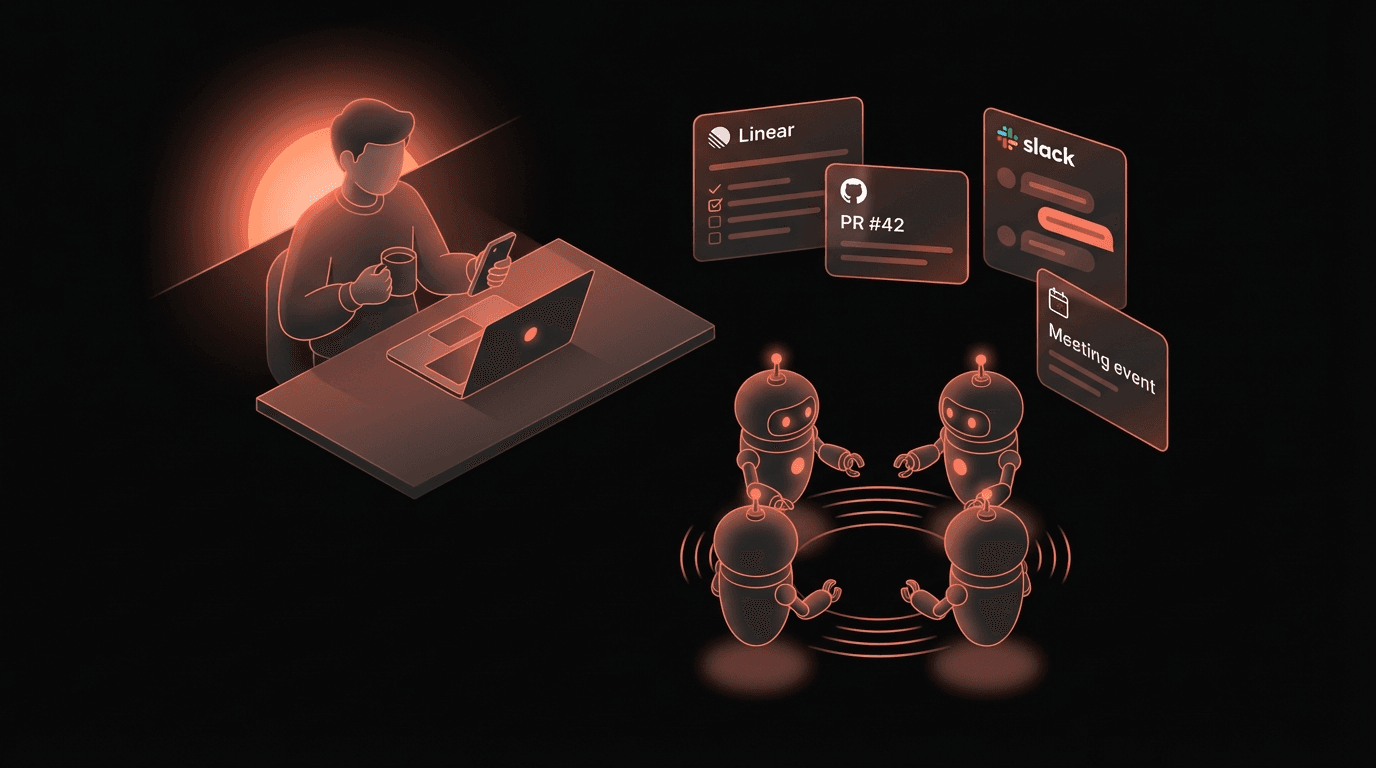
Get startedI used to spend 20 minutes every morning checking Linear for ticket updates, scanning GitHub for overnight PRs, and reading Slack threads to figure out what happened while I was asleep. Now four AI agents do that for me in about 90 seconds and deliver a summary to my Telegram at 7am. I didn't plan for this to become a standup replacement, but that's what happened.
Multi-agent systems are the pattern I'm most excited about in 2026. Not one mega-agent that tries to do everything. A team of specialists that each do one thing well and pass the ball.
What is multi-agent orchestration and why is it trending?#
The concept is straightforward. Instead of building one large agent that handles every task, you build several smaller agents that specialize. One agent is great at pulling data from project management tools. Another is great at analyzing code changes. Another is great at summarizing conversations. A coordinator agent sits on top, delegates work, and synthesizes the results.
This is how my morning standup replacement works. I have four agents.
The first agent connects to Linear and pulls all ticket updates from the past 24 hours. New tickets created, status changes, comments added, blockers flagged. It doesn't analyze anything. It just collects and formats the raw data.
The second agent checks GitHub. New pull requests, merged PRs, review comments, CI/CD failures. Same deal -- collect, format, pass along. No interpretation.
The third agent scans Slack. It reads channels I've designated as relevant, pulls threads with more than 3 messages (my threshold for "something actually happened here"), and extracts the key points. This one does light summarization because Slack threads are noisy and nobody wants to read raw message logs at 7am.
The fourth agent is the coordinator. It receives output from the other three, identifies connections (like a GitHub PR that relates to a Linear ticket), flags anything that needs my attention, and compiles everything into a structured daily briefing. It also ranks items by priority based on patterns it's learned from what I've acted on in the past.
The whole pipeline runs on a cron job at 6:45am. By 7am, I have a Telegram message that looks like a standup summary. What happened yesterday, what's blocked, what needs my attention today. It takes me 2 minutes to read instead of 20 minutes to compile.
Why break this into four agents instead of one? I tried the single-agent approach first. It was worse. One agent trying to authenticate with Linear, GitHub, and Slack, then process three different data formats, then synthesize everything -- it made more errors, was harder to debug, and took longer to run. When the Slack integration broke, it took down the whole pipeline. With separate agents, the Slack agent can fail and I still get my Linear and GitHub summaries.
This mirrors how real teams work. You don't hire one person who does engineering, design, and accounting. You hire specialists. The same principle applies to agents.
The trend is accelerating because the tooling finally supports it. MCP provides a standard way for agents to connect to external tools. A2A provides a standard way for agents to talk to each other. Frameworks like Google's ADK and OpenAI's Agents SDK have built-in multi-agent orchestration. A year ago, coordinating multiple agents meant writing a lot of custom glue code. Now you can describe a multi-agent workflow in a config file.
There's a post that's been circulating about someone running a company with "6 agents, 20 cron jobs, 0 employees." I think that's exaggerated for Twitter engagement, but the underlying idea is sound. You can automate an enormous amount of operational work by combining specialized agents with scheduled triggers. The number of things that actually require a human in the loop is smaller than most people assume.
Why should you care?#
If you're running any kind of project -- solo or with a team -- you're probably spending 1-2 hours per day on operational overhead. Checking statuses, reading updates, compiling summaries, figuring out what needs attention. This is exactly the kind of work that multi-agent systems handle well.
The standup use case is just one example. I've seen people build multi-agent systems for customer onboarding (one agent sends the welcome email, another provisions the account, another schedules the kickoff call), content pipelines (research agent, writing agent, editing agent, publishing agent), and competitive monitoring (one agent per competitor, coordinator that flags changes).
For solo founders, this is a multiplier. You can't hire a team of 5, but you can build a team of 5 agents that handles the work you'd otherwise do yourself or leave undone. The "6 agents, 20 cron jobs" model is basically a one-person company with AI staff. The economics are absurd -- you can run a capable multi-agent system for under $400/month using hosted platforms and API credits. That's less than the cost of one part-time contractor.
The mental shift is real though. You have to start thinking about your work in terms of decomposable tasks. What can be parallelized? What needs to happen sequentially? Where are the handoff points? It's workflow design, and it's a skill most people haven't developed because they've always been the ones executing the tasks, not delegating them.
I've been surprised by how many of my daily routines decompose cleanly into agent pipelines once I actually map them out. Morning standup was obvious. But I also automated my weekly investor update draft, my competitor pricing checks, and my content research pipeline. Each one follows the same pattern: collect, process, synthesize, deliver.
What I'm doing about it#
RapidClaw's templates already support single-agent workflows with cron jobs -- things like the Morning Briefing and Research Assistant. I'm working on making multi-agent orchestration accessible through the same template system. The goal is a template where you define 3-4 specialized agents and a coordinator, connect your tools, and the system handles the pipeline automatically.
It's not ready yet. Multi-agent coordination has edge cases that single-agent workflows don't. What happens when one agent times out? How do you handle conflicting outputs? When should the coordinator ask for human input instead of making a judgment call? I'm working through these questions and will ship something when it's solid, not before.
Who should pay attention#
Solo founders drowning in operational tasks. Engineering leads who spend their mornings compiling status updates. Anyone running a project across multiple tools (Linear + GitHub + Slack is the most common stack I see). And builders who want to experiment with multi-agent patterns -- start with a simple 2-agent pipeline and work up from there. The compound returns of getting your agents to collaborate are significant.
Frequently asked questions#
How hard is it to set up a multi-agent system?#
It depends on your technical comfort level. If you can write basic Python and use APIs, you can get a 2-agent pipeline running in a weekend. The frameworks (Google ADK, OpenAI Agents SDK) handle the hard parts of agent coordination. The time investment is mostly in defining your tools and testing the handoff logic between agents. Start simple and add agents incrementally.
Isn't this overkill for a solo founder?#
It sounds like it, but no. A solo founder is exactly who benefits most. You don't have a team to delegate to, so either you do the operational work yourself or it doesn't get done. Multi-agent systems handle the "or it doesn't get done" category. The 20 minutes I save every morning on standup compilation adds up to over 100 hours per year.
What happens when an agent in the pipeline fails?#
Good multi-agent systems handle failures gracefully. If my Slack agent fails, the coordinator still generates a briefing from Linear and GitHub data, and flags that Slack data is missing. The key is building each agent to be independent. No single agent failure should take down the whole pipeline. This is actually one of the main advantages over the single-agent approach.
I'm building RapidClaw to make AI agents accessible to everyone. Try it free.
Give the busywork to an agent that remembers you
RapidClaw deploys your personal AI agent to Telegram & Discord in 60 seconds — it learns your world, briefs you every morning, and gets smarter every day. Credits included, no API keys, no servers.
Get started — from $19/moRelated Posts
320 Million People Use Microsoft Teams Every Day. I Built an AI Colony Inside It.
The average worker gets 153 messages and spends 57% of their week just communicating. AntHive deploys a colony of specialized AI agents directly inside Microsoft Teams to take back your day.
Gartner Says 1,445% Surge in Multi-Agent System Inquiries. Single Agents Are Already Dead.
Gartner reports a 1,445% surge in client inquiries about multi-agent systems since 2024. Companies are moving from single-agent pilots to coordinated agent teams. Here's why single agents hit a ceiling and what multi-agent architectures actually look like in production.

68% of Small Businesses Use AI but Most Are Winging It
Two-thirds of small businesses use AI regularly. Fewer than a quarter have a strategy. The gap between adoption and structure is where the real opportunity lives.
Stay in the loop
New use cases, product updates, and guides. No spam.