
68% of Small Businesses Use AI but Most Are Winging It
Two-thirds of small businesses use AI regularly. Fewer than a quarter have a strategy. The gap between adoption and structure is where the real opportunity lives.

Reading about AI agents? RapidClaw gives you one that lives in Telegram & Discord, remembers everything, and runs your day — live in 60s, from $19/mo.
Get startedA QuickBooks survey dropped earlier this month that stopped me mid-scroll. In 2026, 68% of small businesses report using AI regularly. That number alone is remarkable. Two years ago it was maybe 15%. The adoption curve has been violent.
But the second number is the one that matters: fewer than 25% of those businesses have any kind of strategy, process, or formal approach to how they use AI.
Let that sit for a second. More than two-thirds of small businesses are using AI. Fewer than a quarter have thought about it beyond "I paste stuff into ChatGPT sometimes."
I've spent the last year talking to small business owners, freelancers, and lean agencies about how they use AI. The pattern is so consistent it's almost a script. They discovered ChatGPT sometime in 2024. They use it for writing emails, brainstorming marketing copy, maybe drafting proposals. They copy-paste the same prompts from a notes app. They forget to use it for three weeks, then pick it back up when a deadline hits. There is no system. There are no automations. There's no measurement of whether any of it actually helped.
They are, in the most technical sense, winging it.
The adoption-strategy gap#
This gap between "I use AI" and "I have AI working for me" is the most underreported story in small business right now. Every headline is about adoption rates going up. Nobody is asking what that adoption actually looks like.
Here's what it looks like in practice. A marketing consultant opens ChatGPT, types "write me 5 LinkedIn posts about B2B sales," skims the output, edits one of them, and posts it. That counts as AI adoption in the survey data. And it is, technically. But it's the equivalent of buying a CRM and only using it to store phone numbers.
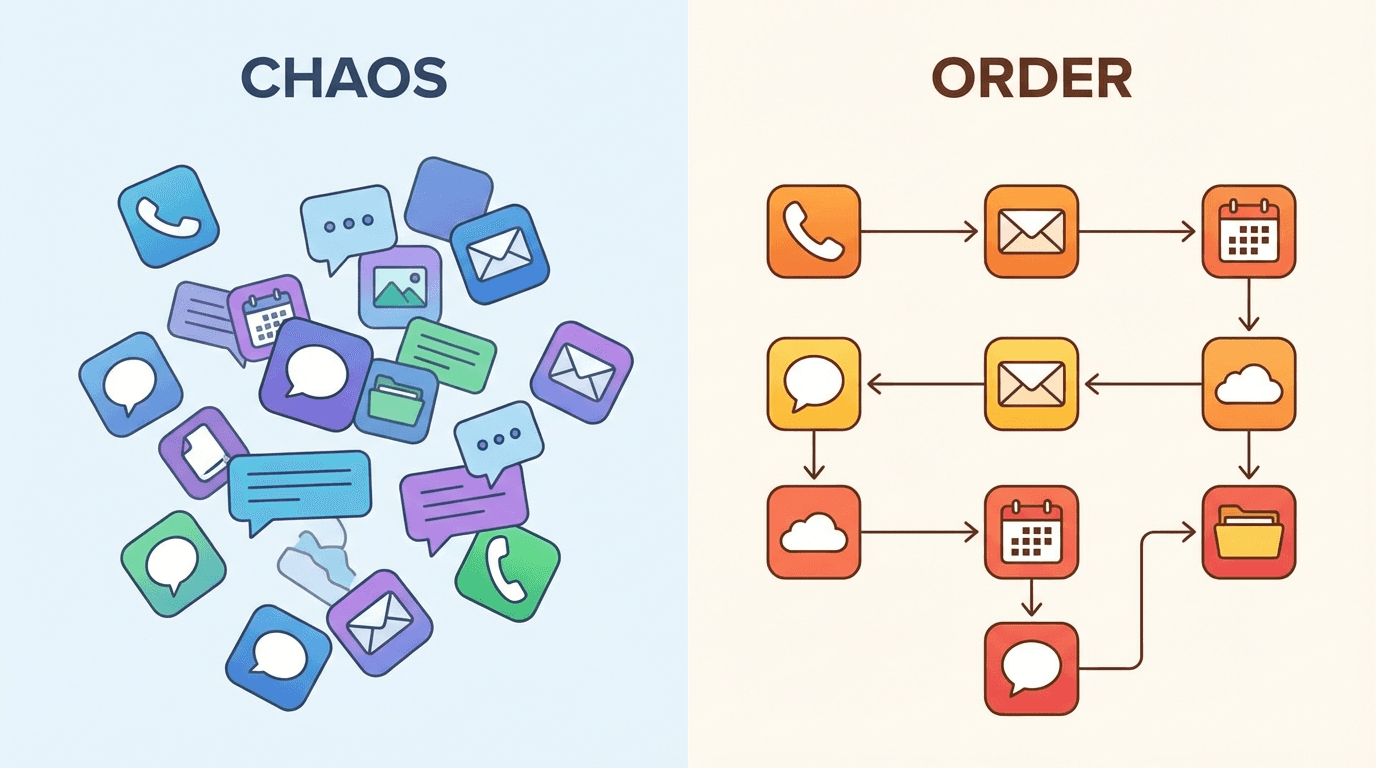
The problem isn't that small businesses are doing something wrong. The problem is that the entire conversation around AI for small business has been about chatbots. Open a chat window. Type a prompt. Get a response. Repeat. That interaction model caps the value at whatever you remember to ask for, whenever you remember to ask for it.
Real AI leverage doesn't come from better prompts. It comes from systems that run without you prompting them at all.
Why ad-hoc ChatGPT usage plateaus fast#
I've watched this happen with dozens of small businesses. There's an initial honeymoon period where ChatGPT feels magical. Then the novelty fades. The prompts get repetitive. The output starts to feel generic. The business owner stops using it as much because the effort of context-switching into a chat window, crafting a decent prompt, and evaluating the output starts to feel like work. Which it is.
Ad-hoc AI usage has three structural problems that no amount of prompt engineering fixes:
It depends on you remembering to use it. If you don't open the chat window, nothing happens. Your AI doesn't monitor your inbox while you're sleeping. It doesn't flag that a competitor changed their pricing. It doesn't notice that your best client hasn't responded in two weeks. It just sits there, waiting for you to type something.
It has no memory across sessions. Every conversation starts cold. You re-explain your business, your audience, your voice. Custom GPTs helped with this a bit, but they're still reactive. They don't accumulate operational knowledge the way a real team member does.
There's no compounding. A human employee gets better over time. They learn your preferences, build institutional knowledge, spot patterns across weeks and months. An ad-hoc ChatGPT session is stateless. Session 500 is no smarter than session 1, because nothing connects them.
This is why the 68% adoption number is misleading. Most of that adoption is people using AI the way they'd use a calculator. It's useful in the moment, but it doesn't change how the business operates.
The 25% who have a strategy are pulling ahead#
The small businesses that have figured out a structured approach to AI aren't using better prompts. They're using different architectures entirely. Instead of on-demand chat, they've deployed always-on agents that run on schedules, monitor inputs, and deliver outputs without being asked.
A recruiting firm I spoke with has an agent that scans job boards every morning and delivers a briefing of new postings matching their clients' criteria. Before the recruiter even opens their laptop, the day's opportunities are summarized and prioritized. No prompt required.
A 2-person marketing agency runs agents that monitor their clients' competitor social accounts, flag changes in messaging or positioning, and draft suggested responses. Their clients think they have a dedicated analyst watching the market. They don't. They have a configured agent and a $30/month subscription.
A freelance consultant has an agent that reviews their CRM every evening and flags deals that have gone cold. It drafts a follow-up email for each one. The consultant reviews and sends in the morning. Before the agent, those follow-ups happened "when I got around to it," which often meant never.
None of these businesses are technical. None of them wrote code. They moved from "I use AI" to "AI works for me" by switching from chat to agents.
From winging it to always-on#
The shift from ad-hoc to structured isn't complicated. It's a mindset change plus the right platform. Here's what that looks like practically:
Audit your repetitive workflows. List every task you do on a regular cadence. Morning email scan. Weekly competitor check. Daily lead follow-up. Monthly report compilation. These are agent candidates. Not the creative, judgment-heavy work. The monitoring, summarization, and triage work that eats your time without exercising your expertise.
Deploy one agent for one workflow. Don't try to automate your entire business in a weekend. Pick the task that costs you the most time per unit of judgment required. Set up a single agent that handles it on a schedule. Run it for a week. Measure whether it actually saved you time.
Go always-on, not on-demand. This is the critical difference. An agent that runs on a schedule and delivers to your Telegram every morning is a team member. An agent you have to remember to trigger is just a slightly fancier chatbot. The value is in the work that happens while you're doing other things.
Use a platform that handles the infrastructure. Self-hosting AI agents is a DevOps project. You'll spend more time managing servers than benefiting from the agents running on them. RapidClaw handles this entirely. It's OpenClaw-as-a-Service: always-on AI agents that live on Telegram, run on schedules you set, and cost less than your coffee budget. You configure the agent, define the schedule, and it runs. No Docker, no server management, no 3am debugging.
The whole setup takes about an hour. Within a week, you'll know if the approach works for your business. Within a month, you'll wonder how you operated without it.
The gap is the opportunity#
That QuickBooks number tells a clear story if you read it right. 68% adoption with sub-25% strategy means roughly half of all small businesses are using AI but getting a fraction of the value. They've crossed the awareness threshold. They know AI is useful. They just haven't made the jump from tool to system.
If you're in that group, you're not behind. The fact that you're using AI at all puts you ahead of a third of your competitors. But the gap between "I use ChatGPT sometimes" and "I have agents running 24/7" is where the disproportionate advantage lives. The businesses that close that gap in 2026 are the ones that will look back and call this the year everything changed.
You don't need a bigger team. You don't need a technical co-founder. You don't need an enterprise AI budget. You need one agent, one workflow, and a platform that keeps it running.
RapidClaw starts at $29/month. The first agent takes an hour to set up. The ROI takes about a week to become obvious.
Stop winging it.
Frequently asked questions#
What does "using AI regularly" actually mean in the QuickBooks survey?#
The survey captures any regular use of AI tools in business operations, which includes everything from ChatGPT for writing to AI features embedded in existing software. The problem with this broad definition is that it conflates passive feature usage with active, strategic deployment. Using Grammarly's AI suggestions counts the same as running a fleet of autonomous agents. The 68% number is real, but the depth of that usage varies enormously.
Why are AI agents better than ChatGPT for small businesses?#
ChatGPT is reactive. You open it, prompt it, and get a response. An AI agent is proactive. It runs on a schedule, monitors inputs you define, and delivers outputs without you asking. The difference is like the difference between a search engine and a personal assistant. Both are useful. But one works while you sleep.
How much does it cost to run AI agents for a small business?#
On a managed platform like RapidClaw, plans start at $29/month for always-on agents delivered via Telegram. Self-hosting is cheaper on paper but the time cost of server management, uptime monitoring, and debugging usually makes it more expensive in practice unless you genuinely enjoy infrastructure work.
Give the busywork to an agent that remembers you
RapidClaw deploys your personal AI agent to Telegram & Discord in 60 seconds — it learns your world, briefs you every morning, and gets smarter every day. Credits included, no API keys, no servers.
Get started — from $19/moRelated Posts

Solopreneurs Using AI Agents Report 340% Revenue Increases. Here's What They're Actually Doing.
An Indie Hackers survey found solo operators running AI agents averaged 340% revenue growth with zero increase in working hours. Here's the playbook they're using.
40% of Small Businesses Will Deploy an AI Agent by December. Most Will Get It Wrong.
Gartner predicts 40% of apps will have AI agents by end of 2026. But 88% of agent projects fail before production. Here are the 5 mistakes killing small business deployments.
Your AI Agent Stack Replaces $2,400/Month in SaaS. Here's the Math.
A typical 10-person team spends $2,400/month on SaaS subscriptions that AI agents can replace for under $200/month. Here's the line-item breakdown showing exactly which tools get replaced and what the agent alternative costs.
Stay in the loop
New use cases, product updates, and guides. No spam.