
Solopreneurs Using AI Agents Report 340% Revenue Increases. Here's What They're Actually Doing.
An Indie Hackers survey found solo operators running AI agents averaged 340% revenue growth with zero increase in working hours. Here's the playbook they're using.

Reading about AI agents? RapidClaw gives you one that lives in Telegram & Discord, remembers everything, and runs your day — live in 60s, from $19/mo.
Get startedThe number stopped me mid-scroll. An Indie Hackers survey of 412 solo operators published in March 2026 found that respondents running AI agents averaged 340% revenue growth over the previous 12 months. Zero increase in working hours. In many cases, a decrease.

I didn't believe it either. So I spent two weeks talking to the people behind those numbers. What I found wasn't magic. It was a specific, repeatable pattern: solopreneurs are deploying small teams of AI agents to handle the work that used to cap their revenue at whatever one human brain could manage in a day.
This is the playbook.
How do solopreneurs use AI agents?#
The short answer: they treat agents like a back office. Not a chatbot. Not a novelty. A functional team that handles lead generation, content production, email triage, client management, and scheduling while the human focuses on the work that actually requires them.
The Indie Hackers survey broke responses into categories. The five most common agent deployments among respondents were:
- Lead generation and qualification (78% of respondents)
- Content creation and distribution (71%)
- Email and inbox management (64%)
- Client communication and follow-up (58%)
- Scheduling and calendar optimization (52%)
Most respondents weren't running one agent. The median was four. The highest-revenue respondents ran six or more, often organized into coordinated squads where agents hand off tasks to each other automatically.
That coordination piece matters. A single agent answering questions is useful. A squad of agents where a research agent feeds a content agent which triggers a distribution agent which reports results back to a briefing agent -- that's what creates the revenue multiplier.
The numbers: manual vs. AI-augmented operations#
Before diving into specific stories, here's what the aggregate data looks like. The survey compared respondents' self-reported metrics before and after deploying AI agents.
| Metric | Manual Solo Operation | AI-Augmented Operation | Change |
|---|---|---|---|
| Revenue (monthly avg) | $4,200 | $18,480 | +340% |
| Working hours/week | 52 | 34 | -35% |
| Clients managed | 6 | 22 | +267% |
| Content pieces/month | 8 | 47 | +488% |
| Lead response time | 4.2 hours | 8 minutes | -97% |
| Email processing time/day | 2.1 hours | 15 minutes | -88% |
The revenue jump isn't because agents are doing magical things. It's because they're removing the bottleneck. When you're a solopreneur, the constraint is always your time. You can only write so many proposals, follow up with so many leads, produce so much content. Agents don't remove the need for your expertise. They remove the ceiling on how much of that expertise you can deliver.
Four solopreneurs, four playbooks#
Priya Nakamura -- Freelance brand strategist, $31K/month#
Priya was billing $8K/month doing brand strategy for D2C companies. Good work, good clients, but she was maxed out at four active engagements because each client needed weekly check-ins, competitive monitoring, and content calendars.
She deployed three agents. A competitive intelligence agent monitors each client's top five competitors daily -- pricing changes, new product launches, social sentiment shifts, press mentions. A content calendar agent drafts monthly content plans based on the competitive data. A client briefing agent compiles everything into a weekly Telegram summary for each client.
"I used to spend Monday and Tuesday just gathering information," Priya told me. "Now I wake up and the information is already organized. I spend Monday and Tuesday doing actual strategy work."
She went from four clients to eleven. Revenue hit $31K/month. Her hours actually dropped because the gathering and formatting work was the most time-consuming part of her week.
The competitive intelligence agent alone saved her roughly 12 hours per week. That was 12 hours she reinvested into taking on more clients at the same quality level.
Daniel Okonkwo -- Solo SaaS founder, $14K MRR#
Daniel runs a niche project management tool for construction companies. As a solo founder, he was splitting his time between building features, handling support, writing documentation, and doing outreach. His MRR had been stuck at $3,800 for six months because he couldn't do all four well at once.
He set up a five-agent squad. A support agent handles first-response for incoming tickets, pulling answers from his knowledge base and escalating anything it can't handle. A content agent writes two blog posts and five social posts per week based on keywords his SEO research agent identifies. A lead qualification agent scores incoming trial signups and sends personalized onboarding sequences. A daily briefing agent summarizes everything each morning.

"The support agent was the biggest unlock," Daniel said. "I was spending 90 minutes a day on support tickets. Now I spend 15 minutes reviewing what the agent flagged. The other tickets get answered instantly, and my response time went from 4 hours to under 5 minutes. That alone reduced churn."
His MRR climbed from $3,800 to $14,000 over five months. He attributes most of the growth to two things: consistent content output driving organic traffic, and faster support response reducing churn. Both were agent-driven.
Camille Dubois -- Freelance copywriter, $22K/month#
Camille writes conversion copy for SaaS landing pages. She was earning $9K/month, working with six clients, and turning away two or three inquiries every month because she didn't have capacity.
Her agent setup is targeted. A lead qualification agent responds to every inbound inquiry within minutes, asks qualifying questions, collects project briefs, and schedules discovery calls. A research agent runs competitive analysis and audience research for each new project before Camille starts writing. A client management agent tracks deliverable deadlines, sends progress updates, and handles revision request scheduling.
"The research agent changed my output quality, not just my capacity," Camille said. "I used to spend 3-4 hours researching before writing. Now the agent does 80% of that research overnight. I review it in 20 minutes, then I write. My first drafts are better because the research is more thorough than what I'd do manually under time pressure."
She now handles fourteen active clients. Her working hours went from 55 per week to 38. The key insight from Camille's setup: agents don't just save time, they improve quality by doing the tedious work more thoroughly than a rushed human would.
Rafael Torres -- E-commerce consultant, $27K/month#
Rafael advises small e-commerce brands on conversion optimization. His bottleneck wasn't client work -- it was finding clients. As a solo consultant, he had no marketing team, no SDR, no content operation. He relied entirely on referrals, which meant feast-or-famine revenue cycles.
He built what he calls his "growth squad." A content agent publishes three articles per week on e-commerce optimization tactics, each targeting long-tail keywords his SEO agent identified. A social distribution agent repurposes each article into LinkedIn posts, Twitter threads, and newsletter sections. A lead nurture agent monitors who engages with the content and sends personalized follow-up sequences. A scheduling agent handles booking calls.
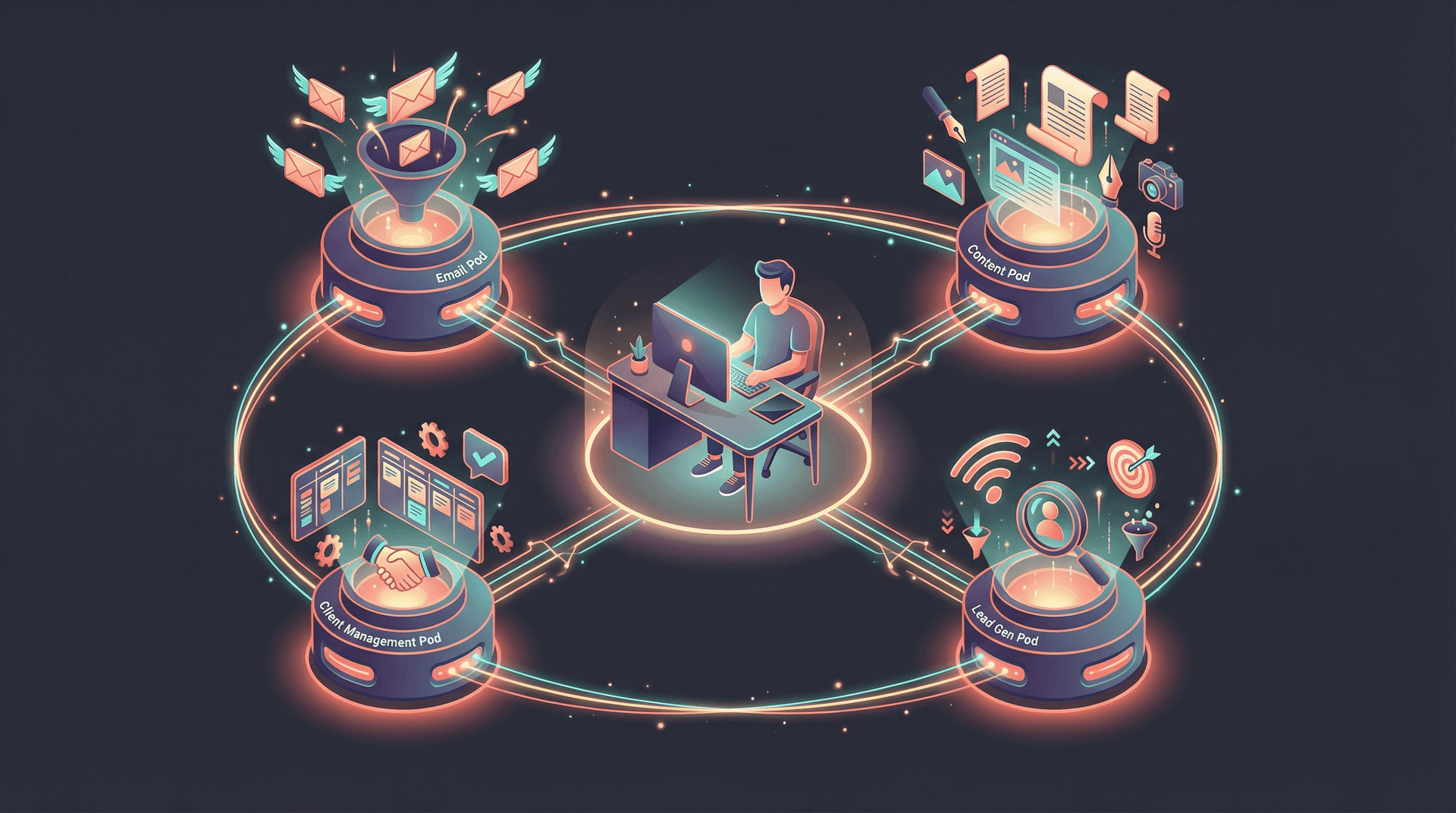
Six months in, Rafael's blog gets 18,000 monthly visitors (up from 200). His inbound leads went from one or two per month to fifteen. He's selective now -- takes only the clients he wants. Revenue went from $7K/month to $27K, and he says the growth squad runs almost entirely on autopilot.
"I spend maybe 30 minutes a day reviewing what the agents produced and approving the content. The rest of my time is client work. I went from spending 60% of my time on marketing and 40% on delivery to the opposite. That's the real revenue driver -- more time doing the thing clients pay for."
Can AI agents grow a small business?#
The data says yes, but with a caveat. Agents grow businesses by removing operational constraints, not by replacing the core value the human provides. Every solopreneur I interviewed emphasized the same thing: the agents handle volume and logistics, the human handles judgment and expertise.
The 340% revenue growth figure makes sense when you think about it this way. Most solopreneurs are operating at maybe 30-40% of their potential revenue because time constraints force them to underinvest in marketing, delay responses to leads, skip follow-ups, and cap their client load. Remove those constraints and revenue approaches what the market would actually bear for their skill level.
The solopreneurs who reported the highest revenue growth shared three traits:
They deployed agents in squads, not silos. A content agent alone is useful. A content agent connected to an SEO agent connected to a distribution agent connected to a lead qualification agent creates a self-reinforcing pipeline. Agents that work together compound each other's output.
They kept humans in the loop for judgment calls. Nobody successful was letting agents send emails or publish content without review. The model is "agent drafts, human approves." This takes minutes instead of hours but maintains quality control.
They focused agents on the bottleneck, not the fun stuff. The temptation is to automate the work you enjoy. The leverage is in automating the work you avoid. Email triage, lead follow-up, competitive monitoring, scheduling -- the boring operational work that eats time without generating direct revenue.
Getting started: the fastest path to your first agent squad#
If you're a solopreneur reading this and thinking "I should try this," the biggest mistake you can make is spending weeks on infrastructure. I've seen people lose a month setting up servers, configuring APIs, and debugging deployment issues before their first agent does anything useful.
RapidClaw exists specifically for this problem. It deploys personal AI agents to your Telegram in under 60 seconds. No servers. No DevOps. You pick a squad template, connect your tools, and your agents start working.
The platform runs on OpenClaw and gives you agent squads out of the box -- coordinated teams of agents that share context and hand off tasks to each other. The competitive intelligence squad, the content pipeline squad, the client management squad. These are the same patterns Priya, Daniel, Camille, and Rafael built manually, packaged so you don't have to.
Pricing starts at $39/month for a single agent, and scales to multi-agent squads with daily briefings, scheduled workflows, and tool integrations. The solo operators in the Indie Hackers survey reported spending an average of $280/month on their agent infrastructure. The revenue return makes that almost invisible.
If you want to see what other solo operators are building with agents, start here:
- How I ran my entire week with 6 AI agents and zero employees
- How a 2-person agency handles 47 clients with AI agents
- I built 3 AI agents on Telegram as a side hustle
- How I built a passive income stream with a Telegram bot
The uncomfortable truth#
The 340% figure is an average, which means some people saw much more and some saw much less. The solopreneurs who reported minimal improvement had a pattern too: they deployed agents reactively (chatbots waiting for input) instead of proactively (agents running on schedules), and they automated tasks that weren't actually their bottleneck.
The agents are tools. Tools amplify what's already working. If you have strong expertise and a clear market but can't scale because you're one person drowning in operational work, agents will multiply your output. If you don't have product-market fit yet, agents will just help you produce more of something nobody wants, slightly faster.
But for the solopreneurs who are good at what they do and constrained only by their hours in the day? The ceiling just got a lot higher. The survey data is early, and 412 respondents is a small sample. But the pattern is consistent with everything else happening in the indie founder community right now. The one-person company isn't a thought experiment anymore. It's an operating model. And the people adopting it fastest are pulling away.
Frequently asked questions#
How much does it cost to run AI agents as a solopreneur?#
The Indie Hackers survey respondents reported an average of $280/month for their full agent setup. This covers LLM API usage, hosting, and tool integrations. Platforms like RapidClaw start at $39/month for a single agent, with multi-agent squad plans available for higher-volume operations. For context, a part-time virtual assistant costs $1,500-2,500/month and handles a fraction of the workload.
Do I need technical skills to set up AI agents?#
No. Managed platforms handle the infrastructure. You configure agents through natural language prompts and templates, not code. If you can write clear instructions for a human assistant -- "check my competitors' pricing pages every Monday and send me a summary" -- you can configure an agent. The main skill is being specific about what you want.
What's the difference between using ChatGPT and running AI agents?#
ChatGPT is reactive -- you open it, type a prompt, get an answer. AI agents are proactive. They run on schedules, monitor things automatically, and message you when something needs attention. The morning briefing arrives before you ask. The lead gets a response before you check your inbox. That proactive pattern is what creates the revenue multiplier, because the agent works while you sleep.
Which tasks should solopreneurs automate first?#
Start with whatever consumes the most time without requiring your unique expertise. For most solopreneurs, that's email triage, lead qualification, competitive monitoring, or content research. These are high-volume, low-judgment tasks that eat hours daily. Automate those first, then expand to content production and client management once you've seen the pattern work.
Give the busywork to an agent that remembers you
RapidClaw deploys your personal AI agent to Telegram & Discord in 60 seconds — it learns your world, briefs you every morning, and gets smarter every day. Credits included, no API keys, no servers.
Get started — from $19/moRelated Posts

40% of Small Businesses Will Deploy an AI Agent by December. Most Will Get It Wrong.
Gartner predicts 40% of apps will have AI agents by end of 2026. But 88% of agent projects fail before production. Here are the 5 mistakes killing small business deployments.
Your AI Agent Stack Replaces $2,400/Month in SaaS. Here's the Math.
A typical 10-person team spends $2,400/month on SaaS subscriptions that AI agents can replace for under $200/month. Here's the line-item breakdown showing exactly which tools get replaced and what the agent alternative costs.

68% of Small Businesses Use AI but Most Are Winging It
Two-thirds of small businesses use AI regularly. Fewer than a quarter have a strategy. The gap between adoption and structure is where the real opportunity lives.
Stay in the loop
New use cases, product updates, and guides. No spam.