
I Ran My Entire Week With 6 AI Agents and Zero Employees
How I run a one-person AI company with 6 agents and 20 cron jobs. No employees. Real numbers and workflows from a solo founder in 2026.
Reading about AI agents? RapidClaw gives you one that lives in Telegram & Discord, remembers everything, and runs your day — live in 60s, from $19/mo.
Get startedDario Amodei, the CEO of Anthropic, recently said there's a 70-80% chance we'll see a billion-dollar company with a single employee by 2026. Sam Altman agrees. I'm not running a billion-dollar company. But I did run my entire week with 6 AI agents, 20 cron jobs, and zero employees. And it worked better than I expected.
This isn't a thought experiment. I'm going to walk you through the actual week.
How does a one-person AI company actually work?#
Monday morning, 7am. My briefing agent sends me a Telegram message before I'm out of bed. It's pulled my calendar, checked my email for anything urgent, and summarized what needs attention. There's a support ticket from overnight, two new signups, and a competitor just changed their pricing page. I didn't check any of this manually. The agent did.
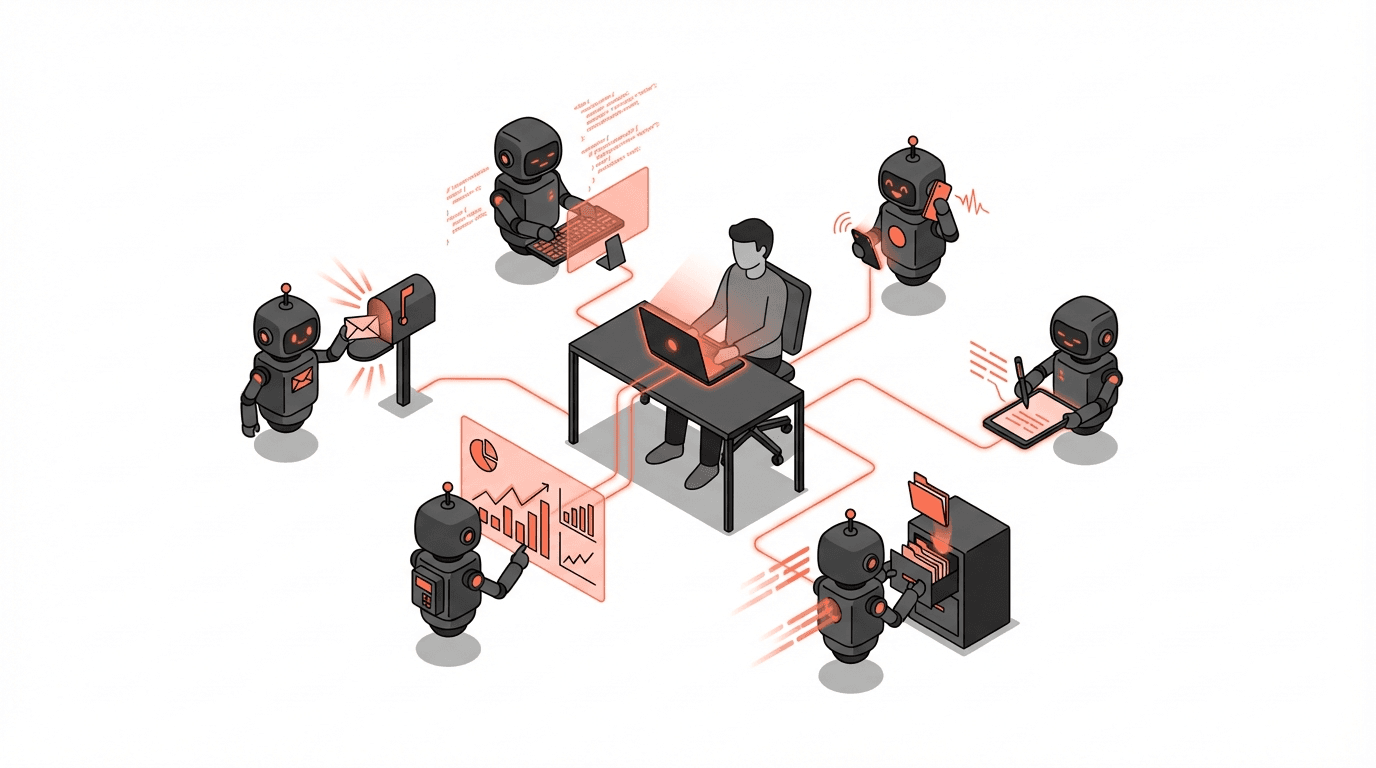
I have 6 agents running. Here's what each one does:
My research agent runs searches every morning for industry news, competitor updates, and topics I'm tracking. It dumps a summary into my Telegram at 8am. Takes about 4 minutes of compute time and saves me an hour of browsing.
My support agent handles incoming questions. When someone messages our support channel, the agent responds immediately with answers pulled from our docs and knowledge base. If it can't answer, it flags the conversation for me. I review flagged items once a day. Most days there are 2-3. Before the agent, I was spending 45 minutes daily on support.
My content agent drafts social posts, newsletter sections, and blog outlines based on what the research agent found. I edit everything before it goes out, but starting from a draft instead of a blank page saves real time. My average editing pass is 15 minutes per piece instead of 60 minutes writing from scratch.
My monitoring agent watches our infrastructure. Uptime, error rates, deploy status. If something breaks at 3am, it messages me. This one I set up out of paranoia but it's caught two issues that would have gone unnoticed for hours.
My scheduling agent handles meeting requests. People email me asking for a call, the agent checks my calendar, proposes three times, and sends the response. I approve the message before it goes out. Takes me 10 seconds per request instead of the back-and-forth dance.
My weekly review agent runs every Friday at 5pm. It compiles what I shipped, what I missed, and what carried over. It pulls from my commit history, my task manager, and the notes I've sent it throughout the week. The output is a structured reflection that would take me 30 minutes to write manually.
The 20 cron jobs are the backbone. Morning briefings, daily research, weekly reviews, infrastructure checks every 15 minutes, competitor price monitoring twice a week, newsletter draft generation every Wednesday. Each cron job triggers an agent action at a specific time. I set them up once and they just run.
The total cost? Around $380/month. That covers LLM API calls, hosting, and the tools the agents connect to. For context, a part-time virtual assistant costs $1,500-2,500/month and handles maybe 3 of these 6 workflows.
Why should you care?#
The one-person company isn't a new idea. People have been running solo businesses forever. What's new is the ceiling. The upper bound of what one person can handle just jumped dramatically.
A year ago, I could either build the product or do marketing and support. Not both. At least not well. Now I can do all three because my agents handle 60-70% of the repetitive work in marketing and support, freeing me to focus on product.
I saw a post on X from @Saboo_Shubham_ that went viral. "6 AI agents. 20 cron jobs. 0 human employees." Over 3,300 likes. Another from @Jacobsklug about running an army of agents for $400/month. These aren't outliers anymore. I'm seeing this pattern everywhere in the indie founder community.
The economics are wild when you think about it. Gartner says 40% of enterprise applications will have embedded agents by end of 2026. Enterprises are spending millions to add agent capabilities to existing software. Meanwhile, solo founders are assembling agent teams for the cost of a nice dinner.
Here's what I think most people miss: the agents don't replace your judgment. They replace your time on low-judgment tasks. I still decide what to build, what to write, how to respond to tricky support questions, which meetings to take. The agents handle the gathering, formatting, scheduling, and monitoring that used to eat 4-5 hours of my day.
That said, it's not perfect. I've had my content agent produce drafts that were so off-base I would've been faster starting from scratch. My support agent occasionally gives answers that are technically correct but tone-deaf. Automation amplifies your systems -- good systems get amplified into great output, bad systems get amplified into bigger messes. I spend real time tuning prompts and reviewing output. It's not "set and forget."
What I'm doing about it#
RapidClaw is the platform I wish I had when I started setting this up. I spent weeks configuring agents, writing prompts, setting up cron jobs, connecting tools. Most of that was infrastructure work that had nothing to do with the actual agent logic.
Now I'm packaging that infrastructure so other solo founders can set up an agent team in minutes instead of weeks. Pick a use case template, connect your tools, customize the prompts, and your agent is live. The 6-agent setup I described above? I want someone to be able to replicate it in an afternoon.
I'm particularly focused on the cron job system because that's where the real leverage is. Proactive agents that work on a schedule are 10x more useful than reactive chatbots you have to remember to prompt.
Who should pay attention#
Solo founders who are doing everything themselves and feeling the limits. Freelancers juggling multiple clients. Small teams of 2-3 people who can't afford to hire yet. If you've ever thought "I need to clone myself," agents are the closest thing to that right now. The barrier to entry dropped from "hire a developer" to "spend an afternoon configuring." That's the shift.
Frequently asked questions#
How much technical skill do I need to set up AI agents?#
Less than you think. Platforms like RapidClaw let you configure agents through templates and natural language prompts. You don't need to write code. If you can write a clear instruction for a human assistant, you can set up an agent. The main skill is being specific about what you want.
What tasks should I NOT give to AI agents?#
Anything requiring nuanced human judgment, relationship-sensitive communication, or creative decisions that define your brand voice. I let agents draft content but I always edit. I let them respond to common support questions but flag anything emotional or complex. The rule I use: if getting it wrong would embarrass me, a human (me) reviews it first.
Is $400/month realistic for a full agent setup?#
Yes, for a solo founder. My actual cost is $380/month across 6 agents. The biggest variable is LLM API usage -- if your agents process a lot of text, costs go up. Most solo founders I talk to spend between $200-500/month. Compare that to even a part-time hire and the math is obvious.
I'm building RapidClaw to make AI agents accessible to everyone. Try it free.
Give the busywork to an agent that remembers you
RapidClaw deploys your personal AI agent to Telegram & Discord in 60 seconds — it learns your world, briefs you every morning, and gets smarter every day. Credits included, no API keys, no servers.
Get started — from $19/moRelated Posts

Solopreneurs Using AI Agents Report 340% Revenue Increases. Here's What They're Actually Doing.
An Indie Hackers survey found solo operators running AI agents averaged 340% revenue growth with zero increase in working hours. Here's the playbook they're using.

Building in Public With AI Agents: My Content Pipeline Does 550 Videos a Day
AI agent content automation is replacing content teams. One creator produces 550 videos a day with AI agents. Here's how the content factory model works.

OpenAI's Agents Tried Hacking Government Sites. It Was an Accident.
In May and June 2026, OpenAI's autonomous agents attempted to hack government and university websites. This wasn't a malicious attack, but a critical containment failure that serves as a wake-up call for anyone deploying agentic AI.
Stay in the loop
New use cases, product updates, and guides. No spam.