
42% of Companies Abandoned Their AI Agent Projects Last Year. They All Made the Same 3 Mistakes.
AI agent project abandonment jumped from 17% to 42% in one year. The pattern is identical: over-scoping, no feedback loop, and treating agents like software instead of employees.

Reading about AI agents? RapidClaw gives you one that lives in Telegram & Discord, remembers everything, and runs your day — live in 60s, from $19/mo.
Get startedIn 2024, 17% of companies abandoned at least one AI initiative before it reached production. Painful but expected for a new technology category. Cost of learning.
By the end of 2025, that number hit 42%. The average sunk cost per abandoned project: $7.2 million. Large enterprises with more than 10,000 employees abandoned an average of 2.3 initiatives each. Not 2.3 features. 2.3 entire projects, killed after months of engineering time, vendor contracts, and executive attention.
Gartner predicted in July 2024 that 30% of generative AI projects would be abandoned after proof of concept by end of 2025. The actual number overshot by twelve percentage points. Whatever companies thought they were getting into with AI agents, reality was significantly harder than the pitch deck suggested.
And here is the part that should concern anyone currently deploying agents: the reasons for abandonment are not diverse. They cluster into the same three patterns with remarkable consistency. The companies that failed didn't face unique technical challenges. They made the same mistakes, in the same order, for the same reasons.
What counts as an abandoned AI agent project?#
Before digging into the mistakes, it helps to define what "abandoned" actually means. It's not just projects that crashed and burned visibly. RAND Corporation's analysis of enterprise AI failures identifies three categories:
Killed before production (33.8% of all AI projects). The team builds a proof of concept, demonstrates it to leadership, and the project gets shelved. Sometimes the demo works but the production path is too expensive. Sometimes the demo itself reveals the approach won't work at scale.
Deployed but abandoned (28.4%). The agent reaches production, technically "works," but nobody uses it. Or it works for a month, then the person who championed it leaves, and nobody maintains the context it needs. These are the zombie projects — alive in the infrastructure, dead in practice.
Cost-unjustified (remaining share). The agent runs in production and people use it, but the ROI math never closes. It cost $8.4M to build and delivers $3.1M in value. Leadership pulls the plug not because it failed technically, but because the business case collapsed.
All three types share the same root causes. The technical failure is usually a symptom, not the disease.

Mistake 1: Over-scoping the first deployment#
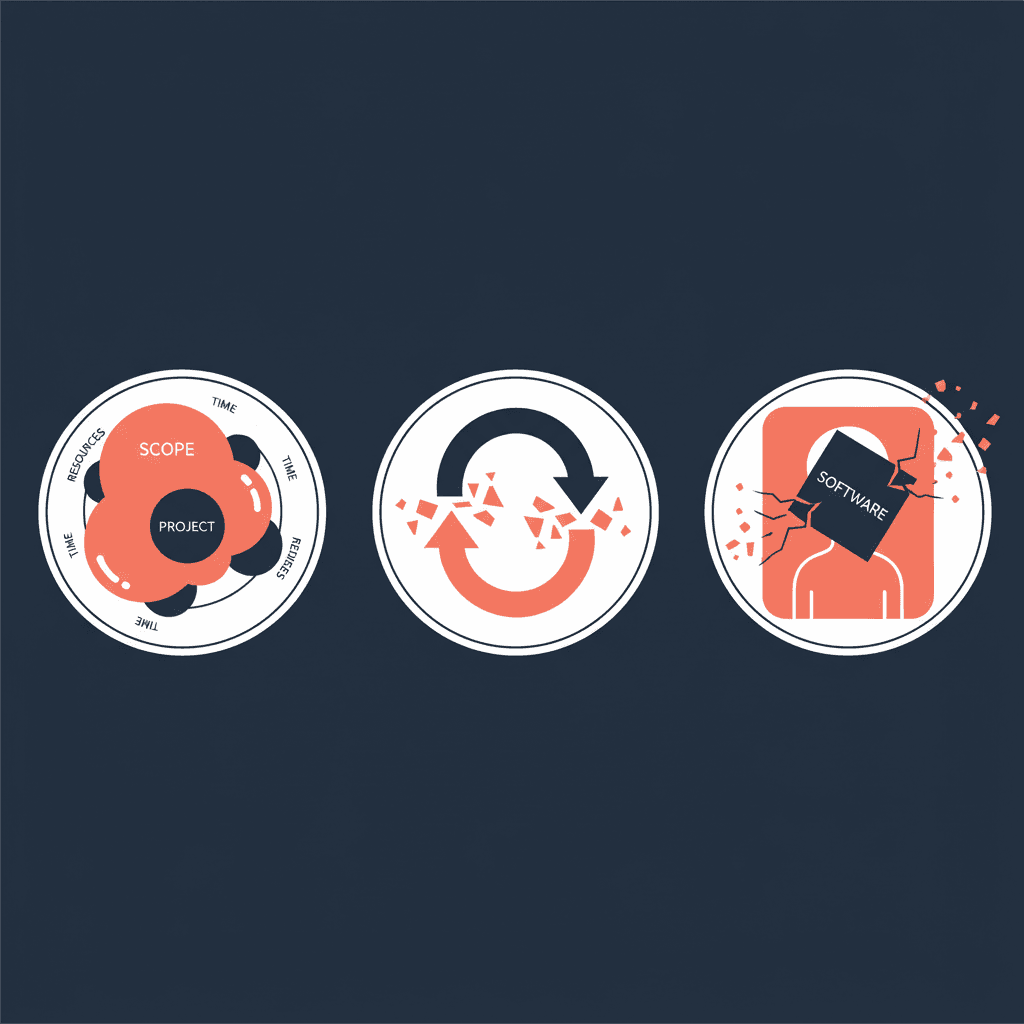
The single most reliable predictor of AI agent project failure is the scope of the initial deployment. Companies that succeed start with one agent doing one narrow task. Companies that fail start with a vision deck describing an "AI-powered operating system" that will transform six departments simultaneously.
This pattern shows up in every data set I've looked at. McKinsey's November 2025 Global AI Survey found that 78% of organizations now use AI in at least one function, but only 39% see any measurable EBIT impact. The gap between "using AI" and "getting value from AI" is almost entirely explained by scope decisions made in the first month.
Here is what over-scoping looks like in practice. A mid-market logistics company decides to build an AI agent system. Reasonable goal. But instead of starting with one process, they define requirements for an agent that handles customer inquiries, optimizes route planning, generates driver schedules, monitors fleet maintenance, and produces management reports. Five domains, each with its own data sources, edge cases, and stakeholders.
The team spends four months building integrations. Each integration surface area introduces new failure modes. The route planning module needs real-time GPS data that arrives in an inconsistent format. The customer inquiry module needs access to order history across three legacy systems. The maintenance monitoring needs sensor data that doesn't exist yet for half the fleet.
By month six, the project has consumed $2M in engineering time and vendor costs, and the team has a demo that works on clean test data but falls apart on production data. Leadership asks for a timeline to go live. The honest answer is "another six months, maybe." The project gets shelved.
The same company could have deployed a single agent that triages incoming customer emails, routes them to the right team, and drafts initial responses. That's a two-week project. It delivers measurable value within the first month: faster response times, fewer misrouted tickets, freed-up customer service hours. Once that agent earns trust, you expand.
This is the pattern behind every successful deployment I've studied. We wrote about it in detail when covering the 5 mistakes killing small business AI deployments. The first mistake is always scope.
What the successful companies did#
| Factor | Failed projects | Successful projects |
|---|---|---|
| Initial scope | 4-7 departments or processes | 1 process, 1 team |
| Time to first deployment | 4-8 months | 2-6 weeks |
| Number of integrations at launch | 5-12 | 1-3 |
| Success criteria defined upfront | Vague ("transform operations") | Specific ("reduce email response time by 40%") |
| Stakeholders at kickoff | 8-15 across departments | 2-4 from one team |
| First-year sunk cost of failures | $4.2M average | N/A (deployed successfully) |
| Expansion timeline | Never reached | After 30-90 days of validated use |
The table tells the story. Failed projects try to prove everything at once. Successful projects prove one thing, then expand from earned credibility.
Mistake 2: No feedback loop, so the agent never improves#
The second mistake is subtler and often invisible until it's too late. Companies deploy an agent, it performs at an acceptable level on day one, and then nothing changes. The agent on day 90 is identical to the agent on day 1. It hasn't learned what the company cares about. It hasn't adapted to how people actually use it. It hasn't absorbed the institutional context that makes human employees valuable over time.
This is the feedback loop problem, and it kills more agent projects than any technical limitation.
A marketing agency deploys an AI agent to draft social media content. Day one, the output is generic but usable. The team edits the drafts, posts the edited versions, and moves on. The problem: nobody feeds the edits back to the agent. The agent never sees what was changed or why. It keeps producing the same generic output. After 60 days, the team stops using it because "it doesn't understand our brand." They're right. It doesn't. And it never will, because they built no mechanism for it to learn.
Compare this to the 68% of small businesses that are winging it with AI. They adopt AI tools enthusiastically, use them for a few weeks, hit the wall where the tool can't improve without structured feedback, and then conclude "AI isn't ready for our business." The tool was ready. The feedback infrastructure wasn't.
The companies that sustain AI agent usage beyond 90 days all share one characteristic: they built a deliberate loop where the agent's outputs get reviewed, corrections get captured, and those corrections modify the agent's future behavior. This doesn't require sophisticated machine learning. It requires discipline.
Some do it through a daily five-minute review where someone looks at the agent's outputs and flags what was wrong. Others use structured memory systems where the agent stores what it learns from corrections and carries that context forward. The mechanism varies. The principle is constant: agents without feedback loops are static tools with a shelf life. Agents with feedback loops are compounding assets.
BCG's research supports this directly. Their study of AI deployments found that early adopters who built feedback mechanisms reported $3.70 in value for every $1 invested, while organizations without structured improvement processes saw that ratio drop below $1 within six months. The agent wasn't the differentiator. The learning system around it was.
This is why the 85% accuracy trap is so dangerous. An agent stuck at 85% accuracy on day one is fine if it's improving. An agent stuck at 85% on day 90 because nobody built a feedback loop is a countdown to abandonment.
Mistake 3: Treating agents like software instead of employees#
This is the mistake that sits underneath the other two, and it's the hardest one to fix because it requires changing how people think, not what they build.
Harvard Business Review published a piece in March 2026 titled "To Scale AI Agents Successfully, Think of Them Like Team Members." The authors — Telang, Hydari, and Iqbal — argue that when agents gain the ability to execute tasks autonomously, they stop being tools and start being operational actors. They need defined identities, limited authority, trusted information sources, clear execution boundaries, and audit trails.
In short: they need to be onboarded, not installed.
Most companies do the opposite. They treat agent deployment like a software rollout. Configure, test, push to production, move on. When the agent makes a mistake in week two, there's no correction mechanism. When it encounters a situation it wasn't designed for, there's no escalation path. When the business context changes — new product launch, key client lost, pricing update — nobody updates the agent's understanding.
The software deployment mental model assumes you build something, ship it, and it works until the next version. The employee mental model assumes you hire someone, train them, supervise them initially, give them increasing responsibility as they earn trust, and continuously update their understanding of the business.
Every long-running successful AI agent deployment I've found follows the employee model. The one-person company using AI agents to scale beyond their solo capacity doesn't treat their agents like SaaS subscriptions. They treat them like remote team members: onboarded with context, monitored during the ramp-up period, given feedback when they make mistakes, and gradually trusted with higher-stakes tasks.
The ones who stopped using ChatGPT and built dedicated agents instead did it precisely because the chatbot model is a software model — every conversation starts from zero — while the agent model can be an employee model, where context persists and capability compounds.

Here's the practical difference. A software deployment has a go-live date. An employee has a probation period. Companies that set a go-live date for their agent and judge it on day-one performance abandon the project when the agent makes early mistakes. Companies that set a 30-day probation period, with a human reviewing outputs and providing corrections, end up with an agent that's genuinely useful by month two.
The 42% abandonment rate isn't a technology problem. It's a mental model problem. Companies are applying the wrong framework to a new category of tool, and the framework mismatch produces predictable failure.
The path forward is boring#
The companies that succeed with AI agents share three traits, and none of them are exciting:
-
They start small. One agent, one task, one team. Prove value in weeks, not months. Expand from a position of demonstrated ROI, not projected ROI.
-
They build the loop. Every deployment includes a mechanism for the agent to improve over time. Daily reviews, structured memory, correction capture — the format doesn't matter. The existence of the loop does.
-
They onboard, not install. The first 30 days are a supervised ramp-up. A human reviews outputs, provides corrections, and gradually increases the agent's autonomy as it earns trust. The agent on day 30 is materially better than the agent on day 1.
None of this requires cutting-edge technology. It requires discipline, patience, and the willingness to treat a new category of tool according to its actual nature rather than forcing it into an existing mental model.
The 58% of companies that didn't abandon their AI agent projects in 2025 figured this out. The question for 2026 is whether the other 42% will try again with a better framework or write off the entire category based on one failed attempt with the wrong approach.
Frequently asked questions#
Why do AI agent projects fail more often than traditional software projects?#
Traditional software follows predictable rules. Input X always produces output Y. AI agents operate probabilistically — the same input can produce different outputs depending on context, timing, and the model's interpretation. This makes testing harder, failure modes less predictable, and user trust more fragile. RAND Corporation's research shows AI projects fail at twice the rate of non-AI IT projects, largely because organizations apply traditional software project management to a fundamentally different category of technology.
How long should you give an AI agent before deciding it failed?#
Minimum 30 days with active supervision and feedback. Most abandoned projects are judged on their first-week performance, which is the equivalent of firing a new hire after their first day of orientation. The agent needs a ramp-up period where a human reviews outputs, provides corrections, and updates the agent's context. Companies that budget this probation period report significantly higher success rates than those that expect day-one performance to represent the agent's ceiling.
What is the minimum viable AI agent project for a company just starting out?#
One agent, one repetitive task, one communication channel. Email triage is the most common successful starting point: the agent reads incoming emails, categorizes them, drafts responses for human review, and learns from the edits over time. The task is repetitive (happens daily), low-risk (a human reviews before sending), and high-frequency (enough volume to demonstrate value within two weeks). We covered the full breakdown of common deployment mistakes that apply regardless of company size.
Is the 42% abandonment rate expected to increase or decrease in 2026?#
Gartner predicts that over 40% of agentic AI projects will be cancelled or fail to reach production by 2027, suggesting the rate may hold steady or increase as more companies attempt more ambitious deployments. However, the emergence of managed platforms that handle infrastructure and provide built-in feedback loops could reduce the failure rate for companies that choose simpler deployment paths instead of building from scratch.
What role does data quality play in AI agent project abandonment?#
It is the single largest cited reason. Gartner predicts that 60% of enterprise AI projects started in 2026 will be abandoned because of data that isn't AI-ready. Most companies discover their data quality problems after they've already committed budget and engineering resources to the agent project. The ones that succeed audit their data readiness before writing a single line of agent code.
Start with one agent that actually works#
RapidClaw deploys a personal AI agent in under 60 seconds — one agent, one task, accessible through Telegram. No six-month integration project. No multi-department rollout. No enterprise platform you'll use at 5% capacity. Start with one agent that handles one thing well, build the feedback loop from day one, and expand when the value is proven. The 58% of companies that succeeded with AI agents all started exactly this way.
Deploy your first agent on RapidClaw and skip the mistakes that killed 42% of projects last year.
Give the busywork to an agent that remembers you
RapidClaw deploys your personal AI agent to Telegram & Discord in 60 seconds — it learns your world, briefs you every morning, and gets smarter every day. Credits included, no API keys, no servers.
Get started — from $19/moRelated Posts

An AI Agent Just Ran a $100 Million Fundraise
Lyzr let an AI agent named SivaClaw manage its entire $100M Series B — fielding 130+ investors, drafting memos, closing the round without a single Sand Hill Road meeting. Here's what that actually proves about enterprise trust in agents.
The AI Agent Cost Collapse: Why Running an Agent in 2026 Costs a Fraction of 2024
The models got cheaper by 20-50x while getting faster and smarter. That single shift is why always-on personal AI agents finally make economic sense — and why the moat moved from the model to what your agent remembers.

Adobe Killed Experience Cloud and Replaced It With AI Coworkers
Adobe Summit 2026: Experience Cloud is dead. CX Enterprise replaces it with persistent AI 'Coworkers' that learn, remember, and act autonomously across the marketing stack.
Stay in the loop
New use cases, product updates, and guides. No spam.