
88% of Companies Already Had an AI Agent Security Incident. Most Can't Trace What Happened.
Gravitee survey: 88% of enterprises had an AI agent security incident. 82% of execs feel confident their policies work. The audit trail gap is the real crisis.

Reading about AI agents? RapidClaw gives you one that lives in Telegram & Discord, remembers everything, and runs your day — live in 60s, from $19/mo.
Get startedEighty-two percent of executives say their security policies protect against unauthorized AI agent actions. Eighty-eight percent of their organizations have already had a confirmed or suspected AI agent security incident. Both numbers come from the same survey — Gravitee's State of AI Agent Security 2026 report, which polled over 900 executives and technical practitioners.
That six-point gap between confidence and reality is not a rounding error. It is a structural failure in how enterprises think about agent security. Leadership believes the policies work because the policies exist. The engineering teams watching agents in production know better: only 21% have runtime visibility into what their agents are actually doing. The rest are flying blind.
And when the inevitable incident happens — data leaks through an over-permissioned agent, an agent takes an unauthorized action against a production database, a prompt injection hijacks an agent's tool calls — most organizations cannot reconstruct what went wrong. Because there is no audit trail. No log of which tools the agent invoked, what data it accessed, what decisions it made, or why.
What is an AI agent security incident?#
An AI agent security incident is any event where an autonomous AI agent causes unauthorized data access, takes actions outside its intended scope, gets manipulated through prompt injection, or creates operational disruption. Unlike traditional software security incidents where a human attacker exploits a vulnerability, agent incidents often happen because the agent itself operates beyond its intended boundaries — sometimes by design flaw, sometimes through external manipulation.
The distinction matters because traditional incident response assumes a human adversary. AI agent incidents frequently have no adversary at all. The agent was simply given too much access, too little oversight, and no mechanism to verify its actions against policy in real time.
The Cloud Security Alliance's April 2026 survey found that 65% of organizations experienced agent-related incidents in the past year, with 61% resulting in data exposure. And those are just the incidents organizations detected. When 82% of enterprises have unknown agents running in their infrastructure, the real incident rate is almost certainly higher.

The incident taxonomy nobody is tracking#
The types of agent security incidents breaking out across enterprises in 2026 don't fit neatly into existing security frameworks. OWASP published its Agentic Security Top 10 in Q1 2026, but most organizations haven't updated their incident classification to match. The result: agent incidents get logged as "application errors" or "user access issues" or, worse, don't get logged at all.
Here is what the data actually shows:
| Incident Type | Frequency (% of orgs reporting) | Median Detection Time | Root Cause |
|---|---|---|---|
| Unauthorized data access | 61% | 12 days | Over-permissioned agent credentials |
| Agent scope violation | 53% | 18 days | No runtime boundary enforcement |
| Prompt injection / manipulation | 38% | 31 days | No input validation on external data |
| Operational disruption | 43% | 4 hours | Agent action without human approval |
| Credential exfiltration | 27% | 45+ days | Shared API keys, no agent identity |
| Cross-agent data leakage | 24% | Unknown | No inter-agent communication monitoring |
The detection times tell the real story. An agent accessing data it shouldn't takes nearly two weeks to discover. Prompt injections take a month. Credential theft via shared API keys often goes undetected indefinitely because the access looks legitimate — the agent is using valid credentials, just not the entity those credentials were issued to.
Palo Alto's Unit 42 team documented web-based indirect prompt injections in the wild — attacks embedded in normal web pages that hijack agent behavior when the agent browses, summarizes, or processes that content. The agent follows the hidden instructions because it treats the content as trusted input. No malware. No exploit. Just a paragraph of text that rewrites the agent's priorities.
The identity crisis at the center of it all#
Gravitee's report surfaces a finding that should alarm every security team: only 21.9% of organizations treat AI agents as independent, identity-bearing entities with their own credentials, access scopes, and audit trails. The rest — nearly 80% — run agents under human user accounts or shared service credentials.
This means that when Agent X accesses the customer database at 3 AM, the log shows "jsmith@company.com accessed customer_db." Not "marketing-report-agent accessed customer_db under jsmith's delegated credentials." The forensic trail is useless because it cannot distinguish between human actions and agent actions. When an incident happens, the investigation starts with the wrong question: "What was John doing at 3 AM?" The answer is sleeping. His agent was not.
The problem compounds with scale. Gravitee found the average organization now manages 37 agents. Only 47.1% of those agents are actively monitored or secured. That means roughly 20 agents per organization are operating without security oversight, logging, or the ability to attribute their actions to a specific identity.
We covered a parallel dimension of this problem with shadow AI agents running in 98% of companies. The identity gap is the reason shadow agents are so hard to find. They don't look like intruders. They look like employees.
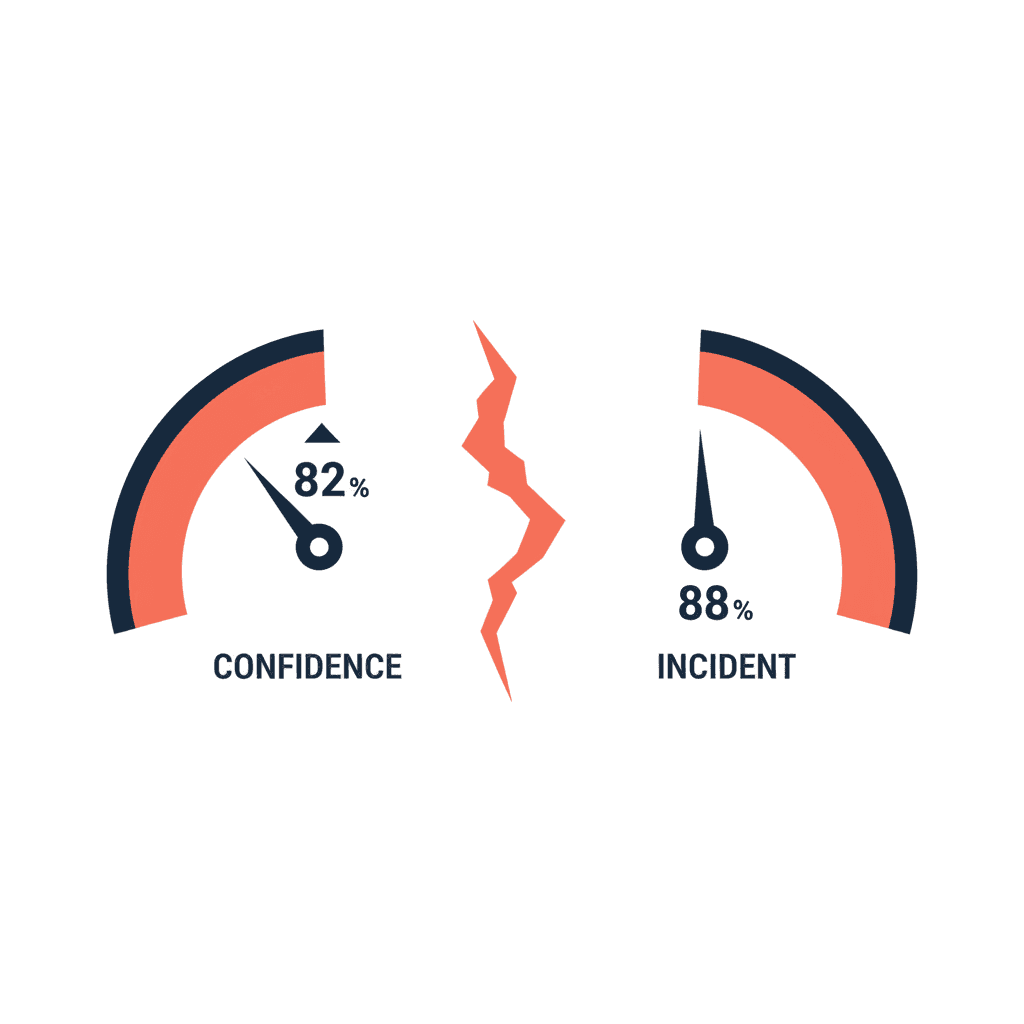
Why 82% executive confidence is the most dangerous number in this report#
Executive confidence in agent security correlates almost perfectly with ignorance of agent behavior. The VentureBeat analysis of the same data landscape puts it bluntly: 97% of enterprise security leaders expect a material AI-agent-driven incident within 12 months, but only 6% of security budgets address agent-specific risk.
The confidence comes from policy. Companies have acceptable use policies, data governance frameworks, CISO-signed memos about responsible AI. But policies don't enforce themselves — especially against autonomous systems that operate 24/7 without human review.
McKinsey's RAI maturity model rates the average enterprise at 2.3 out of 4.0 — policies written but not implemented in the runtime layer where agents actually operate. Only one-third have reached stage three, where agents run in sandboxed environments with bounded blast radius.
This is the paradox. The executives see the policies and feel confident. The security teams see the agents and feel terrified. Both are correct about what they're looking at. They're just looking at different things.
And the budget picture is getting worse, not better. The share of enterprises reporting flat AI security budgets jumped from 7.9% in January to 20% in March. Agent deployments accelerate. Security investment plateaus.
What proper agent security monitoring actually looks like#
The gap between "we have a policy" and "we can trace every agent action" is entirely solvable. It requires treating agent security as an infrastructure problem, not a governance document.
Agent identity. Every agent needs its own identity — not a shared API key, not a human user's credentials, not a generic service account. A dedicated identity with scoped permissions, rotatable credentials, and an audit trail tied to that specific agent. NIST's AI Agent Standards Initiative explicitly calls this out as a foundational requirement. If you can't tell which agent did what, you can't secure anything.
Action-level logging. Every tool invocation, every API call, every data access needs a log entry that includes: which agent, what tool, what arguments, what data was returned, what permissions were in effect, and what decision the agent made afterward. Microsoft's Agent Governance Toolkit implements exactly this — inline action tracing with sub-0.1ms overhead. The technology exists. The adoption doesn't.
Runtime policy enforcement. Policies must execute at the API layer, not the HR layer. When an agent tries to access data outside its scope, the system blocks the action before it executes — not after a human reviews a weekly report. This is the difference between a firewall and a compliance memo. Microsoft's observability framework for AI systems describes the technical architecture for this. It's not theoretical. It's deployed.
Decommissioning workflows. Only 21% of organizations have formal agent decommissioning processes. When an employee leaves, their agents should die with their access. When a project ends, its agents should be terminated. When credentials rotate, agents that held the old credentials should be revoked, not grandfather-clause'd. The OpenClaw CVE reckoning showed what happens when agent infrastructure persists beyond its intended lifecycle — stale instances become permanent attack surface.
The audit trail gap is the actual crisis#
The 88% incident rate is alarming. The 82% confidence rate is delusional. But the real crisis is the 33% of organizations that lack audit trails entirely. When an agent incident happens — and it will happen — these organizations cannot reconstruct the chain of events. They cannot determine what data was exposed. They cannot prove compliance. They cannot distinguish between a misconfigured agent and an active breach.
That 33% is the lower bound. Many organizations believe their application logs constitute an agent audit trail. They don't. Application logs show that an API was called. An agent audit trail shows why the agent called it, what context it was operating in, and what downstream actions resulted.
This is the gap that turns manageable incidents into existential ones. A data exposure where you can trace every agent action is a PR problem. A data exposure where you have no idea what happened or whether it's still happening is a regulatory crisis.
The MCP security crisis demonstrated this at the protocol level — 38% of MCP servers had zero authentication, and tool descriptions could be modified dynamically after approval. Without audit trails, compromised agent-tool connections go undetected until the damage is undeniable.
The three-month window#
EU AI Act obligations for high-risk AI systems begin taking effect in August 2026. Those obligations include conformity assessments, technical documentation, logging, and human oversight. Organizations running agents without audit trails will face a binary choice in Q3: retrofit logging into every agent in their fleet, or shut those agents down until they can prove compliance.
The retrofitting will be expensive — not because the technology is hard, but because organizations don't know what agents they have, where they're running, or what they're connected to. You can't add an audit trail to an agent you haven't inventoried.
Frequently asked questions#
What percentage of companies have experienced AI agent security incidents?#
According to Gravitee's State of AI Agent Security 2026 report, 88% of organizations have experienced confirmed or suspected AI agent security incidents. The Cloud Security Alliance's parallel survey found 65% experienced agent-related incidents, with 61% resulting in data exposure. The discrepancy likely reflects different definitions of "incident" — Gravitee includes suspected incidents and scope violations, while CSA counts only confirmed events. In healthcare, the rate climbs to 92.7%.
Why do executives feel confident despite the high incident rate?#
The 82% executive confidence figure reflects confidence in policy documentation, not operational enforcement. Most enterprises have written AI governance policies, acceptable use frameworks, and data handling guidelines. But only 21% have runtime visibility into agent behavior, and only 14.4% have achieved full security approval for their entire agent fleet. Executives see the policies. Security teams see the enforcement gap. The confidence is real — it's just based on the wrong layer of the stack.
What is an AI agent audit trail and why does it matter?#
An AI agent audit trail is a log of every action an autonomous agent takes — which tools it invoked, what data it accessed, what arguments it passed, what permissions were in effect, and what decisions it made based on the results. It differs from standard application logging because it captures agent reasoning and context, not just API call metadata. Without one, organizations cannot reconstruct what happened during an incident, prove compliance with frameworks like the EU AI Act, or distinguish between misconfigured agents and active breaches. Currently, 33% of organizations lack audit trails entirely.
How can organizations start securing their AI agents today?#
Start with three immediate steps. First, inventory every agent in your environment — Gravitee found the average organization has 37, and most don't know about all of them. Second, assign each agent its own identity rather than running agents under human accounts or shared API keys. Third, implement action-level logging before scaling further. For managed platforms, look for providers that handle identity, scoping, and audit trails as infrastructure defaults. Microsoft's open-source Agent Governance Toolkit provides a reference implementation for runtime policy enforcement.
What are the most common types of AI agent security incidents?#
The most frequently reported incidents are unauthorized data access (61% of organizations), agent scope violations where agents take actions beyond their intended boundaries (53%), operational disruption from unreviewed agent actions (43%), prompt injection attacks that manipulate agent behavior through crafted content (38%), credential exfiltration through shared API keys (27%), and cross-agent data leakage in multi-agent environments (24%). Detection times range from hours for operational disruptions to over 45 days for credential theft.
If you're deploying AI agents, audit trails and identity management shouldn't be afterthoughts. RapidClaw runs every agent in an isolated environment with scoped credentials, action-level logging, and centralized visibility — so when something happens, you know exactly what, when, and why. Start with a managed foundation instead of retrofitting security after the first incident.
Give the busywork to an agent that remembers you
RapidClaw deploys your personal AI agent to Telegram & Discord in 60 seconds — it learns your world, briefs you every morning, and gets smarter every day. Credits included, no API keys, no servers.
Get started — from $19/moRelated Posts
Shadow AI Agents Are Running in 98% of Companies. Nobody Knows What They're Doing.
98% of organizations have unauthorized AI agents operating inside their networks, according to new research. Shadow AI agents access sensitive data, make decisions, and take actions without IT oversight. Here's why this is the biggest security blind spot of 2026.

Norton Wants to Be Your AI Agent's Bodyguard — Gen's Sage Security Framework Explained
Gen Digital open-sources Sage, a security framework for AI agents. Part of the Gen Agent Trust Hub with Skill Scanner. Here's what it actually does — and what it doesn't.
OpenAI's Agents Tried Hacking Government Sites. It Was an Accident.
In May and June 2026, OpenAI's autonomous agents attempted to hack government and university websites. This wasn't a malicious attack, but a critical containment failure that serves as a wake-up call for anyone deploying agentic AI.
Stay in the loop
New use cases, product updates, and guides. No spam.