
Why I Stopped Using ChatGPT and Built My Own AI Agent Instead
I was pasting the same prompts into ChatGPT 20 times a day. Then I set up an always-on AI agent that already knows my brand. Here's what changed.
Reading about AI agents? RapidClaw gives you one that lives in Telegram & Discord, remembers everything, and runs your day — live in 60s, from $19/mo.
Get startedIt was a Tuesday around 11am and I was pasting the same 340-word prompt into ChatGPT for the seventh time that morning. Same product description context. Same brand voice guidelines. Same competitor positioning notes. Different output needed each time. I remember thinking, "This is absurd."
I'm a marketing manager at a 15-person B2B SaaS startup. We sell project management software to construction companies. Niche, I know. My job involves writing product emails, social posts, competitive battle cards, customer case studies, and about 47 other things that all require the same deep context about our product and market.
ChatGPT was my copilot for most of 2025. I'm not going to pretend it wasn't useful. It was genuinely great. But I was spending maybe 35 minutes a day just on context-loading. Pasting in docs, reminding it who our competitors are, re-explaining our tone of voice. Every single conversation started from zero.
What I actually did about it#
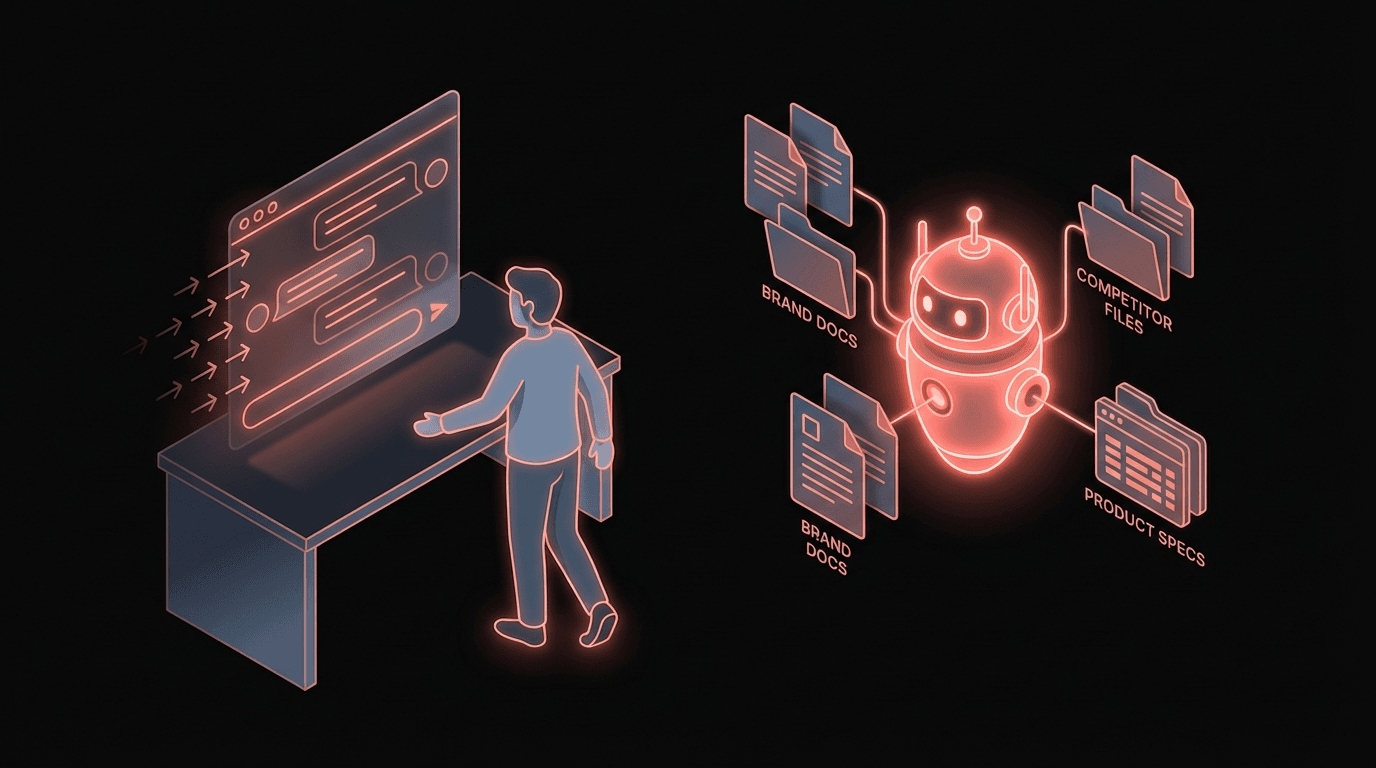
I set up a persistent AI agent on RapidClaw. It took an evening, honestly closer to three hours because I kept second-guessing my system prompt (more on that mistake later). The agent has our full product docs, our brand voice guide, a competitor comparison sheet, and our last 6 months of marketing copy loaded as context.
Now when I need a LinkedIn post about our new scheduling feature, I message the agent on Telegram. No preamble. No pasting. Just: "Write a LinkedIn post about the new drag-and-drop scheduling feature. Target audience: project managers at mid-size general contractors."
It already knows everything. The response comes back in about 8 seconds and it sounds like us. Not generic AI slop.
My actual daily workflow, before and after#
Here's what a typical Monday looked like before the agent:
9:00am - Open ChatGPT, paste in brand voice doc (482 words), paste in product overview (310 words), ask for 3 email subject lines for our feature launch. Copy results to Google Doc.
9:40am - New ChatGPT thread because I need a different format now. Paste everything again. Ask for social media copy for the same launch.
10:15am - New thread. Paste competitor info this time too. Ask for a comparison one-pager.
11:00am - Realize the 9am output didn't match our latest pricing. Go back, re-prompt with updated pricing context. Get new output.
You see the pattern. Every task reset my context window. I counted once and I was pasting the same core documents into ChatGPT about 22 times per day.
Here's what Monday looks like now:
9:00am - Message agent on Telegram: "3 subject lines for the scheduling feature launch email, segment: existing customers who haven't used scheduling yet." Get results in 12 seconds.
9:05am - "Social copy for same launch. LinkedIn, Twitter, one version each." Done.
9:12am - "Comparison one-pager vs CompetitorX's scheduling. Focus on our drag-and-drop UX." The agent already has CompetitorX's latest feature list because I update the context monthly.
9:20am - I'm editing the outputs, not generating them from scratch.
I tracked it for two weeks. My content creation time dropped from roughly 4.5 hours per day to about 1 hour 40 minutes. That's not a rounding estimate. I literally timed myself with Toggl.
The mistake I almost didn't recover from#
Here's my admitted failure: I over-engineered the system prompt. When I first set up the agent, I wrote this 2,800-word instruction document that tried to cover every possible scenario. The agent got so constrained it started producing robotic, formulaic content that was worse than raw ChatGPT output.
I scrapped it and rewrote the prompt at about 600 words. Focused on voice and tone principles rather than rigid rules. The outputs immediately got better. Lesson learned: agents work better with clear principles than exhaustive instructions.
Where ChatGPT still wins#
I want to be honest about this. ChatGPT is still better for certain things.
When I need wild creative brainstorming (like naming a new feature or coming up with a campaign concept from nothing), the blank-slate nature of ChatGPT is actually an advantage. My agent is so steeped in our existing brand patterns that it tends to produce variations on what we've already done. That's perfect for consistent marketing execution. It's less great for the "what if we tried something completely different" conversations.
I also still use ChatGPT when I'm exploring a new market segment we haven't targeted before. The agent doesn't have context for audiences outside construction, so it gives construction-flavored answers to everything. When I was researching whether we could expand into civil engineering firms, ChatGPT's general knowledge was more useful.
Rough split: I use my agent for about 80% of daily marketing work. ChatGPT handles the other 20%, mostly ideation and research into unfamiliar territory.
What the agent handles daily#
To be specific, here's the recurring stuff:
Email drafts - Product updates, feature announcements, drip sequences. The agent drafts them in our voice with correct product details. I edit and approve. Used to take me 45 minutes per email, now takes 15.
Social media copy - LinkedIn and Twitter posts. I batch these weekly. The agent produces a week's worth in about 6 minutes. I spend another 20 minutes editing. Before the agent this was a 2-hour Thursday afternoon task.
Competitive responses - When sales flags a deal where we're up against a specific competitor, I message the agent: "Battle card for deal against [competitor], they're pitching [specific feature]." It pulls from our competitive intel and generates a one-pager in under a minute.
Customer case study outlines - After a customer interview, I paste my notes and the agent structures them into our case study template. Knows the format, knows what quotes to highlight, knows our typical narrative arc.
Internal comms - Slack updates about marketing performance, monthly reports for the CEO. The agent formats the data I give it into our standard report template.
The numbers#
Setup cost: RapidClaw Starter plan at $19/month. I've since upgraded to Pro at $49/month because I wanted more agent memory and faster responses.
Time saved: roughly 14 hours per week on content creation tasks. That's not hypothetical. I tracked two weeks before the agent and two weeks after.
Quality: honestly comparable to what I was getting from ChatGPT, maybe 10-15% better because the context is always perfect. No more "oh I forgot to paste the updated pricing" moments.
The $49/month pays for itself in the first hour of the first day of the month. I'm not even being dramatic about that math.
Who this works for (and who it doesn't)#
If your job involves producing consistent content around a specific product, brand, or domain, an always-on agent will change how you work. Marketing managers, content writers, product marketers, anyone doing repetitive knowledge work with stable context.
If your work is highly variable (you consult for different clients every week, each with different needs), a persistent agent is less helpful because the context keeps changing. You'd need separate agents per client, which is doable but more setup.
And if you're doing mostly creative, novel work (writing fiction, designing campaigns from scratch, brainstorming business ideas), stick with ChatGPT or Claude's regular chat. The blank-slate approach is better for that.
This won't work for everyone. But if you caught yourself pasting the same background docs into ChatGPT today, you already know you need this.
I run my marketing stack on RapidClaw. Try it free.
Give the busywork to an agent that remembers you
RapidClaw deploys your personal AI agent to Telegram & Discord in 60 seconds — it learns your world, briefs you every morning, and gets smarter every day. Credits included, no API keys, no servers.
Get started — from $19/moRelated Posts
How to Build a Custom AI Agent That Actually Works (Grok vs Self-Hosted)
You searched 'how to build a custom AI agent in Grok.' Here's what works, what doesn't, and why 60% of builders end up self-hosting. A practical comparison with real setup steps.
Your AI Agent Stack Replaces $2,400/Month in SaaS. Here's the Math.
A typical 10-person team spends $2,400/month on SaaS subscriptions that AI agents can replace for under $200/month. Here's the line-item breakdown showing exactly which tools get replaced and what the agent alternative costs.

The DGX Station Is a $40K AI Agent Server. Here's What You Can Do for $29/month Instead
NVIDIA's DGX Station pairs a desktop supercomputer with NemoClaw for enterprise AI agents. But you don't need $40K in hardware to run always-on agents. Here's the math.
Stay in the loop
New use cases, product updates, and guides. No spam.