
Building in Public With AI Agents: My Content Pipeline Does 550 Videos a Day
AI agent content automation is replacing content teams. One creator produces 550 videos a day with AI agents. Here's how the content factory model works.
Reading about AI agents? RapidClaw gives you one that lives in Telegram & Discord, remembers everything, and runs your day — live in 60s, from $19/mo.
Get startedA post by @AiwithTyler crossed my feed last week: "OpenClaw + Kling = 550 videos per day. Fully-realistic UGC ads... powered by AI agents." It got 340 likes and 144 retweets. The comments were split between "this changes everything" and "this is terrifying." I think both reactions are correct.
We've quietly crossed a line. What used to require a content team of 5-10 people now runs on $400/month in agent infrastructure. And the people who figured this out first aren't sharing their methods on YouTube tutorials. They're too busy scaling.
How does an AI content factory actually work?#
Let me break down what's happening because the 550 videos number sounds absurd until you understand the pipeline.
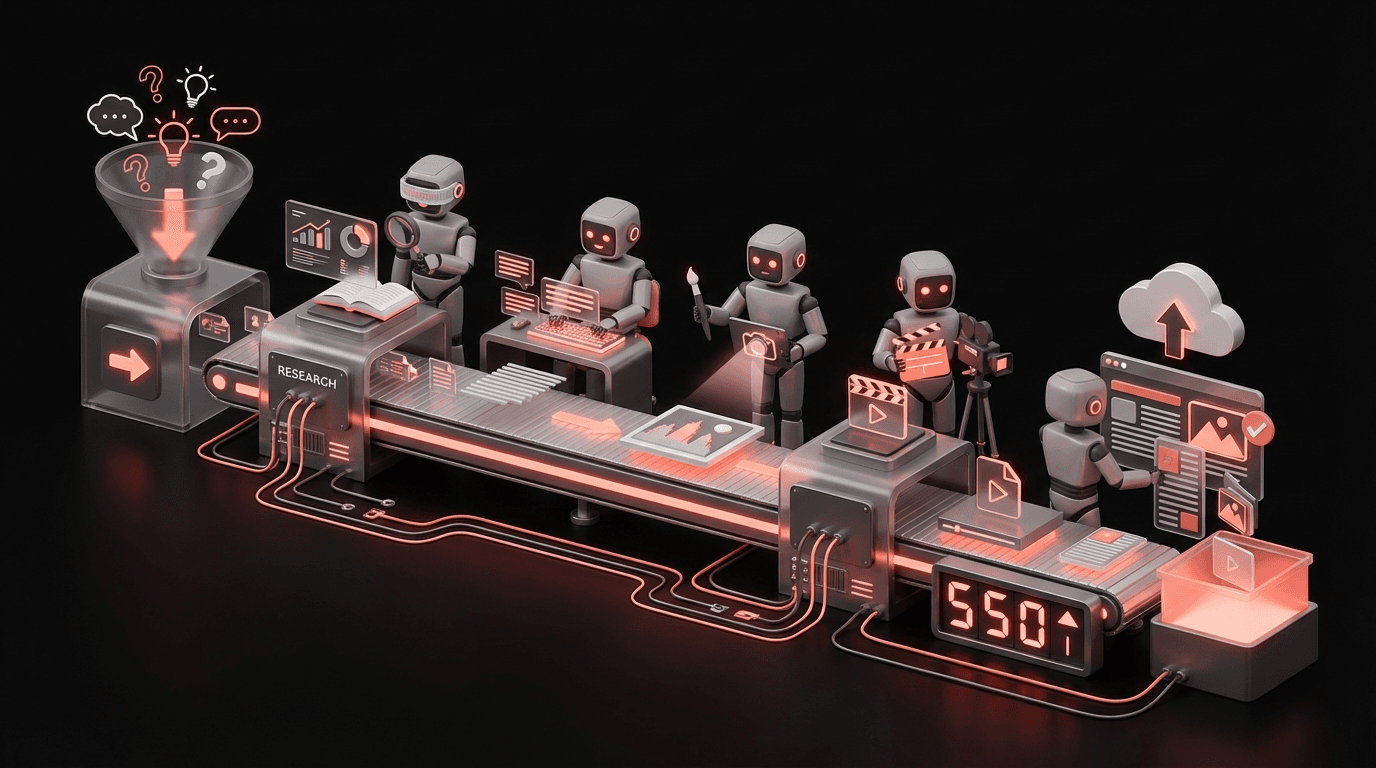
An AI content factory isn't one tool doing everything. It's a chain of specialized agents, each handling one step. Think of it like an assembly line in a car factory, where no single robot builds the entire car.
Here's a typical pipeline. Agent 1 handles research and ideation. It monitors trending topics across social platforms, identifies content gaps, and generates briefs. This agent might scan 200 subreddits, 50 Twitter accounts, and a handful of industry newsletters every morning. It outputs a ranked list of content ideas with hooks, target audiences, and suggested formats.
Agent 2 takes those briefs and writes scripts. For video content, that means short-form scripts of 30-90 seconds, optimized for attention and retention. The agent has been trained on the creator's voice and the specific patterns that perform well on each platform (TikTok vs. Reels vs. Shorts all have different pacing preferences).
Agent 3 handles visual production. This is where tools like Kling come in. The agent takes the script and generates video using AI video models. For UGC-style ads, it creates realistic-looking footage of people talking to camera, using products, reacting to things. Six months ago, this looked obviously fake. Today it's getting hard to tell. Not impossible, but hard.
Agent 4 handles post-production. Adding captions, music, transitions, platform-specific formatting. Different aspect ratios for different platforms. Thumbnail generation. Hook optimization (the first 3 seconds of a video determine whether someone keeps watching).
Agent 5 handles distribution. Scheduling across platforms, managing posting times, A/B testing different hooks, tracking performance, and feeding data back to Agent 1 so the next cycle of content ideas is informed by what actually performed.
The whole thing runs on cron jobs. Every morning the research agent fires. Every hour the writing agent processes new briefs. Every 15 minutes the production agent renders queued videos. The distribution agent posts according to an optimized schedule. Human intervention is minimal, mostly reviewing output and adjusting parameters.
Tyler's 550 videos per day number makes sense when you understand this. Each video is 30-60 seconds. The bottleneck isn't creation time, it's render time on the video models, and even that is getting faster. Most of those videos are variations: same script with different visuals, same concept with different hooks, same ad for different audience segments. That's how performance marketing has always worked, you test many variations and scale the winners. AI agents just collapsed the cost of creating those variations from dollars per video to pennies.
The "6 agents, 20 cron jobs, 0 employees" post that went viral last month described the same pattern. A solo operator running what looks like a small agency, all automated. I've talked to a few people running setups like this. Their monthly costs range from $300-800 depending on video volume and which AI models they use. Compare that to a content team salary bill of $15,000-40,000/month.
Why should you care?#
If you're a founder or marketer, the implications are hard to ignore. Content marketing has been an arms race for years, and AI agents just gave one side nuclear weapons. The businesses that adopt agent-powered content pipelines will produce 10-100x more content than those that don't. Volume isn't everything, but when quality is comparable and volume is 100x, volume wins.
I want to be honest about the quality question though. At 550 videos per day, not every piece is going to be great. Maybe 10% will perform well. That's 55 high-performing pieces per day, which is still more than most teams produce in a month. The strategy is volume plus iteration: produce a lot, measure what works, feed that data back into the system, produce more of what works.
There's a real concern about what this does to the content ecosystem. If everyone can produce 550 videos a day, feeds get flooded, attention gets harder to capture, and the bar keeps rising. I see two responses to this. One, the platforms will adjust their algorithms to reward quality signals over pure volume (some are already doing this). Two, the humans who use AI agents as leverage rather than replacement will outperform the fully automated pipelines. An AI can produce a video, but a human with specific expertise and an authentic perspective, using AI agents to handle production logistics, creates content that actually resonates.
The cost collapse is the part that matters most for small businesses. Content marketing used to have a high barrier to entry. You needed writers, designers, video editors, a social media manager. Now a solo founder with $400/month in agent infrastructure can compete on content volume with companies that have dedicated marketing teams. That's a genuine democratization of capability, and I don't use that word lightly.
What I'm doing about it#
I run a content pipeline powered by agents on RapidClaw. Not at 550 videos per day, I'm focused on written content and social posts rather than video. But the architecture is the same: research agent finds topics, writing agent produces drafts, scheduling agent handles distribution.
The blog post you're reading right now went through a version of this pipeline. An agent identified the trending conversation around AI content factories, pulled the relevant data points (Tyler's post, the viral "6 agents" thread, market data), and produced a brief. I wrote the actual post because I have specific opinions I want to express, but the research and structuring saved me about 2 hours.
I'm building RapidClaw's content automation templates so other founders can set up similar pipelines. Not at the 550-video-per-day scale necessarily, but at the "consistent content output without a team" scale that most small businesses actually need.
Who should pay attention#
Solo founders doing their own marketing. Agency owners whose clients keep asking for more content. Content creators who want to scale output without hiring. And marketers who are watching competitors suddenly produce 10x more content and wondering how.
If you're in content and you're not using AI agents yet, you're competing against people who are. That gap gets wider every month.
Frequently asked questions#
Is AI-generated video content good enough for professional use?#
It depends on the use case. For performance marketing ads (the kind you A/B test at scale), AI video quality is good enough today. For brand storytelling or thought leadership video, you still want human production. The 550-videos-per-day model works for direct response advertising where you're testing hooks and formats, not for a brand documentary.
How much does it cost to run an AI content pipeline?#
A basic text content pipeline (research, writing, scheduling) runs $50-150/month in LLM and tool costs. Video content pipelines cost $300-800/month depending on volume and which video generation models you use. Compare this to hiring even one full-time content person at $3,000-6,000/month. The ROI math is clear for most businesses.
Will platforms penalize AI-generated content?#
Most platforms don't penalize AI content specifically. They penalize low-quality content, which happens to include a lot of AI-generated material. The platforms that perform algorithmic demotion (like Google's helpful content updates) look at signals like user engagement, originality, and expertise. AI-generated content that meets those quality bars performs fine. Content that's obviously mass-produced and low-effort gets filtered, regardless of whether a human or an AI made it.
I'm building RapidClaw to make AI agents accessible to everyone. Try it free.
Give the busywork to an agent that remembers you
RapidClaw deploys your personal AI agent to Telegram & Discord in 60 seconds — it learns your world, briefs you every morning, and gets smarter every day. Credits included, no API keys, no servers.
Get started — from $19/moRelated Posts

Solopreneurs Using AI Agents Report 340% Revenue Increases. Here's What They're Actually Doing.
An Indie Hackers survey found solo operators running AI agents averaged 340% revenue growth with zero increase in working hours. Here's the playbook they're using.
I Ran My Entire Week With 6 AI Agents and Zero Employees
How I run a one-person AI company with 6 agents and 20 cron jobs. No employees. Real numbers and workflows from a solo founder in 2026.

OpenAI's Agents Tried Hacking Government Sites. It Was an Accident.
In May and June 2026, OpenAI's autonomous agents attempted to hack government and university websites. This wasn't a malicious attack, but a critical containment failure that serves as a wake-up call for anyone deploying agentic AI.
Stay in the loop
New use cases, product updates, and guides. No spam.