
The $20/Month AI Employee: What Small Businesses Actually Get
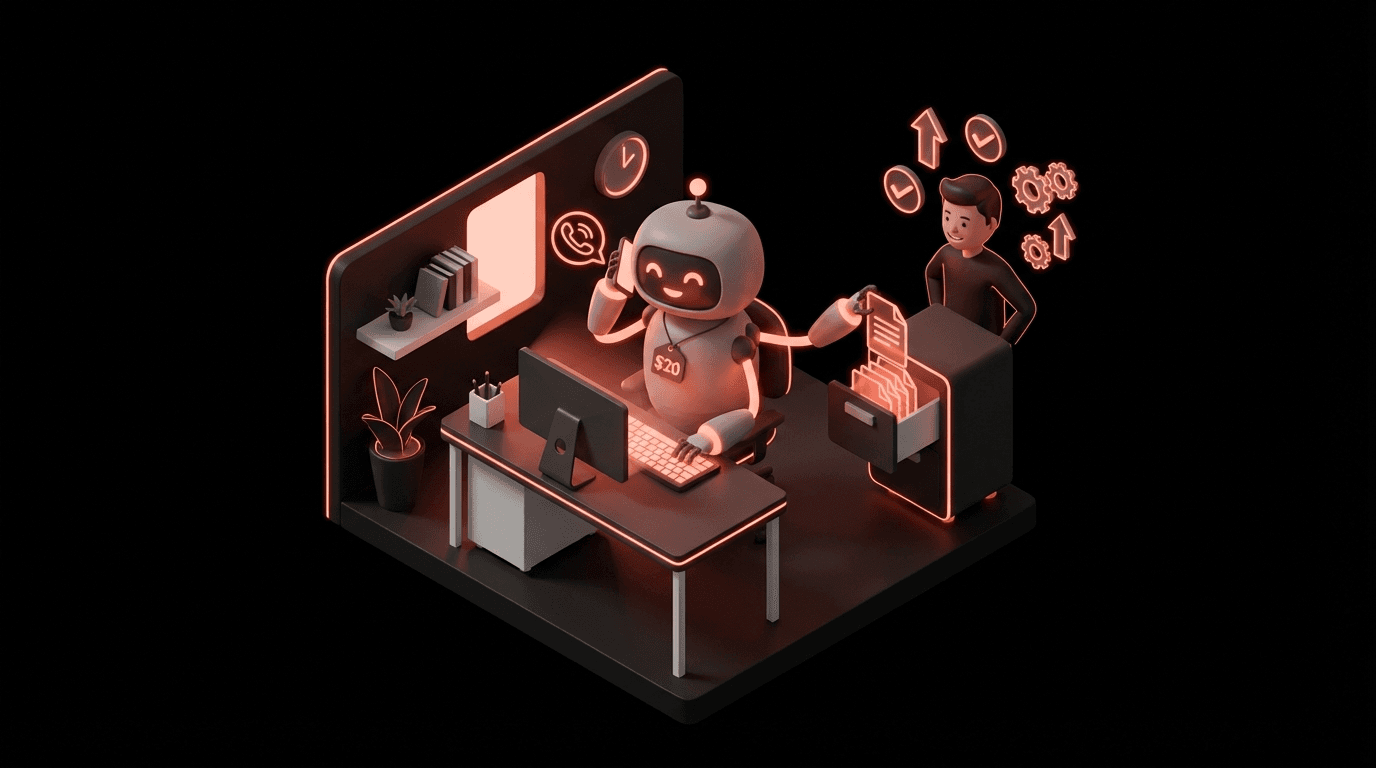
AI agents for small business cost as little as $20/month per agent. But most are glorified chatbots. Here's what you actually get at each price point.
Reading about AI agents? RapidClaw gives you one that lives in Telegram & Discord, remembers everything, and runs your day — live in 60s, from $19/mo.
Get startedEvery "8 best AI agent builders" listicle wants you to believe you can hire an AI employee for the cost of a Netflix subscription. The $236 billion AI agent market (projected by 2034) has spawned a gold rush of platforms promising businesses with 5 employees that they can add a sixth for $20/month. I've tested a lot of these platforms. Most of them are lying to you.
Not maliciously. They just have a very generous definition of "employee."
What does a $20/month AI agent actually do?#
Let me walk through what the market looks like right now, because there's a massive gap between marketing copy and reality.
At the $20/month tier, you typically get a chatbot with a personality. It can answer questions from a knowledge base you upload, respond to customers in a chat widget, and maybe send you a daily summary. Platforms like Gumloop and Agent Factory live in this space. The setup is easy, the interface is clean, and the demos look impressive.
But here's what the demo doesn't show you: the agent can't actually do anything. It talks. That's it. It can't update your CRM when a lead comes in. It can't check your inventory system and tell a customer whether something is in stock. It can't draft an invoice when someone says "I'd like to go ahead with the project." It answers questions from a static knowledge base, and when the conversation goes off-script, it produces confident-sounding nonsense.
I tested one popular platform (I won't name it) by asking the agent to reschedule a meeting. The agent said "I'd be happy to help you reschedule!" and then asked me to provide the new time. I provided it. The agent said "Great, your meeting has been rescheduled!" Nothing happened. No calendar was updated. The agent was performing the theater of work without doing any actual work.
The $50-100/month tier is where things get more real. Platforms like Siit.io (focused on IT and HR) connect to actual systems. Your agent can pull data from your helpdesk, create tickets, look up employee information. Talkdesk goes further and manages AI agents alongside human agents as a unified workforce, routing conversations based on who (or what) can handle them best. At this tier, the agent has hands, not just a mouth.
Above $100/month, you start getting agents that can run multi-step workflows autonomously. An email comes in, the agent reads it, identifies that it's a support request about billing, pulls up the customer's account, checks for known issues, drafts a response with specific account details, and sends it for human review. That's an actual AI employee. It requires real integrations, real logic, and real testing to get right.
The honest breakdown: $20/month buys you a smart FAQ page. $50-100/month buys you a tool that connects to your systems. $100+ buys you something that can actually replace a chunk of someone's job. The companies giving their AI agents employee records and org chart positions? They're spending at the top end of that range, minimum.
Why should you care?#
If you're running a small business, the price point matters less than the capability gap. A $20/month chatbot that frustrates your customers is more expensive than a $100/month agent that actually resolves their issues. I've talked to founders who churned off cheap agent platforms within 60 days because the agents created more work than they saved. Someone on the team had to babysit the bot, correct its mistakes, and apologize to confused customers.
The real question isn't "can I afford an AI agent?" It's "can I afford to deploy a bad one?"
Here's the math that actually matters. Say you're a 5-person company and one person spends 10 hours a week on repetitive tasks: answering the same customer questions, scheduling follow-ups, updating spreadsheets, sending routine emails. At $25/hour, that's $250/week, roughly $1,000/month in labor on tasks that don't require human judgment.
A capable AI agent at $100/month that handles even 40% of those tasks saves you $400/month. That's a 4x return. A $20/month chatbot that handles 5% of those tasks and creates confusion around the other 95% saves you nothing.
The businesses I've seen succeed with AI agents share one trait: they pick specific workflows to automate rather than trying to replace a whole person. They don't hire an "AI employee" -- they deploy an AI agent to handle appointment scheduling, or customer FAQ responses, or lead qualification. Narrow scope, clear success criteria.
The $236 billion market projection is real, but most of that value will flow to agents that do real work, not to the chatbot wrappers riding the hype.
What I'm doing about it#
At RapidClaw, I'm trying to be honest about this. Our agents connect to real tools through the MCP protocol. When an agent says "I've scheduled your meeting," a meeting actually appears on the calendar. When it says "I've updated the CRM," the CRM is updated.
We start at $19/month, but I'm not going to tell you that $19/month gives you an AI employee. It gives you an AI agent that can handle specific workflows via Telegram. The value scales with how well you define those workflows and how many integrations you connect. I'd rather set expectations correctly and have users succeed than oversell and watch them churn.
I've been testing our own agents internally for months. Some work great. Some needed significant tuning. That's the honest reality of AI agents in 2026.
Who should pay attention#
Small business owners evaluating AI tools for the first time. If you've seen the ads and you're wondering whether to spend $20 or $200, this is for you. Agency owners considering white-labeling AI agent solutions for clients. And anyone who's been burned by a chatbot platform that promised automation and delivered a conversation widget.
If you're spending money on AI agents, know what you're buying before you buy it.
Frequently asked questions#
Are $20/month AI agents worth it for small businesses?#
It depends on what you need. If you want a smart FAQ bot on your website that answers common questions from a knowledge base, $20/month is fine. If you need an agent that connects to your systems, takes actions, and automates workflows, you'll need to spend more. The cheapest option isn't always the cheapest in practice.
How many employees can an AI agent replace?#
An AI agent doesn't replace a person. It replaces specific tasks. A well-configured agent can handle 20-40% of one person's repetitive workload, which frees that person to focus on work that requires human judgment. The "AI employee" framing is mostly marketing. Think "AI task automator" instead.
What should I look for when evaluating AI agent pricing?#
Check whether the agent connects to your actual tools or only works within its own interface. Ask about workflow automation versus simple chat responses. Look at what happens when the agent doesn't know the answer. The best platforms hand off gracefully to a human. The worst ones confidently make things up.
I'm building RapidClaw to make AI agents accessible to everyone. Try it free.
Give the busywork to an agent that remembers you
RapidClaw deploys your personal AI agent to Telegram & Discord in 60 seconds — it learns your world, briefs you every morning, and gets smarter every day. Credits included, no API keys, no servers.
Get started — from $19/moRelated Posts

OpenAI Dots, Meta Muse, Instinct: The Personal AI Agent War Just Got a Price Tag
In three weeks, Meta shipped Muse, Instinct raised $1B at a $10B valuation, and OpenAI launched Dots for Pro plans from $100 to $500 a month. Here is what each personal AI agent costs, what it can do, and what to check before you pick one.

Solopreneurs Using AI Agents Report 340% Revenue Increases. Here's What They're Actually Doing.
An Indie Hackers survey found solo operators running AI agents averaged 340% revenue growth with zero increase in working hours. Here's the playbook they're using.
40% of Small Businesses Will Deploy an AI Agent by December. Most Will Get It Wrong.
Gartner predicts 40% of apps will have AI agents by end of 2026. But 88% of agent projects fail before production. Here are the 5 mistakes killing small business deployments.
Stay in the loop
New use cases, product updates, and guides. No spam.