
GitHub's Fastest-Growing AI Repos This Week Are All Agent Frameworks
Every trending repo on GitHub right now is an agent framework. OpenClaw leads the pack. Here's what's growing fastest and why 2026 really is the year of agents.

Reading about AI agents? RapidClaw gives you one that lives in Telegram & Discord, remembers everything, and runs your day — live in 60s, from $19/mo.
Get startedI keep a tab open to GitHub Trending. Have for years. It used to be a mix of developer tools, CSS libraries, random weekend projects that went viral. This week, I scrolled through the top 25 fastest-growing repos and every single meaningful entry was an agent framework. Not chatbot wrappers. Not prompt template collections. Full-blown autonomous agent systems.
Something has shifted, and the data is hard to ignore.
The GitHub signal#
@BoWang87 posted a thread on X last Friday that got 1,131 likes and 178 retweets: "2026 is the year of agents. Here's the evidence from GitHub's fastest-growing AI repos this week (outside of OpenClaw)." The parenthetical is doing a lot of work there. OpenClaw is explicitly the fastest-growing agent framework on GitHub right now. Bo's thread was about the runners-up, and even those are growing at rates that would have been headline-worthy six months ago.
Meanwhile, a thread on r/AI_Agents titled "12 massive Agentic AI developments" pulled 104 upvotes in two days. Not a huge number by Reddit standards, but the comment quality was unusually high. People weren't arguing about AGI timelines. They were comparing orchestration patterns and debating which tool-use protocols would win.
When Reddit comments read like architecture reviews, something real is happening.
Top AI agent repos by GitHub stars (March 2026)#
Here are the actual repos dominating GitHub right now, with real star counts:
| Repo | Stars | Category | What it does |
|---|---|---|---|
| OpenClaw | 210,000+ | Personal AI agent | Open-source AI assistant for Telegram, WhatsApp, Slack, Discord. Fastest-growing GitHub repo in history. |
| Ollama | 162,000+ | Local LLM runtime | Run LLMs on your own hardware. Supports Llama, Mistral, Gemma, DeepSeek. |
| n8n | 150,000+ | Workflow automation | Drag-and-drop agent pipelines. Becoming the de facto action layer for AI agents. |
| Dify | 130,000+ | LLM app platform | AI workflows, RAG, agent capabilities, model management in one product. |
| LangChain | 126,000+ | Agent framework | Foundational Python library. Most agent builders interact with it. |
| Gemini CLI | 99,000+ | CLI agent | Google's open-source AI agent for the terminal. Brings Gemini to command line. |
| Browser Use | 84,500+ | Browser automation | Makes websites accessible for AI agents. Zero to 78K stars in months. |
| AutoGen | 54,000+ | Multi-agent | Microsoft's conversation-driven multi-agent framework. |
| LlamaIndex | 47,000+ | Data framework | 160+ data connectors for RAG and agent pipelines. |
| CrewAI | 44,600+ | Role-based agents | Largest ecosystem of any AI agent framework. Rapid prototyping. |
| Semantic Kernel | 27,000+ | Enterprise SDK | Microsoft's enterprise agent SDK. Optimal for .NET teams. |
| Agno | 26,000+ | Agent runtime | High-performance multi-modal agent runtime. |
| Smolagents | 25,000+ | Code-first agents | HuggingFace's library where agents write Python, not JSON. |
| LangGraph | 24,000+ | Orchestration | Directed graphs for stateful, multi-agent workflows. Production-grade. |
Fastest-growing categories#
Navigate the web autonomously -- clicking, filling forms, making decisions
Google's opinionated open-source agent framework with steep enterprise adoption
Model Context Protocol as the standard for agent-tool connections
Build entire analytical pipelines autonomously, replacing dashboards
Teams of agents that collaborate, delegate, and merge outputs
Browser-Use Agents
browser-useNavigate the web autonomously — clicking, filling forms, reading results, making decisions. Browser Use went from zero to 78K stars in months.
Google ADK / Gemini CLI
orchestrationGoogle's open-source agent toolkit hit 99K stars. Steep adoption curve. Heavy enterprise investment signals market direction.
MCP-Native Orchestrators
protocolModel Context Protocol is now the de facto standard for agent-tool connections. Production infrastructure, not demos.
Data Analysis Agents
dataAgents that build entire analytical pipelines autonomously. LlamaIndex (47K stars) and Dify (130K) lead here.
Multi-Agent Coordination
multi-agentAutoGen (54K), CrewAI (44K), LangGraph (24K) — teams of agents that collaborate, delegate, and merge outputs.
The pattern is clear: every category of trending repo is some variation of "make agents do real work, not just chat."
What the data agents shift means#
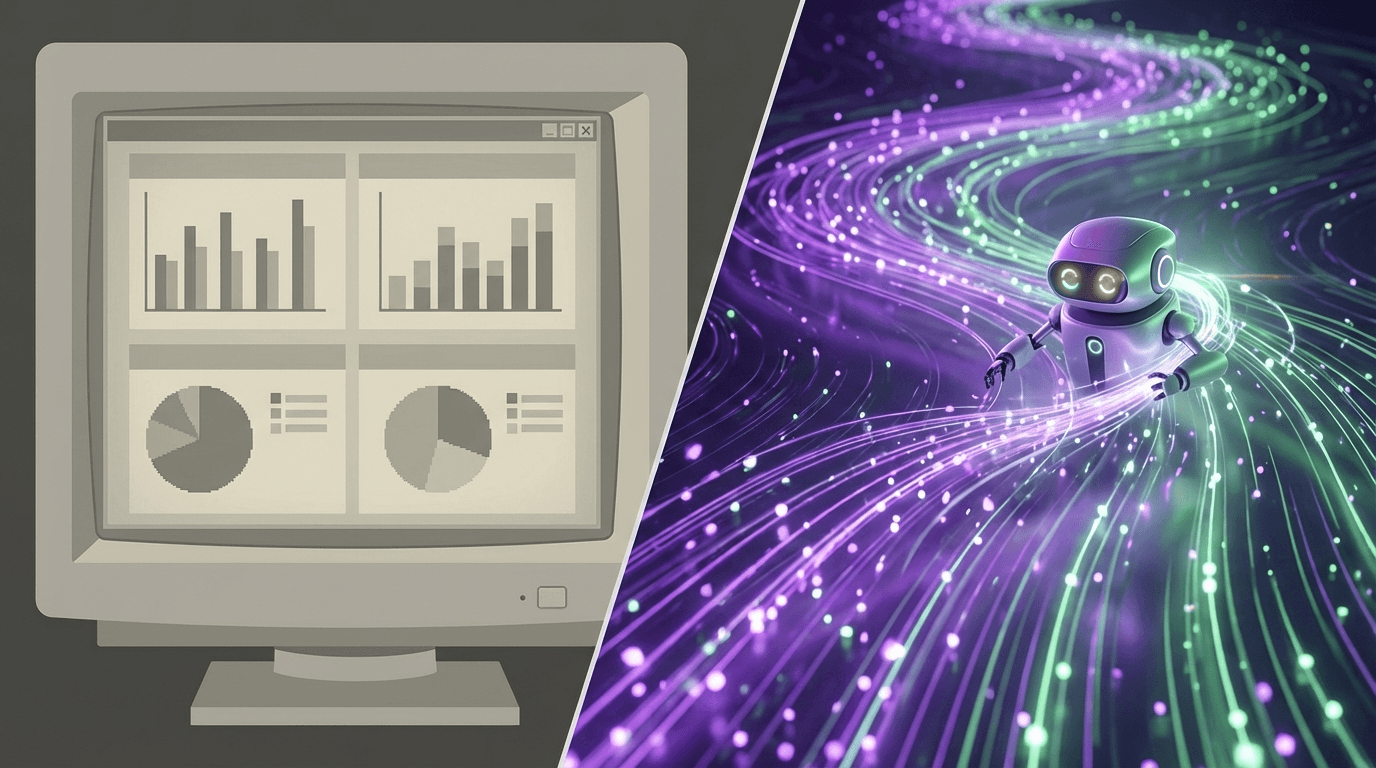
One comment in the Reddit thread stuck with me:
“This is the most telling. We're shifting from dashboards to end-to-end agent execution.”
— r/AI_Agents commenter
I think that's exactly right, and most people are underestimating how big this shift is.
For the last decade, the data stack was about helping humans look at data faster. Better dashboards. Better visualizations. Better SQL interfaces. The implicit assumption was always that a human would interpret the data and decide what to do about it.
Data agents break that assumption. They don't produce a chart for you to look at. They analyze the data, identify the anomaly, draft the response, and execute the fix. The human reviews after the fact, not before.
This is why the BigQuery agent repos are growing so fast. Companies are realizing that their $200K/year data analysts spend 70% of their time on work that a well-configured agent can handle in seconds. Not the strategic thinking. The routine monitoring, anomaly detection, and report generation that eats up entire teams' calendars.
Now, a word of caution.
“Agents scoring 72.5% on computer-use tasks sounds close to human-level until you realize the benchmark tasks are curated.”
— Community discussion
The benchmark tasks are the ones researchers selected because they're well-defined and measurable. Real-world computer use is messy, ambiguous, and full of edge cases that benchmarks don't capture. We're making genuine progress, but let's not confuse benchmark scores with production readiness across all domains.
The agents that are actually working in production right now are narrowly scoped. They do one thing well. Monitor a data pipeline and alert when something breaks. Track competitor pricing and flag changes. Manage a Telegram channel and respond to customer questions using a knowledge base. The generalist agent that replaces a human employee is still mostly theoretical. The specialist agent that handles a specific workflow is shipping today.
| Aspect | 6 Months Ago | Today |
|---|---|---|
| GitHub Trending | Mixed: CSS, tools, misc | All agent frameworks |
| Agent scope | Chatbot wrappers | Autonomous task execution |
| Data handling | Dashboard for humans | End-to-end agent pipelines |
| Multi-agent | Academic papers | Production repos shipping |
| MCP adoption | Early proposal | De facto standard |
Why this matters for you#
If you're a developer, the signal is obvious: learn agent architectures now. The demand for people who can build, deploy, and maintain agent systems is about to explode. Every enterprise software company is scrambling to add agent capabilities, and most of them don't have the in-house expertise to do it well.
If you're a founder or a small team, the opportunity is in deployment, not research. The open-source frameworks are good enough. The models are good enough. What's missing is the layer that makes it easy to go from "I cloned a repo" to "I have a production agent that runs 24/7 without me babysitting it."
That's exactly the gap we built RapidClaw to fill. OpenClaw is the fastest-growing agent framework on GitHub for a reason -- it's genuinely excellent software. But running it yourself means managing servers, handling updates, monitoring uptime, and dealing with infrastructure problems at 2am. RapidClaw gives you always-on OpenClaw agents deployed on Telegram in minutes, with none of the ops overhead.
The GitHub trending page doesn't lie. When every top repo converges on the same category, that category is about to become the default way software gets built. Agent frameworks aren't a trend. They're the next platform layer.
The question isn't whether agents will become standard infrastructure. The question is whether you'll be building on top of that infrastructure or competing against people who are.
Frequently asked questions#
What are the fastest growing AI agent repos on GitHub in 2026?#
The top repos by stars as of March 2026 are: OpenClaw (210K+ stars), Ollama (162K), n8n (150K), Dify (130K), LangChain (126K), Gemini CLI (99K), Browser Use (84K), AutoGen (54K), LlamaIndex (47K), and CrewAI (44K). OpenClaw is the fastest-growing repo in GitHub history, surging from 9,000 to over 210,000 stars in early 2026. Browser Use is the fastest-growing newcomer, going from zero to 78K stars in months.
What is the difference between AI agent frameworks and chatbot wrappers?#
Chatbot wrappers are thin layers around language models that handle conversational input and output. Agent frameworks go much further -- they enable autonomous systems that can reason, plan, use tools, take actions, and chain multi-step workflows together without constant human input. The shift visible on GitHub is from passive chat interfaces to active agents that monitor data pipelines, track competitors, manage client communications, and execute tasks end-to-end.
Are AI agents ready for production use in 2026?#
Narrowly scoped agents are production-ready today. Agents that handle one specific workflow -- like monitoring a data pipeline, tracking competitor pricing, or managing Telegram communications -- are shipping reliably in production environments. Generalist agents that replace entire human roles are still mostly theoretical. Benchmark scores like 72.5% on computer-use tasks sound close to human-level but don't capture the messy edge cases of real-world work.
Which AI agent framework should I use in 2026?#
For complex Python multi-agent orchestration, LangGraph leads. For TypeScript teams, Mastra is emerging as the top choice. CrewAI is best for rapid role-based agent prototyping. n8n and Dify are preferred for visual drag-and-drop agent pipeline design without writing code. For running a personal AI agent on Telegram or Discord without managing infrastructure, OpenClaw via RapidClaw is the managed hosting option.
What is MCP and why does it matter for AI agents?#
Model Context Protocol (MCP) is the emerging standard for how AI agents connect to external tools and data sources. Originally proposed by Anthropic, it has become the de facto protocol for agent-tool connections in 2026. MCP-native agent orchestrators are among the fastest-growing repos on GitHub because they enable production-grade tool integration without custom plumbing for each service.
Give the busywork to an agent that remembers you
RapidClaw deploys your personal AI agent to Telegram & Discord in 60 seconds — it learns your world, briefs you every morning, and gets smarter every day. Credits included, no API keys, no servers.
Get started — from $19/moRelated Posts

Microsoft Just Open-Sourced the Security Shield Every AI Agent Needs
Microsoft released a 7-package open-source Agent Governance Toolkit covering authorization, tracing, prompt injection defense, and PII protection — all under 0.1ms latency. Here's what it means for agent security.

OpenClaw Is Having Its ChatGPT Moment — And Big AI Labs Should Be Worried
OpenClaw's explosive growth mirrors ChatGPT's breakout trajectory. With 100K+ GitHub stars and model-agnostic architecture, it's turning billion-dollar AI models into interchangeable commodities. Here's why that terrifies the labs.

The Lightpanda Browser Is 11x Faster Than Chrome for AI Agents
A Zig-based headless browser just launched that's 11x faster than Chromium for AI agent automation. It got 8,248 likes on X. Here's why developers are excited.
Stay in the loop
New use cases, product updates, and guides. No spam.