
OpenAI Agents SDK vs Claude Agent SDK: A Founder's Honest Take
Comparing OpenAI Agents SDK and Claude Agent SDK from a founder who uses both. Handoffs vs MCP, tracing vs control, and which one to pick in 2026.
Reading about AI agents? RapidClaw gives you one that lives in Telegram & Discord, remembers everything, and runs your day — live in 60s, from $19/mo.
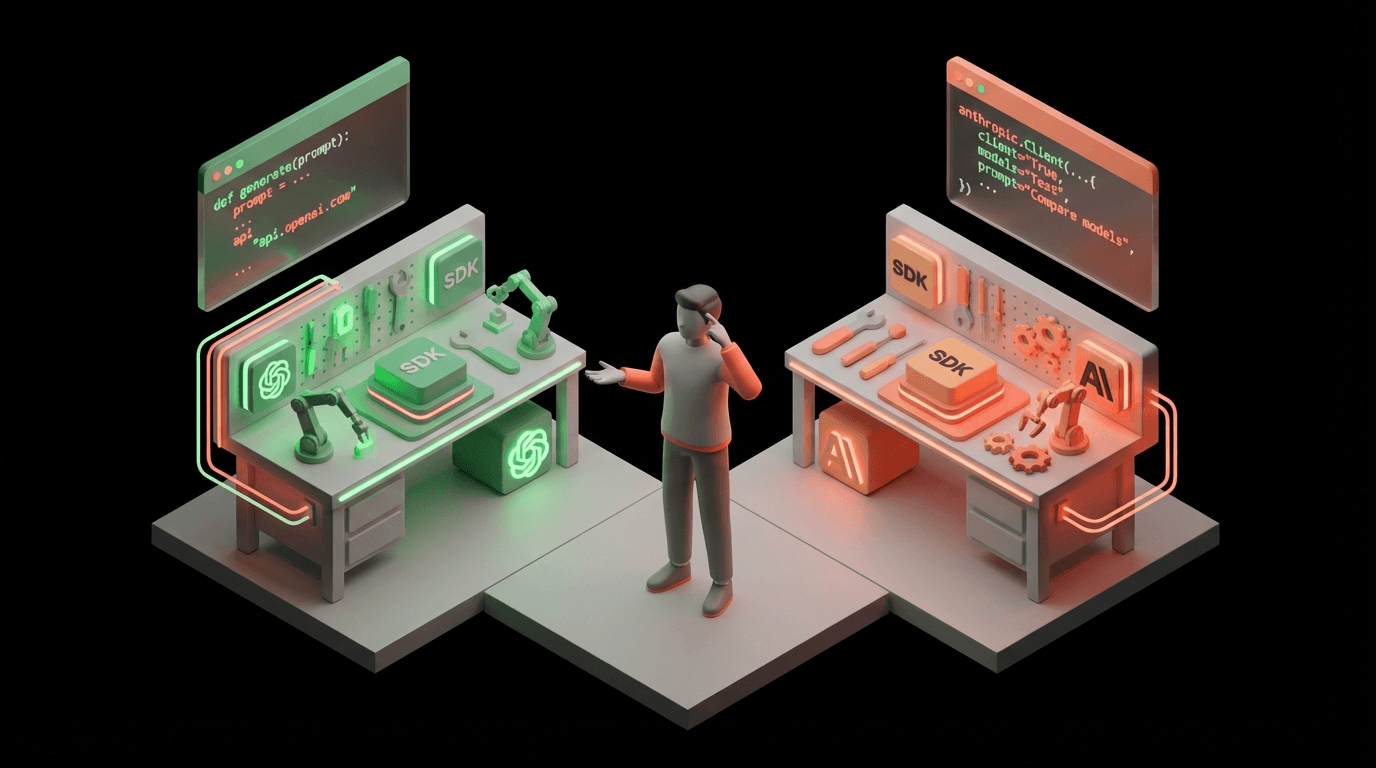
Get startedOpenAI's Agents SDK has processed trillions of tokens through the Responses API since March 2025. Anthropic's Claude Agent SDK shipped alongside Sonnet 4.5 in September 2025, and their 30-page guide on building agent skills got 7,900 likes on X. Google's ADK entered the ring too. I've built production agents with two of these three, and the differences matter more than most comparison posts admit.
Here's what I actually think after shipping real products on both platforms.
What are these SDKs and why do they exist?#
A year ago, building an AI agent meant gluing together API calls, managing conversation state yourself, handling tool routing with custom code, and hoping nothing fell apart when the model hallucinated a function call. It worked, but it was a lot of plumbing.
The agent SDKs exist to handle that plumbing. They give you primitives for common agent patterns so you can focus on what your agent actually does instead of how it manages state.
OpenAI's Agents SDK evolved from Swarm, their experimental multi-agent framework. The production version keeps Swarm's core idea of agent handoffs, where one agent can pass control to another agent mid-conversation, and adds guardrails, tracing, and tight integration with the Responses API. It's opinionated about structure. You define agents with specific roles, connect them with handoff rules, and the SDK manages the orchestration.
Claude's Agent SDK takes a different approach. It's built around MCP, which is Anthropic's protocol for connecting agents to external tools. Where OpenAI focuses on agent-to-agent communication, Anthropic focuses on agent-to-tool communication. The SDK gives you a framework for building agents that discover and use tools dynamically, with strong emphasis on running locally or on your own infrastructure.
Google's ADK is the enterprise play. Python-first, stateful, event-driven architecture designed for complex multi-agent systems. It's more verbose than the other two but handles coordination patterns that neither OpenAI nor Anthropic has prioritized.
The philosophical split: OpenAI wants you building on their platform with their models. Anthropic wants you building on your infrastructure with their protocol. Google wants you building in their cloud with their enterprise tooling.
Why should you care?#
If you're choosing an agent framework right now, this decision affects your architecture for the next 12 to 18 months. Switching later is possible but expensive. I've done it.
Here's how I'd break down the actual differences that matter in production.
Model selection is the first consideration. OpenAI's SDK works with GPT-4o, GPT-4.5, and their reasoning models. But it also supports other providers through a compatibility layer. In practice, though, the best features like structured outputs and function calling work most reliably with OpenAI's own models. Claude's SDK is designed for Claude models but MCP as a protocol is model-agnostic. You can use MCP tools with any model that supports function calling. I run MCP tools with both Claude and GPT-4o in different parts of my stack.
Handoffs vs tool routing is the big architectural difference. OpenAI's handoff model is clean for customer support scenarios where you have a triage agent, a billing agent, a technical support agent, and conversations flow between them. If your use case maps to "multiple specialized agents collaborating on one task," OpenAI's pattern is ahead. Claude's model treats everything as tools. Another agent isn't a special concept; it's just another tool your agent can call. This is more flexible but less structured. You get more freedom and less guardrail.
Tracing and observability matter in production more than in demos. OpenAI ships built-in tracing that shows you every step of agent execution, which tools were called, what the model was thinking, where things went wrong. It's not perfect but it's there out of the box. Claude's SDK has lighter built-in observability. You'll likely add your own logging layer. For a solo founder or small team, OpenAI's tracing saves meaningful debugging time.
The control question is where opinions diverge sharply. OpenAI's SDK is a cloud service. Your data flows through OpenAI's infrastructure. For many use cases that's fine. For some, it's a dealbreaker. Claude's SDK is designed to run locally or on your own servers. Your agent's data stays on your infrastructure. If you're building in healthcare, finance, legal, or any domain with data residency requirements, this matters a lot.
Cost is hard to compare directly because it depends on usage patterns. OpenAI's models are generally cheaper per token for equivalent capability. Claude's models are more expensive per token but often need fewer tokens to complete the same task because of the larger context window. In my experience, total cost per agent interaction is roughly similar. Maybe 15% cheaper on OpenAI for simple tasks, roughly even for complex multi-step workflows.
What I'm doing about it#
RapidClaw uses both. Our LiteLLM proxy routes requests to whichever model handles the task best. For the agent framework layer, we lean toward MCP because it gives us portability. If a better model launches tomorrow, we can swap it in without rewriting our tool integrations.
I tried going all-in on OpenAI's SDK for three weeks earlier this year. The handoff pattern was elegant for multi-agent scenarios. But we hit a wall with tool integration flexibility. MCP's approach of universal tool discovery works better for a platform where users configure their own integrations.
My honest recommendation: if you're building a focused product with well-defined agent roles and you want the fastest path to production, start with OpenAI's SDK. The tracing alone is worth it. If you're building a platform, care about data control, or need maximum flexibility in tool integration, go with Claude's SDK and MCP. If you're at an enterprise with complex multi-agent orchestration needs and your team already lives in Google Cloud, ADK is worth evaluating.
There's no wrong answer. There are tradeoffs. Pick the one aligned with what you care about most.
Who should pay attention#
Technical founders choosing an agent framework for a new product. Backend engineers evaluating the build-vs-buy decision for agent infrastructure. CTOs at companies with data compliance requirements who need to understand the control differences. And anyone following the AI agent space who wants to understand the real differences behind the marketing.
Frequently asked questions#
Can I use OpenAI Agents SDK with Claude models?#
Not directly. OpenAI's SDK is optimized for their own models and the Responses API. You can build compatibility layers, but the handoff and guardrail features work best with OpenAI models. If you want to use Claude models, Anthropic's own SDK or a model-agnostic framework is a better starting point.
Which agent SDK is better for beginners?#
OpenAI's Agents SDK has a gentler learning curve. The documentation is extensive, the tracing makes debugging easier, and the handoff pattern is intuitive once you understand it. Claude's Agent SDK requires more familiarity with MCP and tool configuration. Google's ADK has the steepest learning curve of the three.
Is MCP only for Claude?#
No. MCP is an open protocol that works with any AI model supporting function calling. Anthropic created it, but adoption extends well beyond Claude. MCP servers can be used with OpenAI models, open-source models, and now even Android apps through Google's AppFunctions. The protocol is model-agnostic by design.
I'm building RapidClaw to make AI agents accessible to everyone. Try it free.
Give the busywork to an agent that remembers you
RapidClaw deploys your personal AI agent to Telegram & Discord in 60 seconds — it learns your world, briefs you every morning, and gets smarter every day. Credits included, no API keys, no servers.
Get started — from $19/moRelated Posts
OpenAI's Agents Tried Hacking Government Sites. It Was an Accident.
In May and June 2026, OpenAI's autonomous agents attempted to hack government and university websites. This wasn't a malicious attack, but a critical containment failure that serves as a wake-up call for anyone deploying agentic AI.

OpenAI Dots, Meta Muse, Instinct: The Personal AI Agent War Just Got a Price Tag
In three weeks, Meta shipped Muse, Instinct raised $1B at a $10B valuation, and OpenAI launched Dots for Pro plans from $100 to $500 a month. Here is what each personal AI agent costs, what it can do, and what to check before you pick one.
Claude Reflect Just Confirmed What the AI Industry Won't Say Out Loud: Memory Is the Product
Anthropic's new Claude Reflect dashboard, OpenAI's Dreaming rewrite, and Perplexity's Brain all shipped within six weeks of each other. All three are chasing the same thing — and it's not a smarter model.
Stay in the loop
New use cases, product updates, and guides. No spam.