
Agent Memory Across Sessions Is the Feature Nobody Talks About
Most AI agents forget everything when a session ends. The ones that don't are quietly becoming indispensable. Here's why persistent memory changes everything.

Reading about AI agents? RapidClaw gives you one that lives in Telegram & Discord, remembers everything, and runs your day — live in 60s, from $19/mo.
Get startedI saw a comment on Reddit last week that stopped me mid-scroll: "Agent memory across web sessions is the silent killer nobody mentions." It had maybe 40 upvotes. No replies. Just sitting there, quietly correct, while thousands of people argued about which LLM writes better code.
That comment nailed something I've been thinking about for months. We're all obsessing over model benchmarks and token limits and which AI passes the bar exam, but the actual reason most AI tools feel disposable is much simpler: they forget you exist the moment you close the tab.
The session boundary problem#
Here's what happens every single day to millions of people using ChatGPT, Claude, Gemini, or any other chat-based AI tool.
You open a new conversation. You spend 5 minutes explaining who you are, what your business does, what tone you write in, what project you're working on, what you tried last time that didn't work. The AI gives you a great response. You close the tab. Tomorrow, you do it again. From scratch. The AI has no idea you were ever there.
I ran a ChatGPT Plus subscription for 14 months. In that time, I estimate I spent over 200 hours just on context-loading. Not prompting. Not reviewing output. Just re-explaining the same background information that the AI should have already known because I told it yesterday.
That's not a productivity tool. That's a very expensive notepad with amnesia.
The "memory" features that OpenAI and Anthropic have added are band-aids. ChatGPT's memory stores maybe a dozen facts about you. "User prefers concise responses." "User works in fintech." That's not memory. That's a sticky note on a monitor. It doesn't remember the 47-message conversation you had last Tuesday about restructuring your onboarding flow, the decisions you made, the options you rejected, or why.

What persistent context actually means#
A persistent agent is fundamentally different from a chat tool. It's not just "chat with memory bolted on." The architecture is different.
A persistent agent maintains state. It knows your documents, your preferences, your ongoing projects, your past decisions. When you come back after a weekend, it picks up exactly where you left off. Not because it stored a few keywords about you. Because your entire operational context is part of its permanent working memory.
Think about the difference between a coworker you've worked with for six months versus a contractor you hired five minutes ago. The coworker knows your codebase, your deadlines, your communication style, the failed experiment from last quarter that you don't want to repeat. The contractor needs a 30-minute briefing before they can do anything useful.
Chat-based AI is the contractor. Every single time.
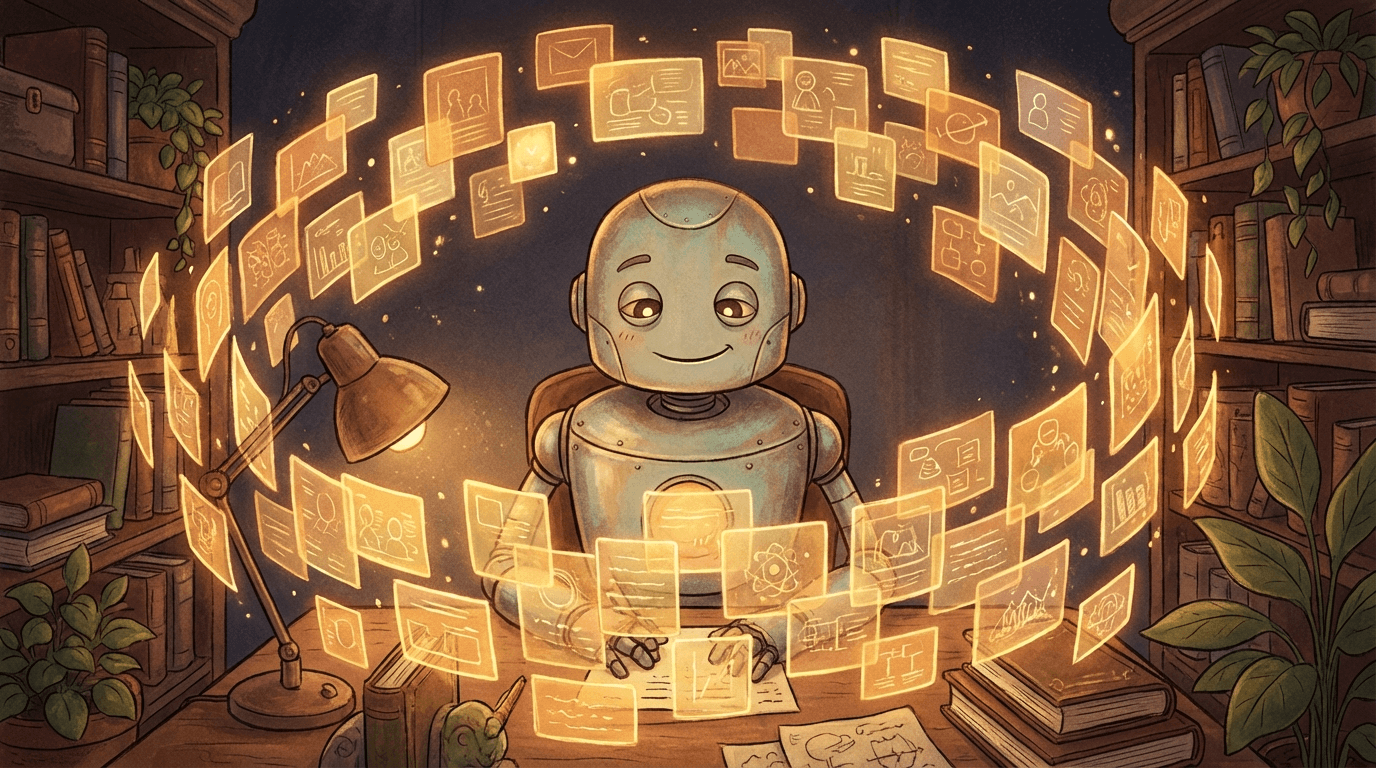
Persistent agents are the coworker. They accumulate knowledge. They get better the longer you use them. The tenth interaction is dramatically more useful than the first because the agent has context from interactions one through nine.
This is why people who switch from chat-based AI to persistent agents almost never switch back. The productivity difference isn't incremental. It's a category change.
The workflows that break without memory#
Some tasks are fine as one-shot conversations. "Summarize this article." "Write a regex for email validation." Those don't need memory. You ask, you get an answer, you move on.
But most real work isn't like that. Real work is iterative, contextual, and builds on itself over days and weeks.
Content creation. You're writing a series of blog posts for a product launch. Each post needs to reference the same product features, the same competitive positioning, the same brand voice. Without persistent memory, you're re-establishing all of that context for every single post. With it, you just say "next post in the series, focus on the integration API" and the agent already knows everything else.
Project management. You're coordinating a product rollout across multiple teams. The agent that remembers last week's standup notes, the blockers you identified, the decisions that got made in the meantime, that agent can actually help you prepare for this week's standup. A session-based chat tool can't do any of that without you manually feeding it everything again.
Customer support. A customer writes in about a problem they reported two weeks ago. A persistent agent that handled the first interaction can pick up the thread. A session-based tool needs you to paste in the entire ticket history.
Sales follow-ups. You had a discovery call with a prospect three days ago. Your persistent agent was there (or you fed it the notes). Now it can draft the follow-up email with specific references to what the prospect cared about. No context dump required.
The pattern is obvious: anything that spans more than one sitting breaks in a session-based model.
Why this is the real moat#
The AI industry is converging on capability. GPT-4o, Claude Sonnet, Gemini Pro, they're all good enough for most tasks. The raw intelligence of the model matters less than people think. What matters is whether the model knows enough about your specific situation to give you a useful answer without a 10-minute preamble.
Persistent context is the multiplier. A slightly less capable model with perfect context will outperform a frontier model with zero context, every single time. I've seen this firsthand. My always-on agent running a mid-tier model produces better outputs for my specific work than GPT-4o in a fresh conversation, because the context gap is just that large.
This is also why the "which AI is best" debate misses the point. The best AI is the one that already knows what you're working on.
The shift is already happening#
People aren't talking about this much yet because the tooling is still early. Most people's mental model of AI is "chatbot I talk to in a browser tab." But the people who've made the switch to persistent, always-on agents are quietly getting 3-5x more value from AI than everyone else.
It's not a hype thing. There's no viral tweet about it. It's just people in niche communities and subreddits saying things like "I can't go back to regular ChatGPT" and nobody asks them to elaborate.
The elaboration is simple: their agent remembers.
Where this is going#
Within a year, session-based AI interactions will feel as primitive as clearing your browser cookies after every website visit. The whole point of a digital tool is that it accumulates context and gets more useful over time. AI tools that reset to zero after every conversation are fighting against the most basic principle of useful software.
The agents that win won't be the ones with the highest benchmark scores. They'll be the ones that know you well enough to be useful without being asked to catch up first.
Frequently asked questions#
What is persistent memory in AI agents?#
Persistent memory means the agent retains everything you've told it across sessions — your documents, preferences, project context, and past conversations. Unlike chat-based AI tools that reset when you close the tab, a persistent agent picks up exactly where you left off. This accumulated context makes every interaction more useful than the last.
How is agent memory different from ChatGPT's memory feature?#
ChatGPT's memory stores a small number of facts about you, like your name and job title. A persistent agent stores your full operational context: ongoing projects, past decisions, rejected options, document contents, and conversation history spanning weeks or months. The difference is a sticky note versus a six-month working relationship with a colleague who knows everything about your work.
Do AI agents with persistent memory get better over time?#
Yes. The more you interact with a persistent agent, the more context it accumulates about your work, preferences, and patterns. By the tenth interaction, the agent produces significantly better outputs than it did on day one because it draws on everything from interactions one through nine. This compounding effect is why users who switch to persistent agents rarely go back to session-based chat tools.
RapidClaw agents maintain persistent context across sessions by design. Your agent remembers your documents, your preferences, and every conversation you've had with it. No re-explaining. No context dumps. It just knows. Try it free.
Give the busywork to an agent that remembers you
RapidClaw deploys your personal AI agent to Telegram & Discord in 60 seconds — it learns your world, briefs you every morning, and gets smarter every day. Credits included, no API keys, no servers.
Get started — from $19/moRelated Posts

OpenClaw 2026.4.9 'Dreaming' Feature: Your AI Agent Now Consolidates Memory While You Sleep
OpenClaw v2026.4.9 introduces Dreaming — a memory consolidation system where your AI agent replays the day's interactions overnight and decides what to remember permanently. Here's how it works.

Brave Search Just Became the Default Brain for 700,000 AI Agents. Google Wasn't Even in the Running.
700,000 OpenClaw agents now use Brave Search by default. Not Google. Not Bing. The search engine market is being rewritten by AI agents.

OpenClaw's 9 CVEs in 4 Days: The Security Reckoning the Agent Ecosystem Wasn't Ready For
Between March 18-21, nine CVEs dropped for OpenClaw in four days. One scored CVSS 9.9. Over 220,000 internet-facing instances were exposed. Here's what happened.
Stay in the loop
New use cases, product updates, and guides. No spam.