
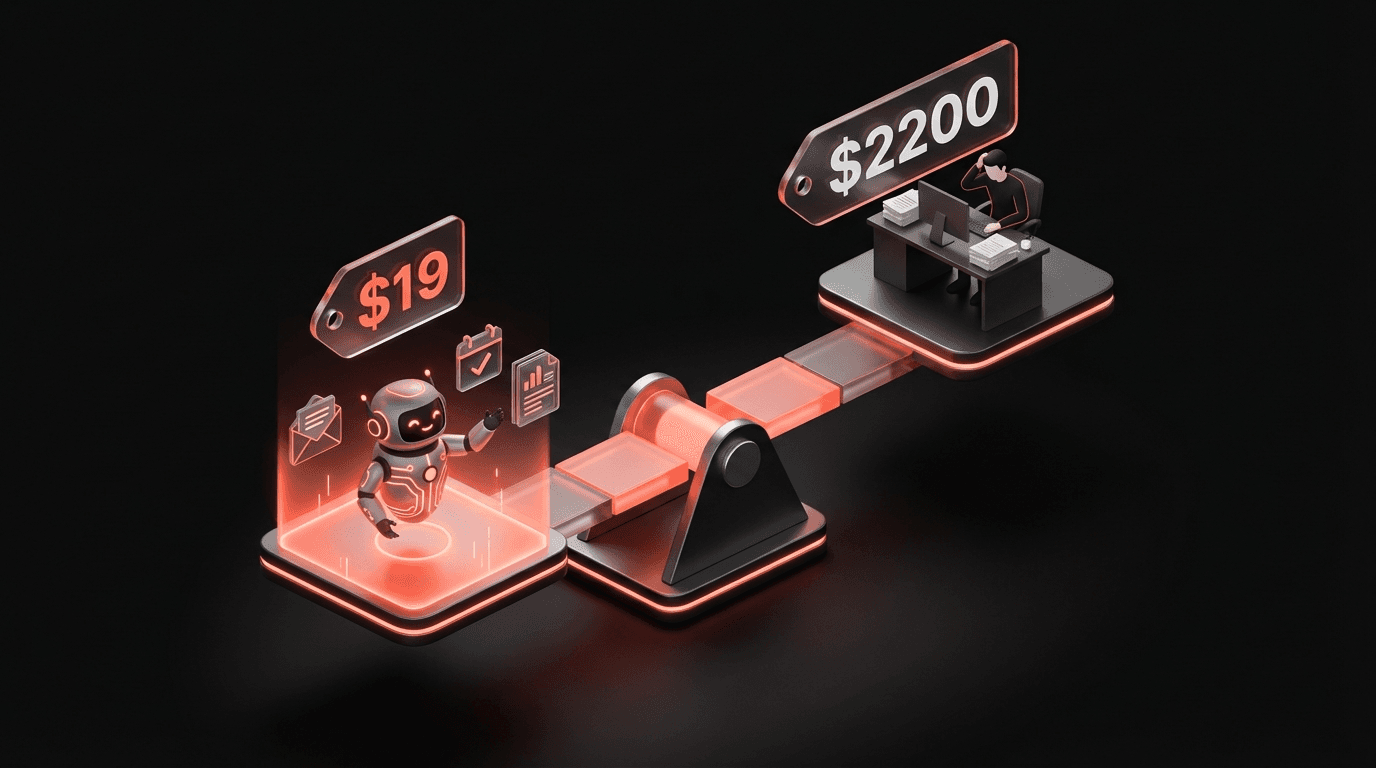
The $19/Month AI Employee That Replaced My $2,200/Month VA
A content creator compares his $2,200/month virtual assistant with a $19/month AI agent. Task-by-task breakdown of what works, what doesn't, and net savings.
Reading about AI agents? RapidClaw gives you one that lives in Telegram & Discord, remembers everything, and runs your day — live in 60s, from $19/mo.
Get startedI was on a call with my accountant in January when she pointed at a line item and said "you're spending $26,400 a year on a virtual assistant?" And I said yes. And she said "is that... necessary?" And I didn't have a good answer.
My VA, Sandra, was great. She'd been with me for 14 months. She handled my email, managed my calendar, researched topics for my videos, monitored YouTube comments, and compiled my weekly analytics reports. She worked 20 hours a week at $27.50/hour, which came to about $2,200/month.
The thing is, when I actually listed out Sandra's tasks, most of them were sorting, filtering, and summarizing. The kind of work that AI agents are genuinely good at. So I ran an experiment.
I'm not proud of how the experiment started. I should have been more thoughtful about it. Instead I basically set up a RapidClaw agent on a Saturday afternoon and started redirecting tasks to it without much of a plan.
The first month was a mess.
The task-by-task comparison#
I make YouTube videos about personal finance (122K subscribers as of last week). Here's what my daily workflow looked like with Sandra, and how the AI agent compares.
Email triage. I get about 90-110 emails per day. Sponsorship inquiries, collaboration requests, viewer questions, newsletters, invoices, and noise. Sandra would sort these into folders and flag the ones I needed to respond to personally. Maybe 8-12 per day needed me.
The AI agent does this better than Sandra did. I'm not being mean, it's just true. It reads every email, categorizes it correctly about 96% of the time, drafts responses for the routine ones (invoice acknowledgments, sponsor inquiry templates, "thanks but no thanks" for pitches that don't fit my channel), and sends me a morning summary on Telegram with only the emails that need my personal attention.
Time saved: about the same as Sandra. Quality: slightly better because it never miscategorizes a sponsor email as spam (Sandra did this twice and I lost a $3,500 deal once because of it).
Calendar management. Sandra handled scheduling for podcast appearances, brand calls, and recording sessions. The AI agent handles this through a Calendly integration. Not quite as flexible as a human who can email back and forth negotiating times, but for 90% of scheduling requests, it works fine. I still handle the "can we move this to Thursday instead" back-and-forth myself.
Research. This was Sandra's best skill. I'd say "I'm doing a video about index fund tax efficiency" and she'd compile 3-4 pages of notes with sources, stats, and opposing viewpoints. Takes her about 3-4 hours.
The AI agent does research too, but differently. It's faster (gives me a summary in minutes, not hours) but less opinionated. Sandra would highlight the most interesting angle for a video. The agent gives me comprehensive information and lets me find the angle. Different workflow. Neither is strictly better, but I miss Sandra's editorial instinct here.
Comment monitoring. I get 200-400 comments per day across my videos. Sandra would read through them, flag questions I should answer, delete spam, and alert me to anything negative that needed a response.
The agent handles this beautifully. It runs through comments every 4 hours, responds to common questions with pinned-comment-style answers, flags hateful or abusive comments for removal, and sends me a digest of the best questions and most engaged threads. This is probably where the AI agent's advantage is biggest. Sandra could spend 2 hours on comments daily. The agent does it in the background continuously.
Weekly analytics. Every Monday, Sandra would pull numbers from YouTube Studio, my email platform, and my Gumroad, then compile a one-page summary with week-over-week trends.
The agent does this automatically now. The report shows up in my Telegram every Monday at 8am. It's more detailed than what Sandra produced because the agent doesn't get bored of pulling numbers. It includes things Sandra never bothered with, like average comment sentiment per video and which topics generated the most subscriber growth.
The first month disaster#
I need to be honest about this. The first month was bad.
I set up the agent without really training it on my voice. The email responses it drafted sounded corporate and stiff. One sponsor replied asking if I'd hired a new manager because the tone was so different from my usual emails. Embarrassing.
The comment responses were too generic. Instead of the casual, first-name-basis tone I use with my audience, the agent was writing things like "Thank you for your insightful comment. I appreciate your engagement." My viewers could smell the bot immediately. I got DMs asking if I was okay.
It took about 3 weeks of tweaking the agent's instructions, feeding it examples of my writing style, and adjusting the tone parameters before it started sounding like me. During those 3 weeks, I was doing more work than before because I was editing everything the agent produced AND configuring the agent at the same time.
Month two was better. Month three was good. Now in month four, I barely touch most of the agent's output.
What the agent cannot do#
Creative judgment. Full stop. When a brand emails me a collab proposal, Sandra could read between the lines and tell me "this feels sketchy, their engagement numbers don't match their follower count." The agent just summarizes the offer.
Relationship nuance. Some of my YouTube friends email casually and the tone matters. The agent doesn't know that when FilmBoy84 emails me, I should respond within the hour because he's a close friend, not just another creator requesting a collab.
Proactive problem-solving. Sandra once noticed that a scheduled recording conflicted with a dentist appointment I'd mentioned in passing on a call. The agent doesn't listen to calls and doesn't know I have a dentist.
For these things, I still hire Sandra. But instead of 20 hours a week, she works 5. We have a weekly call where she handles the human-judgment stuff that the agent can't touch. She picks up relationship management, vets brand deals, and handles anything that requires reading a room.
She was gracious about the change. I was honest with her about what I was doing and why. She now has three other clients filling the hours she lost from me.
The math#
Before: Sandra at 20 hours/week = $2,200/month
After: RapidClaw agent at $19/month + Sandra at 5 hours/week ($550/month) = $569/month
Net savings: $1,631/month. That's $19,572 per year.
I'm getting equal or better output on 4 out of 5 task categories. The one category where Sandra is still better (creative research), I'm paying her specifically for.
Who this won't work for#
If your VA's job is primarily creative, strategic, or relationship-driven, an AI agent won't replace them. If your VA coordinates events, manages a team, or needs to make phone calls, keep your VA.
But if you're paying $2,000+ per month for someone to sort emails, compile reports, and monitor comments? You're overpaying for pattern recognition. That's what AI does best.
I'm not saying fire your VA. I'm saying look at their task list. Highlight everything that's essentially "read input, apply rules, produce output." If that's more than half the list, you have a conversation to have.
It might be uncomfortable. It was for me. But $19,572 per year bought a lot of comfort afterward.
Frequently asked questions#
Can an AI agent fully replace a virtual assistant?#
Not entirely. AI agents excel at pattern-based tasks like email triage, comment monitoring, and analytics reporting — tasks that follow "read input, apply rules, produce output" logic. But they struggle with creative judgment, relationship nuance, and proactive problem-solving that requires human context. The best approach is often a hybrid: use the agent for routine tasks and keep a VA for reduced hours handling the human-judgment work.
How long does it take to train an AI agent to match your communication style?#
Expect about three weeks of active tuning. The first month is typically rough — the agent's drafts will sound corporate and generic until you feed it examples of your writing style, adjust tone parameters, and correct its outputs. By month two, the quality improves noticeably. By month three or four, most outputs require minimal editing.
How much money can you save by replacing a VA with an AI agent?#
Savings depend on your VA's hours and rate. In this case, a $2,200/month VA (20 hours/week at $27.50/hour) was reduced to 5 hours/week ($550/month), with a $19/month AI agent handling the remaining tasks. Net savings were $1,631/month or $19,572/year, while maintaining equal or better output on 4 out of 5 task categories.
Give the busywork to an agent that remembers you
RapidClaw deploys your personal AI agent to Telegram & Discord in 60 seconds — it learns your world, briefs you every morning, and gets smarter every day. Credits included, no API keys, no servers.
Get started — from $19/moRelated Posts
320 Million People Use Microsoft Teams Every Day. I Built an AI Colony Inside It.
The average worker gets 153 messages and spends 57% of their week just communicating. AntHive deploys a colony of specialized AI agents directly inside Microsoft Teams to take back your day.

68% of Small Businesses Use AI but Most Are Winging It
Two-thirds of small businesses use AI regularly. Fewer than a quarter have a strategy. The gap between adoption and structure is where the real opportunity lives.

Agent Memory Across Sessions Is the Feature Nobody Talks About
Most AI agents forget everything when a session ends. The ones that don't are quietly becoming indispensable. Here's why persistent memory changes everything.
Stay in the loop
New use cases, product updates, and guides. No spam.