
MCP vs A2A: Which AI Agent Protocol Actually Matters
MCP vs A2A protocol explained for builders. One connects agents to tools, one connects agents to each other. Here's which matters more in 2026.
Reading about AI agents? RapidClaw gives you one that lives in Telegram & Discord, remembers everything, and runs your day — live in 60s, from $19/mo.
Get startedThere are two protocols fighting to become the HTTP of AI agents. One is MCP, made by Anthropic. The other is A2A, made by Google. If you're building anything with AI agents right now and you're ignoring both of them, you're going to have a bad year.
Here's the thing most people get wrong: they're not competing. They solve completely different problems. And as of December 2025, they're both under the same roof.
What are MCP and A2A, and why do they exist?#
Let me make this simple because the discourse around these protocols has gotten unnecessarily complicated.
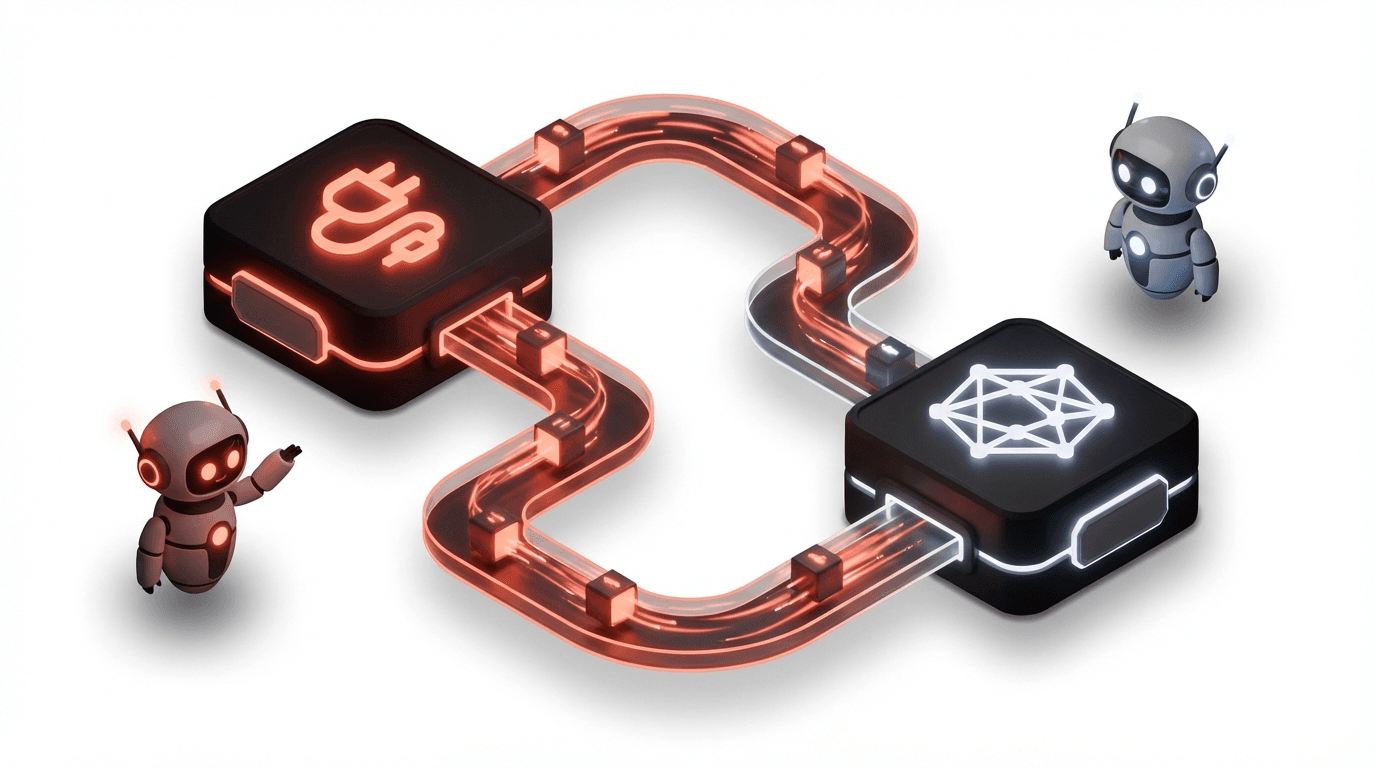
MCP stands for Model Context Protocol. Anthropic built it. It standardizes how an AI agent connects to external tools, databases, and APIs. Think of it as a universal adapter. Before MCP, every time you wanted your agent to talk to a new tool, you had to write custom integration code. MCP gives you a single protocol that works across tools. Your agent speaks MCP, the tool speaks MCP, they understand each other. Done.
A2A stands for Agent-to-Agent protocol. Google built it. It handles communication between agents. Not agent-to-tool, but agent-to-agent. When you have a research agent that needs to hand off work to a writing agent, that handoff needs a protocol. That's A2A.
Here's a rough analogy. MCP is like USB. It lets your computer connect to any peripheral. A2A is like a network protocol. It lets computers talk to each other. You need both, but they do different things.
In December 2025, the Linux Foundation launched the Agentic AI Foundation (AAIF) with OpenAI, Anthropic, Google, Microsoft, AWS, and Block as co-founders. Both MCP and A2A are now under this umbrella. That's significant. It means the industry decided to collaborate on standards instead of fragmenting into incompatible ecosystems. For once.
The MCP spec recently added a "tasks" concept that enables long-running async capabilities. Before this, MCP was mostly synchronous. Your agent calls a tool, waits for a response. Now an agent can kick off a task that takes minutes or hours and get notified when it finishes. This is a big deal for real-world workflows where you're processing large datasets, running complex searches, or waiting on external systems.
Gartner predicts that the majority of API gateway vendors will incorporate MCP by end of 2026. That tells you where the momentum is.
I want to be clear about what "majority of API gateway vendors" means in practice. API gateways are the front door to every company's backend services. When those gateways speak MCP natively, every AI agent gets instant access to the services behind them. We're talking about a world where your agent can interact with any company's APIs through a standard protocol, the same way your browser can load any website through HTTP. That's the scale of change -- and it's coming faster than most people expect.
Why should you care?#
If you're a founder or builder working with AI agents, these protocols determine what your agents can do and how easily they can do it.
Before MCP, integrating a new tool into your agent stack meant days of work. You had to read API docs, handle authentication, manage error states, format inputs and outputs. Now you install an MCP server for that tool and your agent can use it immediately. The number of available MCP servers has exploded. There are hundreds covering everything from GitHub to Slack to databases to file systems. This is the composability layer that was missing.
I think MCP matters more than A2A right now for most builders. Here's my reasoning. Most people building agents today have one agent that needs to connect to many tools. That's the MCP use case. The A2A use case (multiple agents coordinating on complex tasks) is real, but it's a later-stage problem. You need your agents working individually before you need them working together.
That said, I see A2A becoming more relevant fast. The moment you have more than 3 agents in your system, you need some way for them to coordinate without routing everything through a central orchestrator. A2A gives you that. The early adopters of A2A are enterprise teams running agent swarms for things like supply chain optimization and multi-step customer service flows.
One thing that concerns me is vendor lock-in risk. Even with AAIF governance, the implementations still vary. An MCP server built for Claude might work differently than one built for GPT. The spec is standard but the ecosystem is young. I've hit compatibility issues firsthand.
The practical takeaway: if you're building agents today, learn MCP. Make sure your tool integrations use it. When you start running multi-agent systems, add A2A. Don't try to adopt both at once.
I'll add one more thing. The developer experience gap between these two protocols is real. MCP has better docs, more examples, and a larger community. A2A's documentation is thinner and the reference implementations are fewer. This matters when you're a small team making a bet on which protocol to invest in first. Go where the community already is.
What I'm doing about it#
At RapidClaw, we adopted MCP early. Every tool integration in our platform speaks MCP natively. When you connect a Notion workspace or a Google Calendar to your agent, that connection uses the MCP protocol under the hood. You don't have to think about it, but it means your agent can use any MCP-compatible tool without custom code.
We're watching A2A closely. I'm experimenting with multi-agent workflows where a research agent passes findings to a writing agent, which passes drafts to a review agent. Right now I'm handling that coordination in application code, but as A2A matures, I plan to move that layer to the protocol.
Honestly, the AAIF governance structure gives me more confidence than anything else. Having all the major players agree on standards is rare in tech. It usually means the standards will actually stick.
Who should pay attention#
Backend developers building agent integrations. Founders shipping AI products who want their tools to work with the growing agent ecosystem. Platform engineers evaluating which standards to adopt before committing to an architecture. If you're in any of those categories, spend an afternoon reading both specs. The MCP spec in particular is well-written and practical.
Even if you're not building agents yourself, understanding these protocols helps you evaluate tools. When someone tells you their platform "supports MCP," you'll know what that actually means and what questions to ask.
Frequently asked questions#
Is MCP only for Anthropic's Claude?#
No. MCP started at Anthropic but it's now an open standard under the Linux Foundation's AAIF. OpenAI, Google, Microsoft, and AWS are all co-founders. You can use MCP with any LLM. The protocol is model-agnostic.
Do I need both MCP and A2A?#
Most builders need MCP first. It handles the more common case of connecting agents to tools and data sources. A2A becomes relevant when you're running multiple agents that need to coordinate. Start with MCP, add A2A when your architecture demands it.
Will one protocol win over the other?#
They're not competing. They solve different problems. MCP handles agent-to-tool connections. A2A handles agent-to-agent communication. The fact that both are under AAIF governance suggests the industry sees them as complementary, not rivals.
I'm building RapidClaw to make AI agents accessible to everyone. Try it free.
Give the busywork to an agent that remembers you
RapidClaw deploys your personal AI agent to Telegram & Discord in 60 seconds — it learns your world, briefs you every morning, and gets smarter every day. Credits included, no API keys, no servers.
Get started — from $19/moRelated Posts

30 CVEs in 60 Days: The MCP Security Crisis Nobody Secured Before Shipping
38% of MCP servers have zero authentication. 7,000+ servers analyzed, CVSS 9.8 exploits in the wild. The protocol connecting AI agents to your tools was built for functionality, not security.
Google's MCP for Android Means Your Phone Apps Talk to AI Now
Google announced MCP for Android via AppFunctions, letting AI agents discover and control your phone apps. Here's why this changes mobile AI workflows.

OpenAI's Agents Tried Hacking Government Sites. It Was an Accident.
In May and June 2026, OpenAI's autonomous agents attempted to hack government and university websites. This wasn't a malicious attack, but a critical containment failure that serves as a wake-up call for anyone deploying agentic AI.
Stay in the loop
New use cases, product updates, and guides. No spam.