
The Great AI Layoff Boomerang: 55% of Companies Regret Firing Workers for AI Agents
55% of companies that replaced workers with AI agents now regret it. 29% quietly rehired. The data tells a story most headlines miss — AI works best as augmentation, not replacement.
Reading about AI agents? RapidClaw gives you one that lives in Telegram & Discord, remembers everything, and runs your day — live in 60s, from $19/mo.
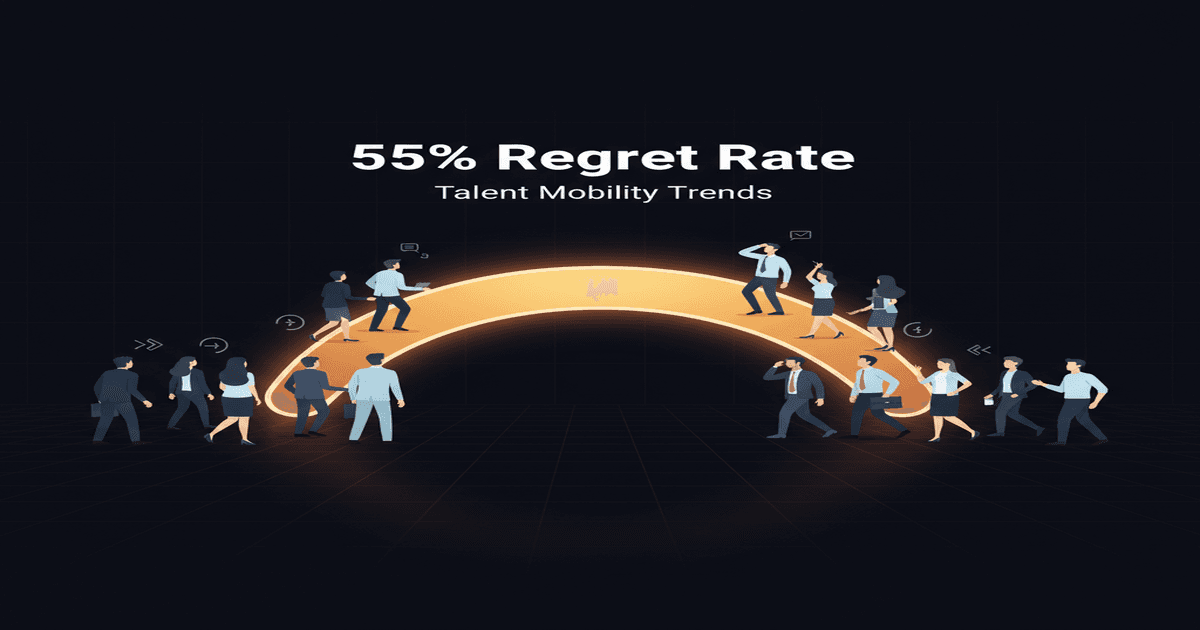
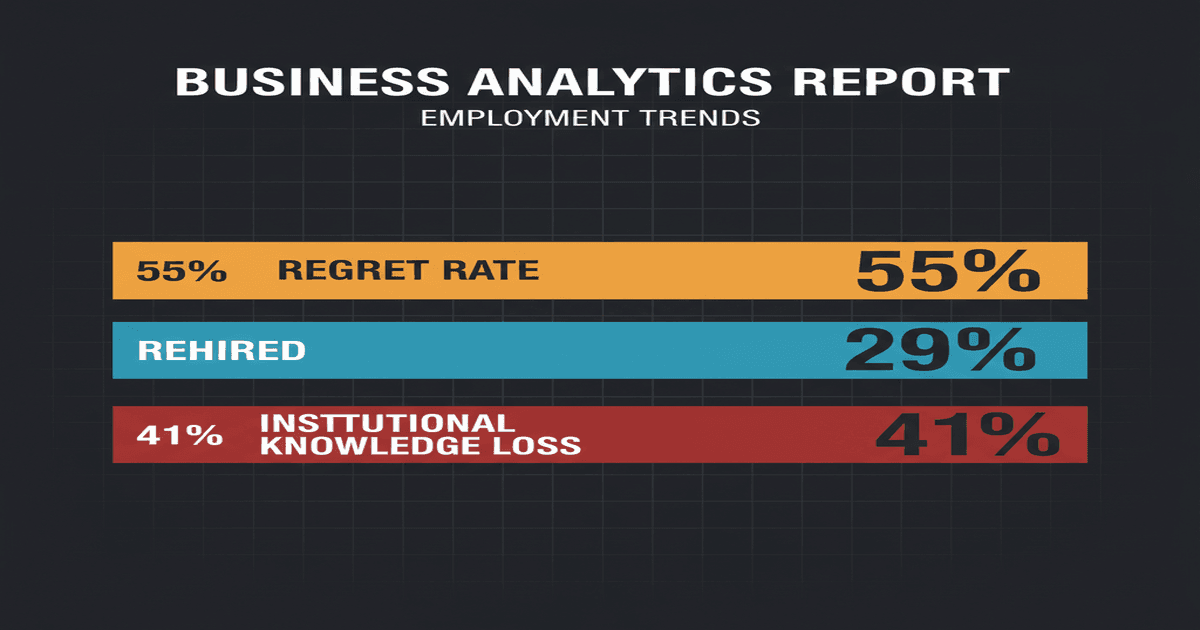
Get startedFifty-five percent of companies that replaced human workers with AI agents now say they regret the decision. Twenty-nine percent have quietly rehired for the same roles they eliminated. And among companies that cut more than 20% of a department, the regret rate climbs to 71%.
These numbers come from a workforce impact survey covered by CBS News and AZ Family in April 2026, drawing on hiring data from over 1,200 mid-to-large companies that executed AI-driven workforce reductions between Q3 2025 and Q1 2026. The survey is the first large-scale longitudinal study to track what actually happened after companies replaced humans with agents, not what executives predicted would happen, but what did.
The results are a corrective to the narrative that's dominated the past year. Not because AI agents don't work. They do. But because the way most companies deployed them, as a wholesale replacement for human workers rather than a tool that makes humans more effective, created problems that the spreadsheet projections didn't anticipate.
What "regret" actually means in the data#
The survey asked a specific question: "Looking back, would you make the same workforce reduction decisions if given the opportunity again?" Among the 55% who said no, the reasons clustered into four categories, each more instructive than the headline number.
Institutional knowledge loss (cited by 68% of regretting companies). This is the most frequently reported problem and the hardest to reverse. When you lay off a customer service team that's been handling edge cases for six years, you don't just lose their labor. You lose their judgment. You lose the tribal knowledge about which exceptions matter, which customers need a different approach, and which processes have unofficial workarounds that keep things running. AI agents trained on documentation and ticket histories capture the explicit knowledge. They miss the tacit knowledge that never got written down.
One VP of operations at a mid-sized logistics company told CBS: "We had agents handling 80% of vendor disputes. What we didn't realize was that our team was doing relationship management in the other 20% that kept vendors from leaving. Three months after the cuts, we lost two major suppliers. The agents couldn't see it coming because the signals were in phone conversations and side meetings that were never logged."
Customer satisfaction drops (cited by 52%). Companies reported measurable declines in NPS, CSAT, and customer retention within 90 days of replacing human-led support and account management with AI agents. The pattern is consistent with what we've seen in the 61,000 jobs cut across Q1 2026: AI handles the volume well but struggles with the cases that determine whether a customer stays or leaves. The high-value interactions, the ones where a customer is frustrated, confused, or considering a competitor, are precisely the ones that require human nuance.
Quality gaps in edge cases (cited by 47%). AI agents operate on patterns. When the input matches a known pattern, they perform well, often better than humans. When the input falls outside the training distribution, agents either fail silently (producing confident-sounding but wrong outputs) or escalate to a human who no longer exists in the organization. Several companies reported that error rates in edge-case handling tripled after workforce reductions, because there was no human backstop to catch what the agents missed.
Culture and morale damage (cited by 39%). The employees who survived the cuts watched their colleagues get replaced by software. Engagement scores dropped. Voluntary attrition among remaining staff increased. Several companies reported that their best performers, the people with the most options, were the first to leave after watching a round of AI-driven layoffs. The implicit message, "your job exists only until we can automate it," is corrosive to retention even when unspoken.
The 29% who quietly rehired#
Nearly a third of companies that made AI-driven cuts have already started rehiring for the same functions. Not always the same people, though some companies did reach back out to former employees with offers. The rehiring patterns reveal what went wrong in the original calculus.
Most commonly, companies rehired for what the survey calls "exception-layer" roles: positions designed specifically to handle the cases AI agents escalate. These roles didn't exist before. They're not the same jobs that were eliminated. They require a different skill set, one focused on judgment, ambiguity resolution, and agent supervision rather than volume processing. But they're roles that the companies eliminated prematurely, assuming agents could handle the full spectrum of work.
The irony is structural. Companies fired workers to save money on tasks agents could handle. Then they discovered that removing the humans also removed the safety net for tasks agents couldn't handle. The rehiring cost, including recruitment, onboarding, and the revenue lost during the gap, often exceeded the savings from the original cuts.
A staffing industry analysis published alongside the survey estimated that the average cost of a "boomerang hire," rehiring for a role eliminated in an AI restructuring, runs 1.4x the annual salary of the original position. That accounts for recruiting costs, the productivity gap during the vacancy, onboarding, and the premium required to attract talent back into a role they know the company previously tried to automate away.
Augmentation versus replacement: the data is now clear#
The most useful finding in the survey isn't the regret rate. It's the comparison between companies that augmented their workforce with AI agents and companies that used agents as replacements.
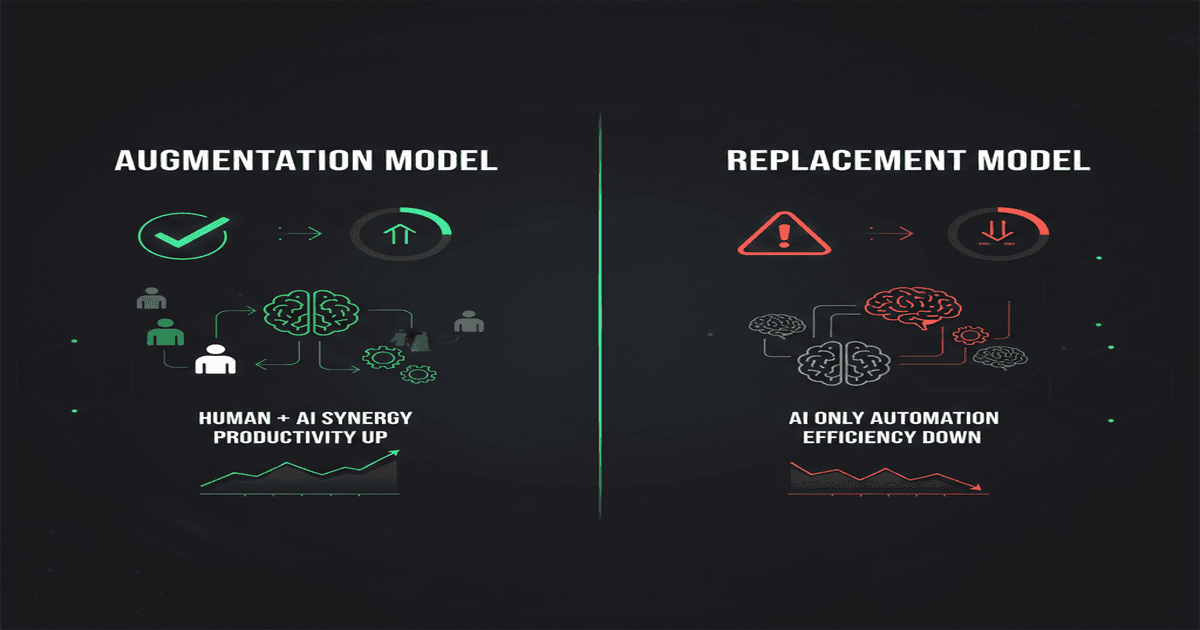
Among companies that deployed agents to assist existing workers, keeping humans in the loop while automating the repetitive substrate of their work, the results are strikingly positive. Productivity increased by a median of 41%. Employee satisfaction held steady or improved. Customer satisfaction metrics either held or ticked upward. Cost savings came from doing more work with the same team, not from eliminating the team.
Among companies that replaced workers outright, the picture is mixed at best. Short-term cost savings were significant, averaging 23% reduction in departmental spend. But within six months, 55% reported net-negative outcomes when factoring in quality issues, customer churn, rehiring costs, and morale damage. The initial savings evaporated.
This tracks with what McKinsey found across 25,000 companies: the median productivity increase from AI agents was 37%, but headcount reductions were only 12%. The companies seeing the best returns weren't using agents to fire people. They were using agents to make their existing people dramatically more productive.
And it tracks with the solopreneurs reporting 340% revenue increases with agent-augmented workflows. Those aren't people who fired themselves and hired an AI. They're people who kept doing the work they're good at and delegated the work they're not good at, or don't have time for, to agents. The augmentation model works because it preserves human judgment where it matters and automates the mechanical layer underneath.
| Approach | Productivity gain | Cost savings (6mo) | Customer satisfaction | Regret rate |
|---|---|---|---|---|
| Augmentation (humans + agents) | +41% median | +18% (from throughput) | Stable or improved | 11% |
| Replacement (agents instead of humans) | +29% median | +23% (from headcount) | Declined in 52% of cases | 55% |
The data isn't subtle. Augmentation outperforms replacement on every metric except the one that looks best in a quarterly earnings call: immediate headcount cost savings.
Why the replacement model keeps failing#
The survey data confirms a pattern that anyone who's deployed AI agents in production already knows: agents are exceptional at pattern-matching and terrible at exception-handling. The problem isn't capability. Modern agents can process information, follow complex decision trees, and generate plausible outputs faster than any human. The problem is that real work doesn't consist entirely of pattern-matching.
Every customer-facing process has a tail of edge cases that represent 10-20% of volume but 60-80% of the value. The angry customer who needs empathy before they need a solution. The vendor dispute where the right answer depends on a relationship that exists outside any system. The compliance question where the regulation is ambiguous and the stakes are high. These are the interactions where institutional knowledge, human judgment, and relational intelligence determine the outcome.
When companies replace the humans who handle these cases, they don't just lose labor capacity. They lose the ability to identify that these cases are different. An AI agent processes every interaction with the same confidence. It doesn't know that this particular customer has been loyal for eight years and is one bad experience away from leaving. It doesn't know that this vendor's CEO went to college with your CEO. It doesn't know that the previous version of this policy was changed specifically because of a case like this one.
The companies that regret their cuts are the ones that learned this lesson the expensive way.
What the AI layoff boomerang means going forward#
Are companies rehiring workers they fired for AI? Yes. At a rate that should give pause to any executive planning a replacement-first deployment strategy.
The boomerang effect isn't a signal that AI agents don't work. It's a signal that the deployment model matters more than the technology itself. Agents deployed as augmentation tools consistently outperform agents deployed as replacement tools. The technology is the same. The strategy around it makes the difference.
For companies still planning AI workforce transitions, the survey data points to a practical framework. Start with augmentation. Let agents handle the volume layer while humans handle the exception layer. Measure the results for two to three quarters. Then, and only then, evaluate whether any roles can be safely reduced, knowing that the exception layer almost always needs to stay human.
For individual workers, the takeaway is equally practical. The workers who survived every round of cuts in the survey had one thing in common: they had already learned to work with AI agents as part of their daily workflow. They weren't competing with agents. They were using agents to make themselves more valuable. Their job wasn't "do the work." Their job was "manage the agents that do the work, and handle what they can't."
That's a skill you can start building now. Not by reading about AI. By running an agent that handles part of your actual workload, learning its strengths and limitations firsthand, and developing the judgment to know when to trust it and when to override it.
Frequently asked questions#
Are companies rehiring workers they fired for AI?#
Yes. According to an April 2026 workforce impact survey of over 1,200 companies, 29% of companies that executed AI-driven workforce reductions have already rehired for the same or similar roles. The rehiring is concentrated in "exception-layer" positions, roles focused on handling the edge cases and judgment calls that AI agents cannot reliably manage. The average cost of these boomerang hires runs 1.4x the original position's annual salary.
What is the AI layoff boomerang?#
The AI layoff boomerang refers to the pattern of companies that replaced human workers with AI agents, then had to rehire for those same functions after discovering that agents couldn't handle the full spectrum of work. Fifty-five percent of companies that made AI-driven cuts now express regret, citing institutional knowledge loss, customer satisfaction declines, quality gaps in edge cases, and culture damage as primary reasons.
Why do companies regret replacing workers with AI agents?#
The top reasons are institutional knowledge loss (68%), customer satisfaction drops (52%), quality gaps in edge cases (47%), and morale damage among remaining employees (39%). The common thread is that AI agents handle routine, pattern-based work well but fail at the high-judgment, relationship-dependent, and ambiguous work that often determines business outcomes.
Is it better to augment workers with AI or replace them?#
The data strongly favors augmentation. Companies that deployed agents alongside existing workers saw 41% median productivity gains with stable customer satisfaction and only 11% regret. Companies that replaced workers saw lower productivity gains (29%), customer satisfaction declines in 52% of cases, and a 55% regret rate. Augmentation outperforms replacement on every metric except short-term headcount cost savings.
How can workers protect themselves from AI replacement?#
Start using AI agents as part of your daily workflow now. Workers who survived every round of cuts in the survey had learned to work with agents rather than competing against them. Build practical experience instructing, supervising, and correcting agents. The skills that make you irreplaceable aren't the tasks you perform manually but your ability to manage agents and handle the exceptions they escalate.
The companies that got it right kept their people and added agents. RapidClaw deploys a personal AI agent on Telegram in minutes — augmentation you control, not replacement you fear. See plans.
Give the busywork to an agent that remembers you
RapidClaw deploys your personal AI agent to Telegram & Discord in 60 seconds — it learns your world, briefs you every morning, and gets smarter every day. Credits included, no API keys, no servers.
Get started — from $19/moRelated Posts
61,000 Jobs Cut by AI Agents in 2026 — But the Real Story Isn't Layoffs
Block fired 4,000 support reps after AI resolved 70-80% of tickets. Klarna cut 700. But the story everyone's missing is what happened to the work AI couldn't handle — and the new roles emerging around it.
29% of Employees Are Sabotaging Their Company's AI Agents -- Here's What Actually Happens
29% of workers admit to sabotaging AI agents at work. Fortune survey reveals Gen Z leads resistance, but companies that handled the transition well saw 340% more adoption.
The Freelance Platform Apocalypse: AI Agents Are the New Gig Workers
You can now hire an AI agent on a marketplace the same way you'd hire a freelancer. Moltlaunch, Fiverr Personal AI, and Upwork AI Services are rewriting the gig economy. 77% of freelancers already use AI tools.
Stay in the loop
New use cases, product updates, and guides. No spam.