
McKinsey Now Has 25,000 AI Agent Employees. Your Company Has Zero.
McKinsey's CEO revealed 25,000 AI agents now make up 40% of the firm's 60,000 workforce. Here's why small businesses can deploy agents too, starting at $29/month.
Reading about AI agents? RapidClaw gives you one that lives in Telegram & Discord, remembers everything, and runs your day — live in 60s, from $19/mo.
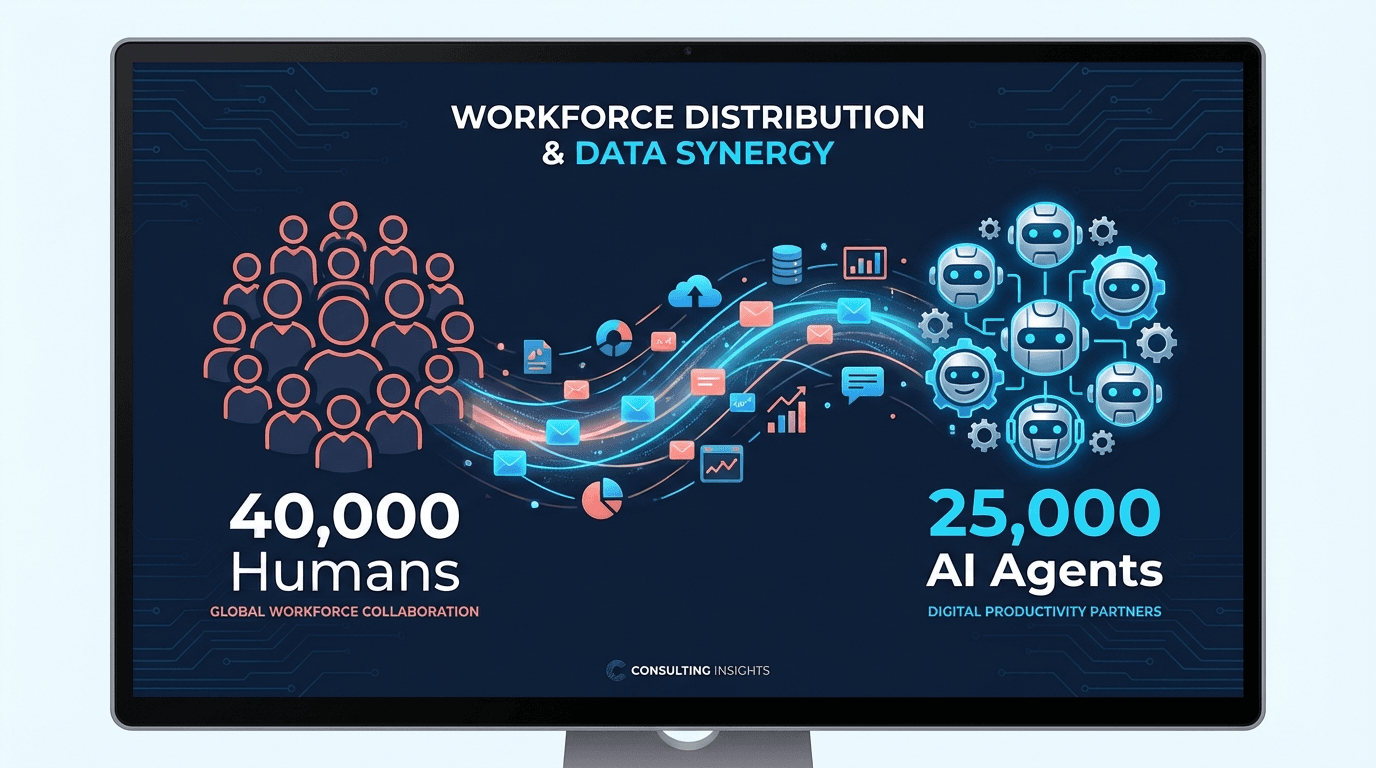
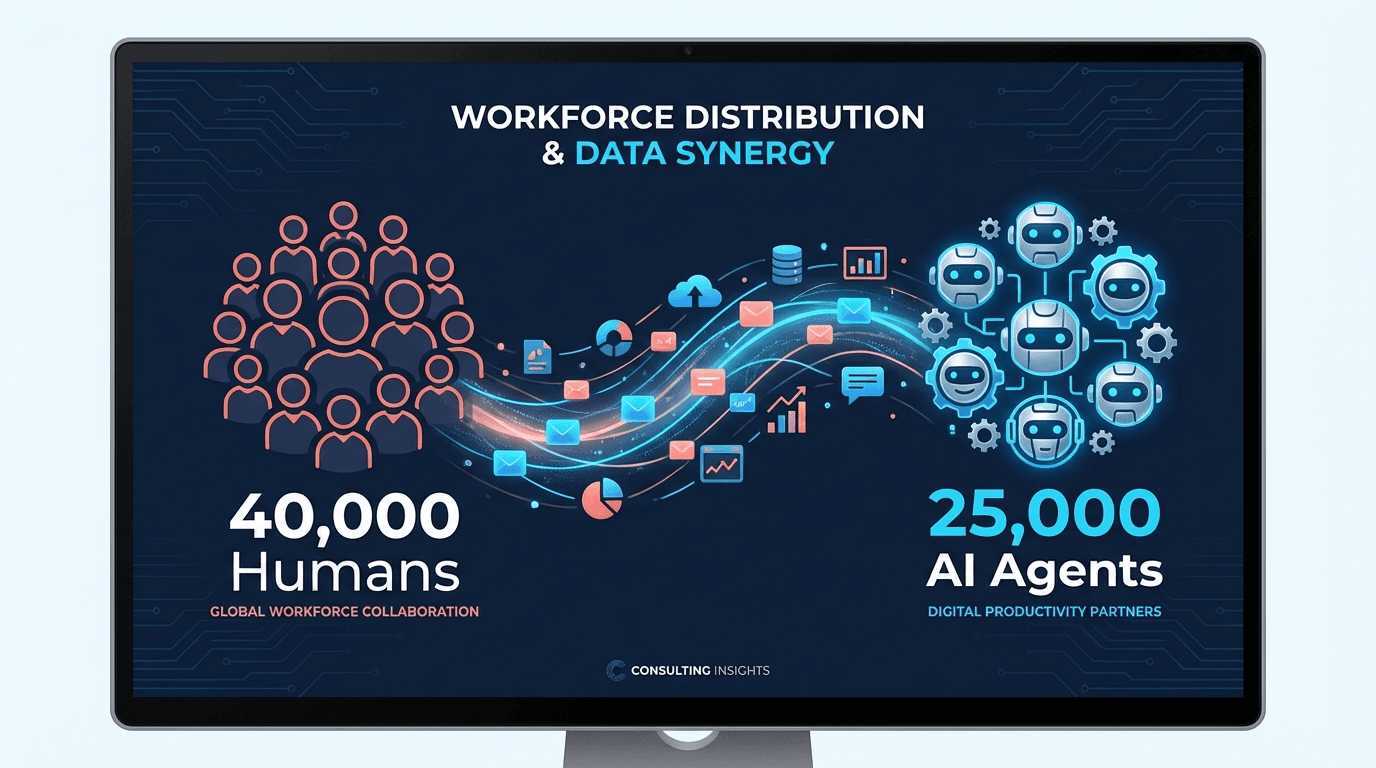
Get startedBob Sternfels dropped a number at CES that should have made every small business owner sit up straight. McKinsey's CEO told the audience that his firm now has roughly 60,000 "employees." About 40,000 of them are human. The other 25,000 are AI agents.
Not chatbots. Not auto-responders. Agents. Software that monitors inboxes, synthesizes research, drafts deliverables, triages client requests, and runs recurring workflows without a human touching them. McKinsey saved 1.5 million hours in search and synthesis work last year alone because of these agents. That's the equivalent of about 720 full-time employees doing nothing but reading and summarizing documents.
How many AI agents does McKinsey actually use?#
The number has shifted slightly depending on the venue. Sternfels initially said 20,000 on HBR's IdeaCast, then revised upward to 25,000 at CES. A McKinsey spokesperson confirmed the higher figure. The plan, according to Sternfels, is to reach a 1:1 ratio of agents to humans by the end of 2026. That means 40,000 AI agents working alongside 40,000 people.
Think about that for a second. The most prestigious consulting firm on the planet is telling you that within months, every single employee will have at least one AI agent working for them. Not as a nice-to-have. As the default operating model.
And this isn't just McKinsey. The Big Four and top strategy houses have collectively spent over $10 billion on AI initiatives since 2023. Enterprise AI investment is projected to hit $307 billion this year. Gartner predicts 40% of enterprise apps will have embedded AI agents by end of 2026, up from under 5% in 2025.
The enterprise world is going all-in. And most small businesses haven't started.
What McKinsey's agents actually do#
This is where the hype meets reality. Sternfels was specific about the kinds of work these agents handle. It's not science fiction. It's grunt work.
Research synthesis. Agents pull data from internal knowledge bases, public filings, market reports, and client documents. They produce first-draft summaries that consultants then refine. This used to take junior associates 6-8 hours per project.
Email triage and scheduling. Agents sort incoming client communications, flag urgent items, draft initial responses, and coordinate meeting logistics across time zones.
Proposal generation. Agents assemble boilerplate sections, pull in relevant case studies, and format deliverables to client specifications. A human still reviews everything, but the first 70% of the work is automated.
Internal operations. Staffing allocation, expense processing, compliance checks. The kind of work nobody enjoys but every company needs done.
Here's my take: none of these tasks are unique to McKinsey. A 10-person marketing agency does all of this. A solo consultant does all of this. A small e-commerce brand does most of this. The difference is McKinsey spent billions building custom infrastructure. You don't have to.
The gap between enterprise and everyone else#
The numbers paint a stark picture. According to Forrester's 2026 predictions, enterprises are restructuring entire divisions around agentic AI. Atlassian cut staff to go agentic. Meta slashed 20% of its workforce. These companies are spending hundreds of millions just on the transition.
Meanwhile, only 58% of small businesses are even using generative AI in any capacity. And the gap between "using ChatGPT sometimes" and "running AI agents that handle real workflows" is enormous.
I wrote about this pattern in our coverage of small business AI adoption. Most SMBs are winging it. They'll use ChatGPT to draft an email, then manually copy-paste it into Gmail, then manually update their CRM, then manually follow up three days later. That's not an agent. That's a fancy autocomplete with extra steps.
| McKinsey (Enterprise) | Small Business (5-50 people) | |
|---|---|---|
| AI investment | $2B+ over 3 years | $29-199/month |
| Agents deployed | 25,000 | Usually 0 |
| Implementation time | 18-24 months | Same day |
| Custom infrastructure | Yes, built in-house | Managed platform |
| Tasks automated | Research, triage, proposals, ops | Same tasks, smaller scale |
| Human oversight | Dedicated AI ops team | You check Telegram |
| ROI timeline | 12-18 months to measure | Week 1 |
The table above isn't a joke. The same categories of work get automated at both scales. The difference is cost, speed, and complexity. McKinsey needed a massive internal engineering effort. A small team needs a managed platform and 30 minutes of setup.
Can small businesses actually use AI agents?#
Yes. And 73% of SMBs that adopted AI agents in 2025 reported measurable productivity gains within 90 days, according to Salesmate's industry adoption data. The successful ones started with a single agent handling a specific task, not a grand AI transformation strategy.
Here's what's already working for teams under 50 people:
Morning briefing agents. Pull overnight emails, Slack messages, calendar events, and news mentions into a single daily digest. Delivered to Telegram at 7am. Takes five minutes to read instead of 45 minutes of inbox scanning.
Email triage. Agent reads incoming email, categorizes by urgency and topic, drafts replies for routine messages, flags the ones that need your brain. A one-person company running this saves 5-10 hours per week.
Client follow-up. Agent tracks when proposals were sent, monitors for replies, and nudges you (or the client directly) when something goes stale. No more deals dying in your inbox because you forgot to follow up on a Thursday.
Content scheduling. Agent monitors your topic list, drafts social posts, queues them for review, and publishes on your schedule. Not great content, but good enough first drafts that cut production time in half.
Competitor monitoring. Agent watches pricing pages, job postings, product changelogs, and social mentions of your competitors. Sends a weekly summary instead of you manually checking six websites.
The cost math that makes this obvious#
McKinsey's AI investment is somewhere north of $2 billion over the past three years. Divided across 25,000 agents, that's roughly $80,000 per agent in development and infrastructure costs. Obviously that includes a lot more than just the agents themselves, but the point stands. Enterprise AI is expensive.
A managed AI agent platform like RapidClaw starts at $29/month. That gets you a personal agent running 24/7 on Telegram, with morning briefings, email triage, and workflow automation built in. The Pro tier at $79/month adds multi-agent squads. You can have an email agent, a research agent, and a scheduling agent working together for less than what McKinsey spends on coffee for one consultant per month.
I'm not saying these are equivalent in sophistication. McKinsey's agents are deeply integrated with proprietary data systems and fine-tuned for consulting-specific workflows. But for a 10-person agency or a solo founder, the agent doesn't need to analyze Fortune 500 M&A deals. It needs to make sure you don't miss that prospect's follow-up email while you're on a client call.
What to deploy first#
If you're starting from zero, don't try to build McKinsey's agent army overnight. Start with one agent doing one thing well.
Week 1: Morning briefing. Get a single agent that aggregates your overnight email, calendar, and one data source (news mentions, analytics, whatever matters most to your business). Read it over coffee instead of spending the first hour of your day in reactive mode.
Week 2: Email triage. Once you trust the briefing agent, let it start categorizing and drafting email responses. You review and send. The agent learns your patterns.
Week 3: Recurring workflows. Pick one repetitive task you do weekly. Competitor price checks. Client status updates. Invoice reminders. Set up a scheduled workflow that runs automatically.
Month 2: Multi-agent coordination. Now you've got enough context for a second agent. Maybe a research agent that feeds into your briefing, or a client-facing agent that handles scheduling.
This is the same playbook McKinsey followed, just compressed. They started with research synthesis agents in 2024. Then email. Then proposals. Then operations. The difference is their rollout took 18 months across 40,000 people. Yours takes a few weeks across your team of five.
The real question isn't whether, it's when#
Sternfels said something on the HBR podcast that I keep coming back to. He said McKinsey is moving from a fee-for-service model to outcomes-based arrangements. Clients don't pay for consultant hours anymore. They pay for results. And the agents are what make that possible, because they collapse the time between question and answer from days to minutes.
That same logic applies to every small business. Your clients don't care how many hours you spent on their project. They care about the output. If an agent can handle the first 70% of the work and you polish the last 30%, you just tripled your effective capacity without hiring anyone.
Forty percent of agent projects will fail by 2027, according to Gartner. Most of those failures will be overambitious enterprise rollouts with unclear goals and too many stakeholders. The small teams that start simple, one agent, one task, clear ROI, those are the ones that'll still be running agents a year from now.
McKinsey has 25,000 AI agents because they can afford to spend $2 billion figuring this out. You don't need $2 billion. You need $29 and a willingness to let software handle the work you shouldn't be doing manually in the first place.
Give the busywork to an agent that remembers you
RapidClaw deploys your personal AI agent to Telegram & Discord in 60 seconds — it learns your world, briefs you every morning, and gets smarter every day. Credits included, no API keys, no servers.
Get started — from $19/moRelated Posts

An AI Agent Just Ran a $100 Million Fundraise
Lyzr let an AI agent named SivaClaw manage its entire $100M Series B — fielding 130+ investors, drafting memos, closing the round without a single Sand Hill Road meeting. Here's what that actually proves about enterprise trust in agents.

42% of Companies Abandoned Their AI Agent Projects Last Year. They All Made the Same 3 Mistakes.
AI agent project abandonment jumped from 17% to 42% in one year. The pattern is identical: over-scoping, no feedback loop, and treating agents like software instead of employees.

Adobe Killed Experience Cloud and Replaced It With AI Coworkers
Adobe Summit 2026: Experience Cloud is dead. CX Enterprise replaces it with persistent AI 'Coworkers' that learn, remember, and act autonomously across the marketing stack.
Stay in the loop
New use cases, product updates, and guides. No spam.