
Atlassian Just Cut Staff to Go Agentic — What Small Teams Should Learn
Atlassian and Meta are laying off staff to restructure around AI agents. But for small teams, the lesson isn't about layoffs — it's about leverage.

Reading about AI agents? RapidClaw gives you one that lives in Telegram & Discord, remembers everything, and runs your day — live in 60s, from $19/mo.
Get startedThe headlines hit in waves this month. Atlassian is cutting staff to restructure around agentic AI. Meta slashed 20% of its workforce. The AI Weekly News Rundown for March 12th led with "Atlassian AI Layoffs" as a top story. And if you read between the lines of every enterprise earnings call and strategy memo right now, you hear the same phrase repeated like an incantation: agentic AI.
I've been watching this from the other side. Not from inside a company with 10,000 employees, but from a team of three building products for small businesses. And what I keep thinking is: the enterprises are spending billions to get to a place that small teams can reach for a few hundred dollars a month.
Let me explain.
What happened at Atlassian#
Atlassian, the company behind Jira, Confluence, and Trello, announced a restructuring that cuts traditional roles and redirects investment toward AI agent capabilities. This isn't a cost-cutting play dressed up in AI language. They're genuinely reorganizing how their products work, moving from tools that humans operate to tools where AI agents handle routine workflows and humans supervise.
Meta did something similar but louder. A 20% headcount reduction, with executives explicitly tying the cuts to AI replacing functions that used to require large teams. Customer support, content moderation, internal tooling, QA. Roles that involve pattern recognition, rule application, and repetitive decisions.
The March 2026 roundup from the AI community summed up the broader trend well: "The shift from 'efficiency' to 'agentic' is real. You can feel companies reorganizing." That line stuck with me because it captures something most reporting misses. This isn't about companies using AI to do the same things cheaper. It's about companies fundamentally changing what they do and how work gets assigned between humans and software.
Atlassian isn't just adding a chatbot to Jira. They're building systems where an agent can triage tickets, assign them based on historical patterns, draft initial responses, and escalate only the ones that need a human decision-maker. That changes the org chart. Whole teams that existed to do triage and routing become unnecessary. Not because the work disappeared, but because the work got automated at a level that wasn't possible two years ago.
The enterprise agentic pivot#
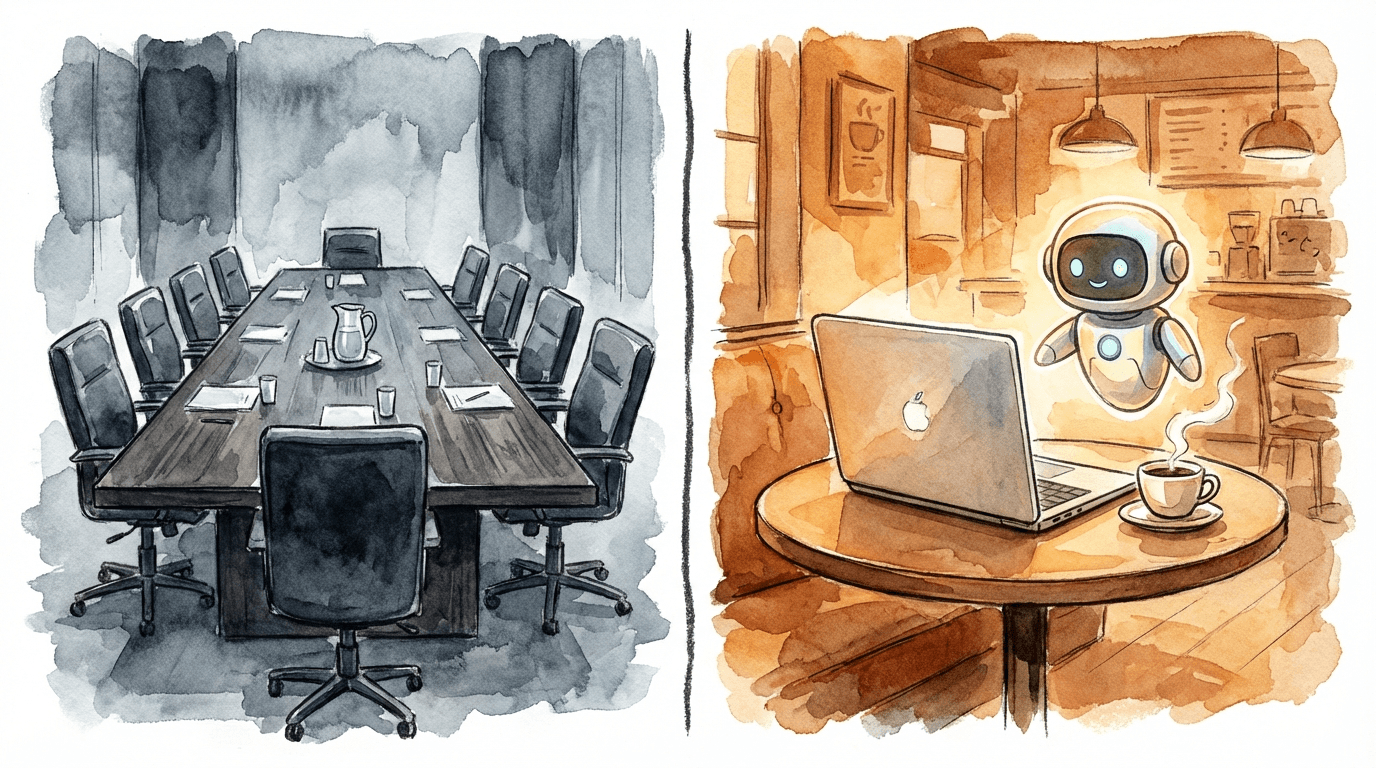
Every major tech company is making this same move right now. NVIDIA is investing in open-source agent frameworks. Google is building agent development kits and embedding agent capabilities into Android. The Gartner prediction that 40% of enterprise applications will have embedded agents by end of 2026 is looking conservative at this point.
But here's what strikes me about the enterprise approach: it's incredibly expensive and slow. These companies are spending hundreds of millions of dollars on agent infrastructure, hiring specialized AI teams, running months-long pilots, navigating compliance reviews, and dealing with internal politics about which departments get automated first.
Atlassian has thousands of engineers working on this transition. Meta has entire divisions dedicated to it. The enterprise version of "going agentic" involves committees, roadmaps, vendor evaluations, and quarterly reviews.
And after all of that, what do they end up with? An AI agent that can triage Jira tickets.
I don't say that to be dismissive. Doing this at Atlassian's scale, across millions of users, is genuinely hard engineering. But the core capability, an AI agent that monitors a channel, makes decisions based on rules you set, and takes action, that's available to a 2-person team right now. Today. For the cost of a nice lunch.
Why small teams have the advantage#
This is the part that most of the layoff coverage misses entirely. The narrative is "big companies are cutting staff because AI can do the work." The counter-narrative, the one I think is more important, is "small teams can now do work that previously required big companies."
When Atlassian lays off a team that did ticket triage, the story is about job loss. When a 3-person agency deploys an AI agent to handle ticket triage for their clients, there's no story at all. But the second scenario is arguably more significant, because it means the barrier to offering enterprise-grade service just dropped dramatically.
Small teams have three structural advantages in the agentic shift:
Speed of deployment. An enterprise takes 6 months to pilot an AI agent. A small team can deploy one in an afternoon. No compliance review. No cross-departmental alignment meetings. No vendor selection process. You pick a platform, configure the agent, connect your tools, and it's live.
Cost efficiency. Enterprise agent deployments involve custom infrastructure, dedicated ML engineers, and vendor contracts with six-figure annual commitments. A small team can run a fleet of always-on agents for under $100/month. The per-agent cost at small scale is a rounding error. At enterprise scale, it's a line item that needs CFO approval.
Willingness to experiment. This is the big one. Large companies can't afford to let an AI agent make a mistake on a customer interaction. The downside risk is too high. So they over-engineer guardrails, run extended pilots, and deploy conservatively. A small team can try something, see if it works, adjust on the fly, and iterate in days instead of quarters. You learn faster because you can afford to move faster.
I've talked to founders running 2-3 person shops who have agent setups that rival what Fortune 500 companies are spending millions to build. The difference is the small team did it in a weekend and the enterprise did it across fiscal year planning cycles.
How to deploy agents without an enterprise budget#

If you're running a small team and the Atlassian headlines made you think "we should be doing something with AI agents," here's the practical version of how to start.
Start with one repetitive workflow. Don't try to automate everything. Pick the task that eats the most time relative to the judgment it requires. For most small teams, this is some version of monitoring, triage, or summarization. Watching a channel for relevant information, deciding what matters, and presenting a summary.
Choose always-on over on-demand. The biggest difference between a useful agent and a novelty is whether it runs proactively on a schedule. A chatbot you have to remember to prompt is a toy. An agent that sends you a briefing every morning, monitors your brand mentions every hour, or reviews your pipeline every evening is a team member.
Use a platform that handles the infrastructure. Self-hosting AI agents means managing servers, handling uptime, dealing with API rate limits, and debugging at 3am when something breaks. Unless you genuinely enjoy DevOps, this is a distraction from your actual work. RapidClaw exists specifically for this. It's OpenClaw-as-a-Service, always-on AI agents that live on Telegram, starting at $29/month. You configure the agent, set the schedule, and it runs. No server management, no Docker containers, no 3am pages.
Build guardrails before you scale. The lesson from every agency and small team I've talked to is the same: agents are great at drafting and flagging, dangerous at publishing and deciding. Start with a human-in-the-loop setup where the agent does the work and you review it before anything goes out. Once you trust the output on a specific workflow, you can gradually loosen the review requirement.
Measure the time saved, not the output quality. The first version of your agent will produce mediocre output. That's fine. The question isn't "is this as good as what I'd produce?" It's "did this save me time, even accounting for the editing?" If your agent gives you a 70% draft in 4 minutes instead of you writing a 95% version in 60 minutes, the agent is winning. You'll spend 10 minutes editing the draft to 95% and still save 45 minutes.
The real lesson from the layoffs#
Atlassian is laying off people because it took them until 2026 to realize that AI agents can handle workflows they were paying humans to do. Meta is doing the same. These are companies with effectively unlimited resources, and they're still playing catch-up to what the technology makes possible.
If you're running a small team, you don't have the baggage of an existing org chart to reorganize. You don't have politics about which department gets automated. You don't have a 12-month procurement cycle for new tools.
You have an afternoon, a Telegram account, and a problem you want solved. That's enough to start.
The enterprises will eventually get their agentic infrastructure right. They'll spend the money, hire the teams, run the pilots, and deploy at scale. But by the time they get there, the small teams that started now will have been running agents for months, learning what works, and compounding the advantage.
The lesson from Atlassian isn't "AI is coming for your job." The lesson is that the work AI can do just became accessible to everyone, not just companies with nine-figure R&D budgets. The only question is whether you start now or wait until it's obvious.
Frequently asked questions#
Are the Atlassian layoffs purely about AI?#
Not entirely. Like most restructurings, there are efficiency and cost factors involved. But the explicit framing around agentic AI and the reallocation of resources toward agent development is genuine. This isn't just a headcount reduction with an AI label slapped on it. The roles being cut are roles that AI agents are specifically designed to replace.
Can a small team actually compete with enterprise AI agent deployments?#
On capability, yes. A well-configured agent on a platform like RapidClaw can do the same triage, monitoring, and summarization work that enterprise teams are building custom solutions for. On scale, no. If you need to process millions of tickets across thousands of users, you need enterprise infrastructure. But most small teams don't have that problem.
What's the minimum viable agent setup for a small team?#
One agent, one workflow, one schedule. Set up an agent that monitors something you care about (brand mentions, competitor updates, support tickets, industry news) and delivers a summary to your Telegram every morning. Cost: under $30/month. Time to set up: about an hour. If that single agent saves you 30 minutes a day, you'll know within a week whether the approach works for your team.
Give the busywork to an agent that remembers you
RapidClaw deploys your personal AI agent to Telegram & Discord in 60 seconds — it learns your world, briefs you every morning, and gets smarter every day. Credits included, no API keys, no servers.
Get started — from $19/moRelated Posts

An AI Agent Just Ran a $100 Million Fundraise
Lyzr let an AI agent named SivaClaw manage its entire $100M Series B — fielding 130+ investors, drafting memos, closing the round without a single Sand Hill Road meeting. Here's what that actually proves about enterprise trust in agents.

42% of Companies Abandoned Their AI Agent Projects Last Year. They All Made the Same 3 Mistakes.
AI agent project abandonment jumped from 17% to 42% in one year. The pattern is identical: over-scoping, no feedback loop, and treating agents like software instead of employees.

Adobe Killed Experience Cloud and Replaced It With AI Coworkers
Adobe Summit 2026: Experience Cloud is dead. CX Enterprise replaces it with persistent AI 'Coworkers' that learn, remember, and act autonomously across the marketing stack.
Stay in the loop
New use cases, product updates, and guides. No spam.