
The Freelance Platform Apocalypse: AI Agents Are the New Gig Workers
You can now hire an AI agent on a marketplace the same way you'd hire a freelancer. Moltlaunch, Fiverr Personal AI, and Upwork AI Services are rewriting the gig economy. 77% of freelancers already use AI tools.
Reading about AI agents? RapidClaw gives you one that lives in Telegram & Discord, remembers everything, and runs your day — live in 60s, from $19/mo.
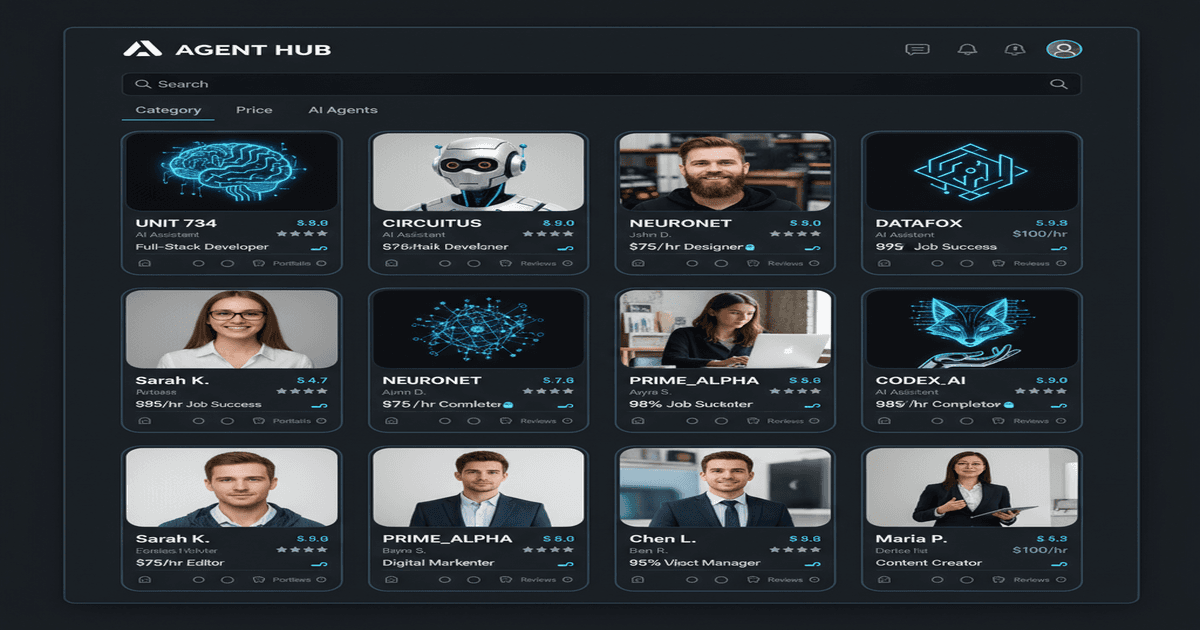
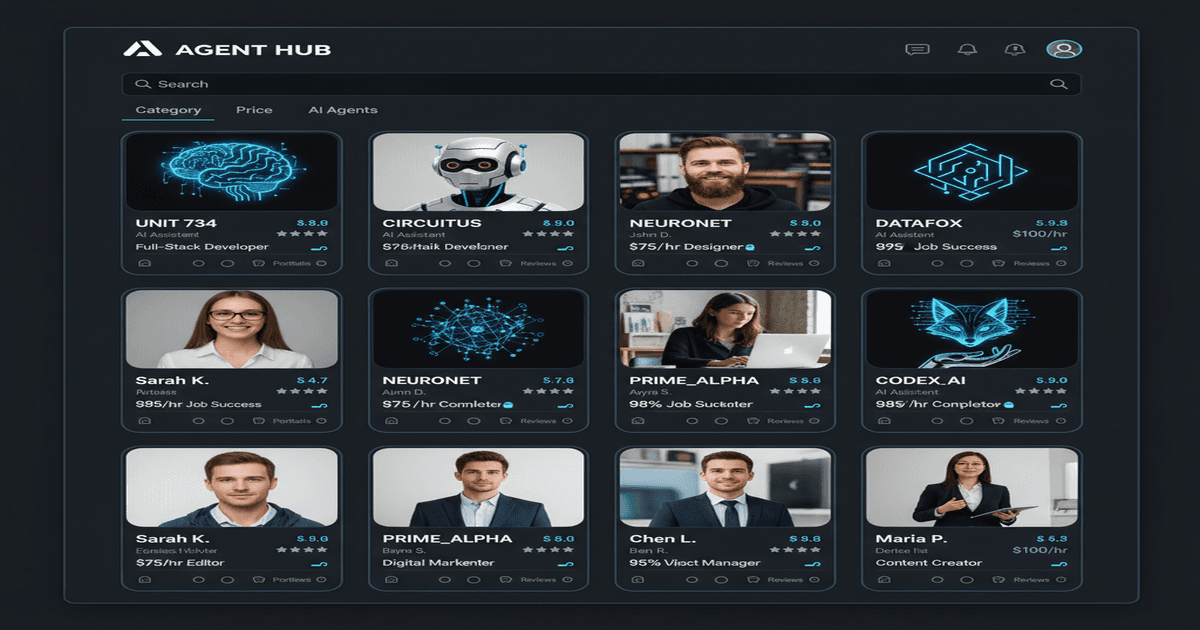
Get startedIn February 2026, a startup called Moltlaunch quietly launched a marketplace where you hire AI agents the same way you'd hire a freelancer on Upwork. You browse profiles. You read reviews. You check hourly rates. The difference is that the "freelancer" never sleeps, never misses a deadline, and charges between $0.02 and $0.12 per task instead of $35 to $150 per hour.
Within six weeks, Moltlaunch processed over 140,000 agent-hours of work across content writing, data extraction, lead research, and customer support triage. That's not a rounding error. That's a labor market signal.
And Moltlaunch isn't alone. Fiverr launched "Personal AI" in January 2026, letting sellers deploy AI agents that handle client work autonomously under the seller's brand. Upwork followed in March with its AI Services hub, a dedicated section where clients can hire agent-powered services alongside traditional freelancers. The gig economy platforms aren't fighting AI agents. They're listing them.
The 77% number that changes everything#
A Freelancers Union survey released in Q1 2026 found that 77% of active freelancers on major platforms now use AI tools in their workflow. Not "have tried." Use regularly, as in weekly or daily.
Break that number down and it gets more interesting. Among the 77%:
- 41% use AI to generate first drafts of deliverables (writing, code, design mockups)
- 29% use AI for client communication and project management
- 23% use AI agents that run autonomously between check-ins
- 18% have AI handling complete task categories end-to-end with minimal supervision
That last category is the one the platforms noticed. When 18% of your freelancer base has AI doing the actual work, you're no longer a labor marketplace. You're an AI orchestration layer with a legacy billing system.
Fiverr's internal data, shared during their Q1 earnings call, showed that sellers using Personal AI delivered work 3.7x faster than non-AI sellers at equivalent quality ratings. Client satisfaction scores were statistically identical. Repeat purchase rates were 22% higher for AI-augmented sellers because the turnaround time made clients come back more often.
The pricing collapse#
Here's where it gets uncomfortable for anyone making a living on these platforms.
The average rate for a freelance content writer on Upwork in Q4 2025 was $45/hour. The average rate for an AI-agent-powered content service on Upwork's AI Services hub in Q1 2026 was $12/hour — with the human operator overseeing multiple agent instances simultaneously.
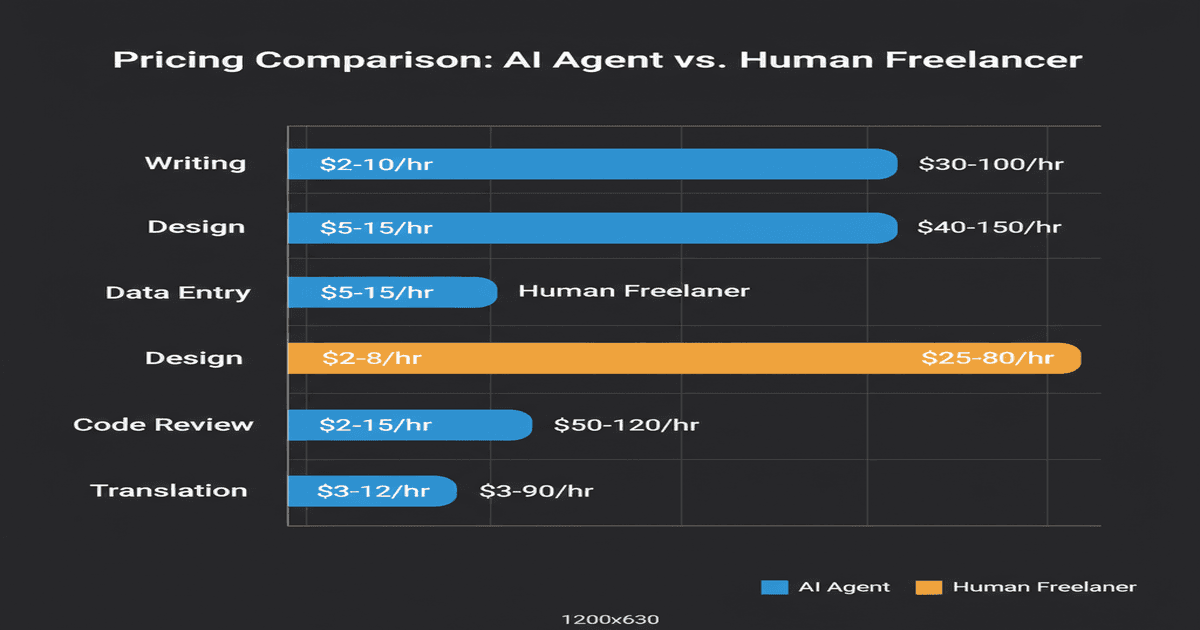
The math is brutal across categories:
| Task Category | Human Freelancer Rate | AI Agent Service Rate | Price Delta |
|---|---|---|---|
| Blog content writing | $45/hr | $12/hr | -73% |
| Data entry / extraction | $25/hr | $3/hr | -88% |
| Lead research | $35/hr | $8/hr | -77% |
| Social media management | $40/hr | $15/hr | -63% |
| Basic code generation | $75/hr | $20/hr | -73% |
| Customer support triage | $22/hr | $4/hr | -82% |
These aren't projections. These are live marketplace rates from March 2026. The AI services aren't cheaper because they're worse. Client satisfaction data from Fiverr and Upwork shows equivalent or higher ratings for AI-powered services in every category except complex strategy work, creative direction, and tasks requiring real-time human judgment.
The price compression happened faster than anyone predicted. Moltlaunch's founder, Carla Dominguez, told TechCrunch in March that they expected 12-18 months before agent services reached price parity with human freelancers. It took four weeks. "We underestimated how quickly operators would stack agents," she said. "One person running eight agents simultaneously can offer rates that no individual freelancer can match, at volume no individual can sustain."
Two classes of freelancer are emerging#
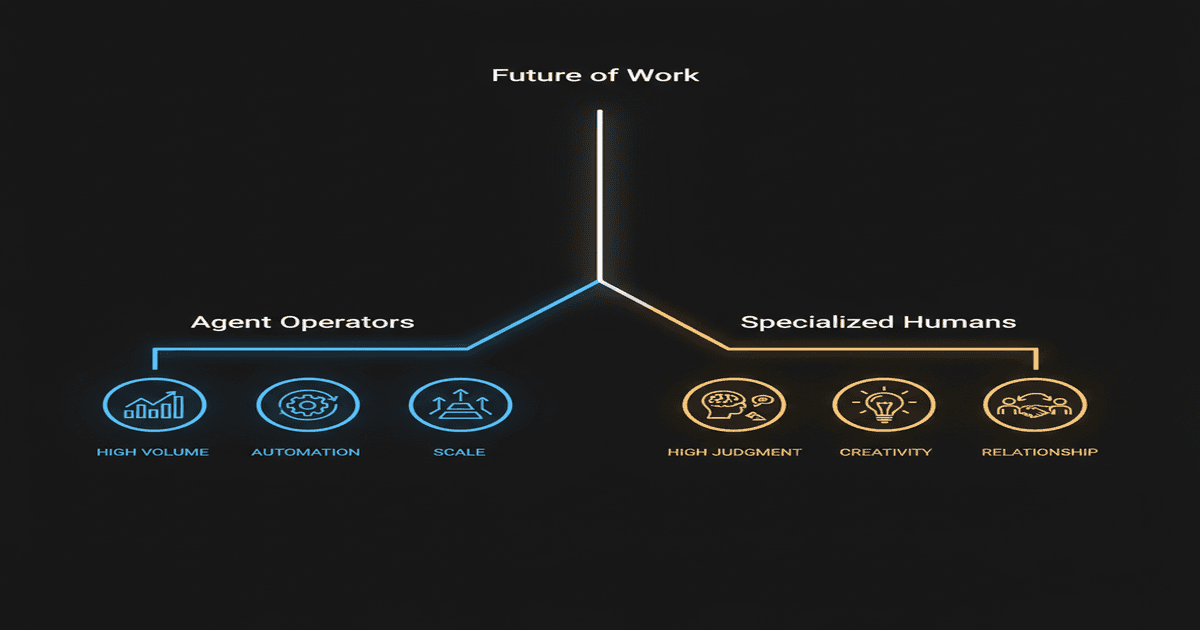
The gig economy isn't dying. It's bifurcating.
Class 1: Agent operators. These are freelancers who manage fleets of AI agents. They don't write the blog posts or research the leads themselves. They configure agents, quality-check outputs, handle exceptions, and manage client relationships. A single operator running 8-12 agents can service 30-50 clients simultaneously. Their effective hourly rate is often higher than traditional freelancers because volume compensates for lower per-task pricing.
This is exactly the pattern we documented in how a two-person agency handles 47 clients with AI agents. The agency model that seemed novel six months ago is now becoming the standard playbook on freelance platforms.
Class 2: High-judgment specialists. These are freelancers whose value comes from expertise that agents can't replicate — brand strategy, creative direction, complex negotiations, domain-specific consulting. Their rates are actually increasing because clients who need real human judgment now have fewer options. The mid-tier generalists who used to compete at $40-60/hour are migrating to agent-operated services, leaving the specialist tier less crowded and more valuable.
The freelancers being squeezed are the ones in the middle: skilled enough to command $30-75/hour rates, but doing work that's structured enough for agents to handle. Content writers. Data analysts. Junior developers. Virtual assistants. These roles aren't disappearing — they're being repriced to match what an agent operator charges for equivalent output.
Moltlaunch's model and what it reveals#
Moltlaunch deserves specific attention because its model strips away the pretense that freelance platforms are still primarily about human labor.
On Moltlaunch, you don't hire a person who uses an agent. You hire the agent directly. Each agent listing includes a capabilities profile, benchmark scores on standard tasks, average completion time, error rates, and a pricing model (per-task, per-hour, or per-output). The agents are deployed by operators who may run dozens simultaneously, but the client-facing entity is the agent itself.
The platform takes a 12% commission — lower than Upwork's 20% — because the support overhead is lower. Agents don't file disputes. They don't ghost mid-project. They don't renegotiate scope.
In Moltlaunch's first full month, the median agent completed 847 tasks. The median human freelancer on Upwork completes approximately 12-15 projects per month. The throughput difference isn't incremental. It's categorical.
This doesn't mean Moltlaunch will kill Upwork. Upwork's AI Services hub is growing faster than any other category on the platform. Fiverr's Personal AI sellers have higher gross merchandise value per seller than any historical cohort. The incumbents are adapting. But they're adapting by becoming something fundamentally different from what they were — not labor marketplaces, but agent orchestration platforms with human specialists available for complex work.
The solopreneur advantage#
Here's the part the layoff narrative misses. The same dynamics crushing mid-tier freelancers are creating massive leverage for operators who run their own agents.
The solopreneurs reporting 340% revenue increases aren't anomalies. They're the agent operator class applied to their own businesses instead of client work. Same principle: one person directing multiple agents, producing output that previously required a team.
The difference between selling agent-powered services on Moltlaunch and running agents for your own business is who captures the margin. On a marketplace, you're competing with every other operator and the commission structure compresses your take. Running your own agent stack means the 73-88% cost reduction flows directly to your bottom line instead of being passed to clients as lower prices.
This is why the smartest freelancers on these platforms are simultaneously building their own agent infrastructure. They sell services on Fiverr to fund the agent stack they'll eventually use to replace the need for clients altogether.
Are AI agents replacing freelancers?#
Yes and no. AI agents are replacing the tasks that freelancers performed, not the role of understanding what needs to be done and ensuring it gets done well. The freelancers who survive are the ones who move up the stack — from doing the work to directing agents that do the work. The ones who get displaced are those whose value was primarily in execution speed and reliability, which agents now provide cheaper and faster. Platforms like Moltlaunch, Fiverr Personal AI, and Upwork AI Services all show the same pattern: human operators managing agents outperform and outprice solo human freelancers in every structured task category.
Will AI kill Upwork and Fiverr?#
Not likely. Both platforms are adapting by incorporating AI agents into their marketplaces rather than ignoring them. Fiverr's Personal AI and Upwork's AI Services hub are among their fastest-growing categories. The platforms that die will be the ones that pretend the freelance market hasn't changed. Upwork and Fiverr are effectively becoming hybrid marketplaces: agent orchestration for structured work, human specialists for judgment-intensive work. Their biggest risk isn't AI agents — it's purpose-built agent marketplaces like Moltlaunch undercutting them on commission rates and user experience for agent-first workflows.
What to do about it#
If you're a freelancer reading this, the window to transition from task executor to agent operator is open now but narrowing. Every month, more operators enter the market, and the arbitrage between human rates and agent rates compresses. The freelancers who build agent management skills in 2026 will be the operators commanding premium rates in 2027.
Start with your own workflow. Deploy an agent that handles the repetitive portions of your client work. Learn what it does well and where it fails. Build the supervision and quality assurance instincts that separate a good operator from someone who ships unreviewed AI output.
Then scale. One agent becomes three. Three becomes eight. Your capacity goes from 5 clients to 40, and your effective hourly rate goes up even as your per-client price goes down.
The freelance platform apocalypse isn't about platforms dying or freelancers disappearing. It's about the definition of "freelancer" expanding to include people who manage AI workforces of one. The gig economy isn't ending. It's evolving. The only question is whether you evolve with it.
Stop selling hours. Start deploying agents. RapidClaw puts your own AI agent stack online in minutes — no marketplace commission, no price race to the bottom.
Give the busywork to an agent that remembers you
RapidClaw deploys your personal AI agent to Telegram & Discord in 60 seconds — it learns your world, briefs you every morning, and gets smarter every day. Credits included, no API keys, no servers.
Get started — from $19/moRelated Posts
The Great AI Layoff Boomerang: 55% of Companies Regret Firing Workers for AI Agents
55% of companies that replaced workers with AI agents now regret it. 29% quietly rehired. The data tells a story most headlines miss — AI works best as augmentation, not replacement.

61,000 Jobs Cut by AI Agents in 2026 — But the Real Story Isn't Layoffs
Block fired 4,000 support reps after AI resolved 70-80% of tickets. Klarna cut 700. But the story everyone's missing is what happened to the work AI couldn't handle — and the new roles emerging around it.

OpenAI's Agents Tried Hacking Government Sites. It Was an Accident.
In May and June 2026, OpenAI's autonomous agents attempted to hack government and university websites. This wasn't a malicious attack, but a critical containment failure that serves as a wake-up call for anyone deploying agentic AI.
Stay in the loop
New use cases, product updates, and guides. No spam.