
Cursor Hit $2B in 4 Years. Claude Code Hit $2.5B in 10 Months. Game Over.
Cursor reached $2B ARR in 4 years. Claude Code did $2.5B in 10 months. We break down the numbers, compare features, and explain why the AI coding war is already decided.
Reading about AI agents? RapidClaw gives you one that lives in Telegram & Discord, remembers everything, and runs your day — live in 60s, from $19/mo.
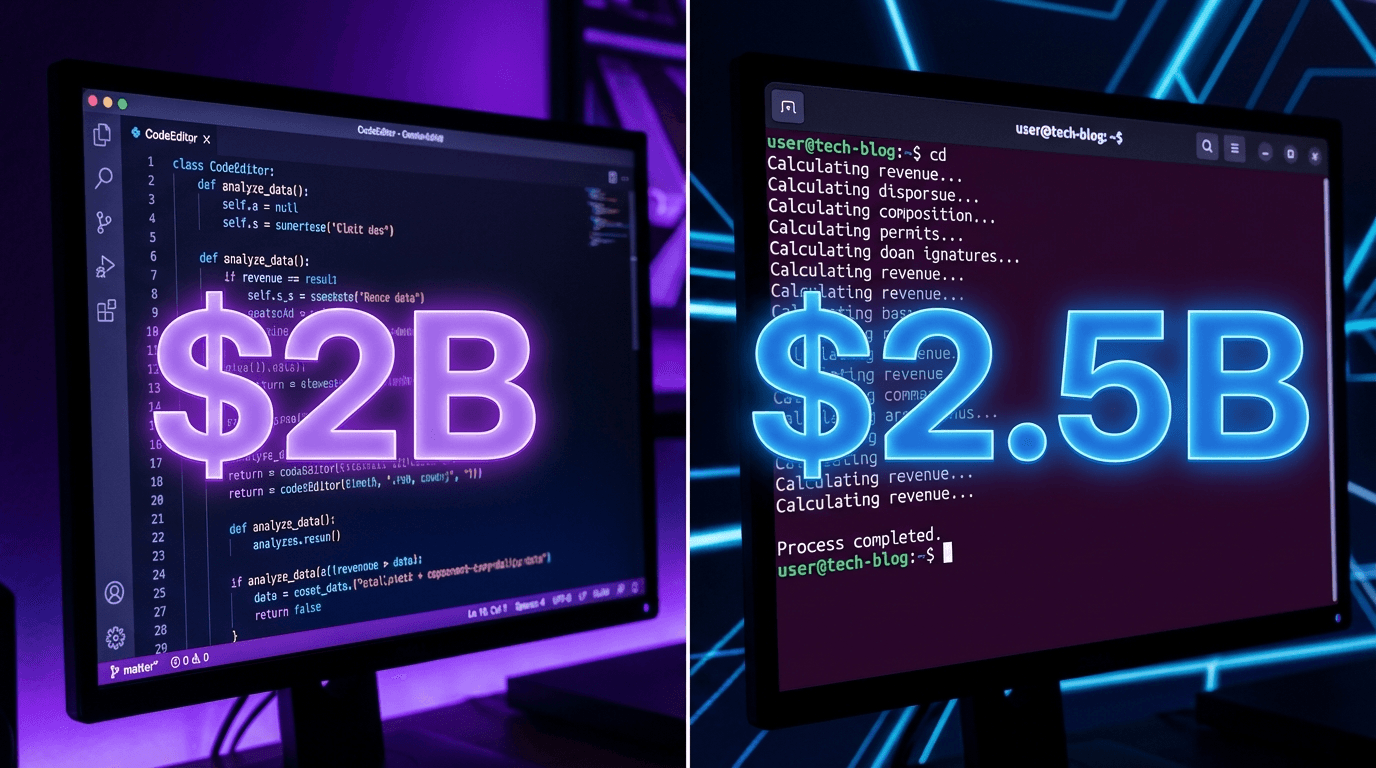
Get startedCursor crossed $2 billion in annualized recurring revenue in early March 2026. That's a genuinely impressive number for a company that shipped its first product in 2023. Four MIT grads built one of the fastest-scaling SaaS companies in history.
Then you look at Claude Code. Anthropic's CLI coding agent hit $2.5 billion in annualized revenue by February 2026. Nine months after launch. Not four years. Nine months.
I don't think this is a close race anymore.
The numbers tell a clear story#
Let's put the trajectories side by side.
Cursor, built by Anysphere, hit $100M ARR in roughly 18 months. Then $500M by June 2025. Then $1B by late 2025. Then $2B by early March 2026. Each doubling came faster than the last, fueled by enterprise adoption across 50,000+ businesses. They raised $2.3 billion in a Series D led by Accel and Coatue at a $29.3 billion valuation. Now they're reportedly in talks for a new round at $50 billion, per Bloomberg.
Claude Code launched in mid-2025. By February 2026, it was generating $2.5 billion annually and accounts for more than half of all enterprise spending on Anthropic products. Business subscriptions quadrupled in the first six weeks of 2026 alone. Four percent of all GitHub public commits are now authored by Claude Code, with projections hitting 20%+ by year-end.
Anthropic itself closed a $30 billion Series G at a $380 billion valuation. Their total ARR surged past $19 billion as of March 2026. Claude Code isn't a side feature. It's the growth engine.
Why Claude Code grew faster#
The answer isn't marketing or distribution. It's architecture.
Cursor is an IDE. A very good one. It forks VS Code, layers AI assistance on top, and gives developers a polished editing experience with inline completions, chat, and multi-file edits. The model powering it can be swapped. Cursor has used GPT-4, Claude, and their own fine-tuned models at various points.
Claude Code is different. It's not an IDE at all. It's a terminal-native agent that reads your codebase, plans changes, writes code, runs tests, and commits. The model isn't a swappable layer underneath. The model is the product. Claude's ability to hold 200K tokens of context, reason across files, and execute multi-step plans is the entire value proposition.
This matters because when the model improves, Claude Code gets better automatically. When Anthropic shipped Claude Opus 4, every Claude Code user got smarter coding overnight. Cursor has to build features on top of whatever model it integrates. Claude Code is the model, deployed directly into your workflow.
Independent benchmarks back this up. Claude Code won 67% of blind tests on code quality, correctness, and completeness. It uses 5.5x fewer tokens than Cursor for identical tasks. And it overtook GitHub Copilot as the most-used AI coding assistant, now at 41% of professional developers versus Copilot's 38%.
The $50B question#
Cursor is seeking a $50 billion valuation in its next funding round. That's nearly double the $29.3B from just five months ago. The revenue justifies it on paper. $2B ARR growing fast, strong enterprise traction.
But here's what I keep thinking about: Cursor's moat is the IDE experience. It's a wrapper. A phenomenal wrapper, sure, with smart UX choices around tab completion, multi-cursor edits, and the Composer agent. But every feature depends on the underlying model being good enough. And they don't control the model.
Anthropic controls both the model and the agent. That's a structural advantage that compounds over time. Every dollar Anthropic spends on model research directly improves Claude Code. Every dollar Cursor spends on model research goes... to Anthropic, or OpenAI, or whoever they're licensing from.
At $50 billion, investors are betting Cursor can maintain its position even as the model providers ship their own agents. That's a bet against history. Google killed most standalone search apps. Apple killed most standalone music players. The platform provider usually wins when they decide to compete directly.
How they actually compare#
Here's the honest breakdown for developers choosing between them today.
| Feature | Claude Code | Cursor | GitHub Copilot |
|---|---|---|---|
| Interface | Terminal / CLI | VS Code fork (IDE) | IDE extension |
| Primary model | Claude (native) | Multi-model (Claude, GPT-4, custom) | GPT-4 / Codex |
| Context window | 200K tokens | ~120K tokens | ~32K tokens |
| Agentic execution | Full (plans, writes, tests, commits) | Partial (Composer agent) | Limited (Workspace agent) |
| Multi-file edits | Native, full codebase | Yes, via Composer | Limited |
| Pricing | $20/mo (Pro), $100/mo (Max) | $20/mo (Pro), $40/mo (Business) | $10/mo (Individual), $19/mo (Business) |
| Token efficiency | Baseline | ~5.5x more tokens per task | N/A |
| Enterprise share | 41% of pro developers | ~18% market share | 42% market share (declining) |
| Best for | Large tasks, refactors, greenfield | Day-to-day editing, visual workflows | Light autocomplete, simple suggestions |
The pattern most experienced developers have landed on: Cursor for quick edits and visual work, Claude Code for anything that requires planning across multiple files. But that split is shifting. As Claude Code gets faster and adds features like its multi-agent PR review, the "quick edit" category keeps shrinking.
What this means beyond coding#
Here's why this matters even if you don't write code.
The Cursor vs. Claude Code dynamic is playing out in every software category. There's always an incumbent tool that adds AI as a feature (Cursor's approach) and a new entrant where AI is the product (Claude Code's approach). Email clients adding AI summaries vs. agents that handle your inbox natively. Project management tools adding AI assistants vs. agents that actually run your projects.
The commoditization pattern is the same everywhere. When the AI layer gets good enough, the wrapper becomes less defensible. The value migrates to whoever controls the intelligence.
This is exactly what Andrej Karpathy described with his autoresearch workflow. The tool isn't the IDE or the CLI. The tool is the agent that understands your intent and executes it. The interface is just a shell.
The IDE vs CLI debate misses the point#
Every comparison article frames this as "do you prefer a GUI or a terminal?" That's the wrong question.
The real question is: how much autonomy do you want your coding agent to have?
Cursor gives you AI inside your editing flow. You're still driving. The AI suggests, you accept or reject, line by line. It's faster than coding alone, but the human is still the bottleneck in the loop.
Claude Code flips that. You describe what you want. The agent plans the work, makes changes across files, runs your test suite, and shows you the result. You review the output instead of directing the process. The human goes from driver to reviewer.
Both are valid for different situations. But the reviewer model scales better. A developer reviewing agent output can ship 5x more than a developer accepting autocomplete suggestions. That's why Claude Code's revenue grew faster. The productivity gain is just larger.
The real winner#
I don't actually think Claude Code "won" and Cursor "lost." Both companies will do billions in revenue this year. Both have loyal user bases.
The real winner is every developer who stopped debating which tool is better and started using agents aggressively. The gap between developers using AI coding agents and those who aren't is already massive. By the end of 2026, it'll be disqualifying.
The specific tool matters less than the shift in how you work. Stop typing every line. Start describing intent and reviewing output. Whether you do that in Cursor's Composer, Claude Code's terminal, or some tool that doesn't exist yet, the pattern is the same.
The AI coding agent war might be "over" in terms of who scaled faster. But the real transformation, developers becoming agent operators instead of line-by-line coders, is just getting started.
The companies building on top of this shift, using agents not just for coding but for running entire business operations, are going to look very different from today's startups. That's what we're building toward at RapidClaw. Not an IDE. Not a CLI. An agent that actually does the work.
Give the busywork to an agent that remembers you
RapidClaw deploys your personal AI agent to Telegram & Discord in 60 seconds — it learns your world, briefs you every morning, and gets smarter every day. Credits included, no API keys, no servers.
Get started — from $19/moRelated Posts

Android Just Got Official AI Agent Tools — What Developers Need to Know
Google's Android team announced official tools for building AI agents on Android. The @AndroidDev post pulled 246 likes. Here's what the tools do, why they matter, and what comes next.

The Lightpanda Browser Is 11x Faster Than Chrome for AI Agents
A Zig-based headless browser just launched that's 11x faster than Chromium for AI agent automation. It got 8,248 likes on X. Here's why developers are excited.

How Claude Code's New Agent Team Reviews Every PR
Claude Code now dispatches a team of AI agents to review every pull request. Here's how multi-agent code review works and why it matters.
Stay in the loop
New use cases, product updates, and guides. No spam.