
Mizuho's Agent Factory: One Bank's Plan to Mass-Produce 10,000 AI Agents
Japan's third-largest bank cut agent development time by 70% and is scaling to 10,000 autonomous AI agents across operations. Their 'Agent Factory' approach is becoming the enterprise blueprint.

Reading about AI agents? RapidClaw gives you one that lives in Telegram & Discord, remembers everything, and runs your day — live in 60s, from $19/mo.
Get startedMizuho Financial Group, Japan's third-largest bank with $2.1 trillion in assets, has a problem that most enterprises will recognize. They need AI agents across hundreds of business functions. They needed them yesterday. And building each one from scratch was taking their engineering teams 14 to 18 weeks.
So they built a factory.

The concept is deceptively simple. Instead of treating each AI agent as a bespoke software project, Mizuho created a standardized production pipeline that assembles agents from pre-validated components: compliance modules, data connectors, reasoning templates, and deployment wrappers. The result is a repeatable process that cut their agent development cycle from 16 weeks to under 5. A 70% reduction.
Their target is 10,000 agents across retail banking, corporate lending, risk management, treasury operations, and customer service by end of 2027. They currently have around 800 in production. The gap between 800 and 10,000 is exactly why the factory model exists.
This is not a proof of concept. It is an operating model that other banks are already studying.
How are banks using AI agents?#
Banking has moved well past the chatbot stage. The current wave of AI adoption in financial services is focused on autonomous agents that complete multi-step workflows without human intervention.
According to Gartner's 2026 banking technology survey, 67% of global banks with over $50 billion in assets are piloting or deploying AI agents in at least one business line. McKinsey estimates that agentic AI could generate $200 to $340 billion in annual value for the banking sector by 2028, primarily through operational automation, risk reduction, and faster decision cycles.
The use cases span every department. Compliance teams deploy agents that continuously monitor regulatory changes across jurisdictions and flag required policy updates. Credit teams use agents to assemble loan packages, pulling data from multiple systems, running preliminary risk assessments, and generating approval recommendations. Treasury operations rely on agents for liquidity forecasting that updates in real time rather than daily.
What separates the 2026 approach from earlier automation efforts is the autonomy. These agents don't just execute predefined rules. They reason about novel situations, escalate appropriately, and improve over time. Gartner's enterprise AI agent predictions suggest that by 2028, 30% of enterprise software interactions will be agent-mediated rather than human-initiated.
Mizuho looked at this trajectory and made a calculation. If every agent takes four months to build, they will never reach the scale needed to remain competitive. The math simply does not work. Hence the factory.
What is Mizuho's Agent Factory?#
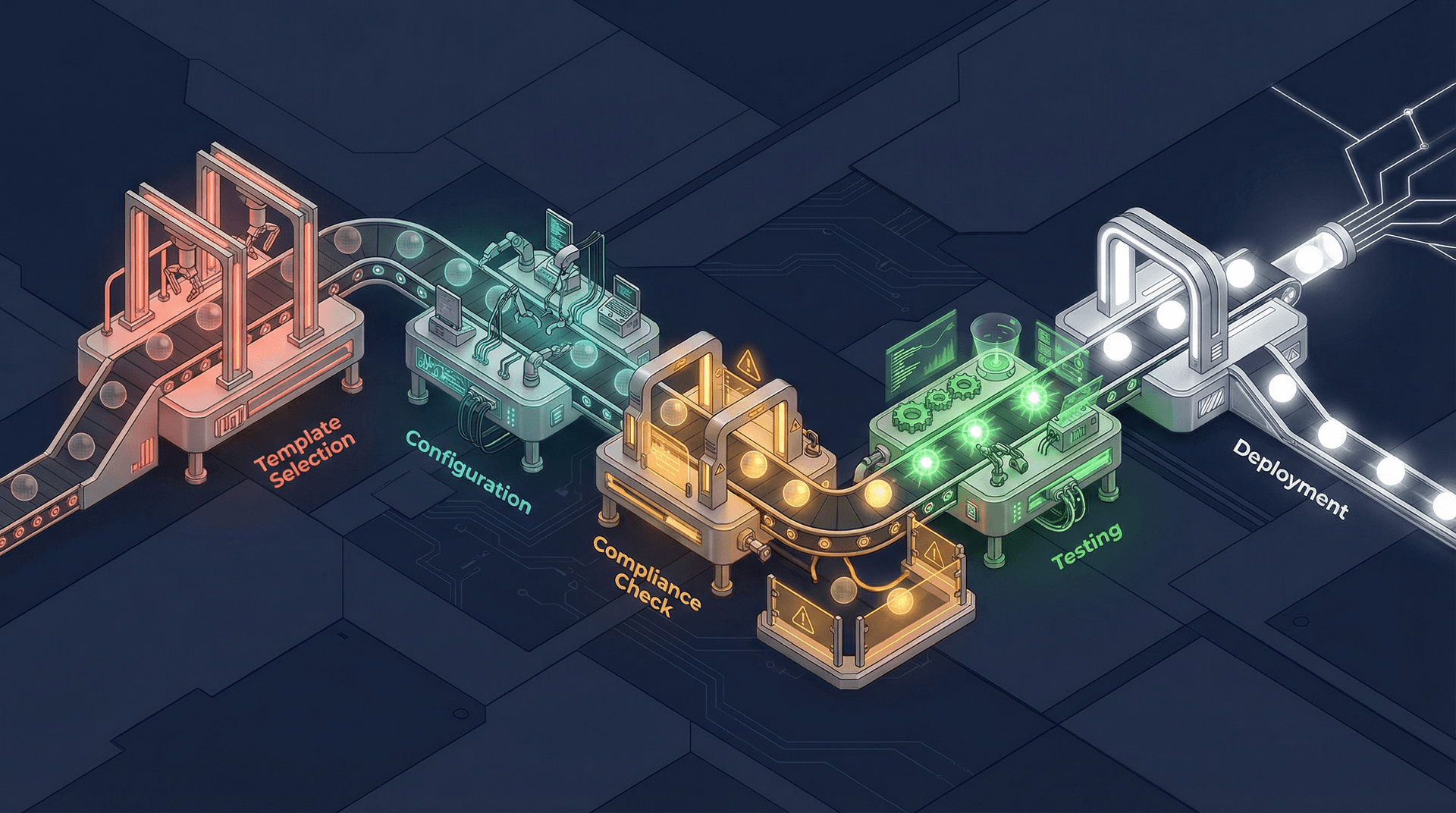
The Agent Factory is a structured production pipeline with five stages: specification, assembly, compliance validation, deployment, and monitoring. Each stage has standardized inputs, outputs, and quality gates.
Stage 1: Specification. Business teams submit agent requests through a structured intake form. They define the task, data sources, decision authority level, escalation rules, and success metrics. This replaces the traditional months-long requirements gathering process. Mizuho has pre-built specification templates for 40 common banking workflows, so most requests take under a day to formalize.
Stage 2: Assembly. This is the core innovation. Rather than writing each agent from scratch, the factory team selects from a library of validated components. There are roughly 200 modules covering data access, reasoning patterns, output formatting, human-in-the-loop checkpoints, and integration connectors. An agent for credit risk assessment might combine a financial data connector, a regulatory reasoning template, a risk scoring module, and an escalation handler. Assembly takes days, not months.
Stage 3: Compliance validation. Every agent passes through automated compliance testing before deployment. This includes regulatory checks (does this agent handle PII correctly under Japan's APPI and GDPR for European operations?), risk checks (can this agent make decisions that exceed its authority?), and audit trail verification (are all agent actions logged in the format required by FSA regulators?). Mizuho built this layer in partnership with their compliance division, and it runs automatically. No manual review bottleneck.
Stage 4: Deployment. Agents deploy into Mizuho's private cloud infrastructure with standardized monitoring, logging, and failover. Each agent gets a unique identity, access credentials scoped to its specific data needs, and rate limits appropriate to its function. Deployment is automated and takes under an hour.
Stage 5: Monitoring and iteration. Every agent in production reports performance metrics back to the factory. Task completion rates, error frequencies, escalation patterns, and user satisfaction scores feed into a continuous improvement loop. Underperforming agents get flagged for review. High-performing agents become templates for similar use cases.
The numbers that matter#
The comparison between Mizuho's factory approach and traditional agent development tells the story clearly.
| Dimension | Traditional development | Agent Factory |
|---|---|---|
| Time to deploy | 14-18 weeks | 3-5 weeks |
| Engineering hours per agent | 800-1,200 | 200-350 |
| Compliance review | 3-6 weeks (manual) | 2-3 days (automated) |
| Cost per agent | $180,000-$280,000 | $45,000-$90,000 |
| Maintenance overhead | Dedicated team per agent | Shared module updates |
| Consistency of outputs | Varies by team | Standardized |
| Reusability of components | Low (bespoke code) | High (modular library) |
The cost reduction alone is significant, roughly 65-70% per agent. But the real leverage is in maintenance. When Mizuho updates a compliance module to reflect a new FSA regulation, every agent using that module gets the update simultaneously. In a traditional model, each agent would need individual patching. At 10,000 agents, the maintenance math of bespoke development is simply untenable.
Mizuho's CTO Hideo Yamamoto framed it bluntly in a March 2026 internal memo that was later referenced in Nikkei Asia's reporting: "We cannot hire enough engineers to build 10,000 agents one at a time. We must industrialize."
Why banking and why now#
Banking is the ideal proving ground for the agent factory model for three reasons.
First, banking workflows are highly structured. Loan origination, KYC verification, trade settlement, and regulatory reporting all follow well-defined processes with clear inputs, outputs, and decision criteria. This structure makes it possible to decompose workflows into reusable components. Less structured industries will find modularization harder.
Second, banking is heavily regulated. This sounds like a disadvantage, but it actually forces the kind of rigorous validation that makes agent factories viable. Mizuho's automated compliance layer exists because regulators require it. That compliance layer then becomes a competitive advantage because it enables faster, more confident deployment. Banks that treat compliance as a bolt-on will never move at factory speed.
Third, the scale of opportunity is enormous. A bank like Mizuho has thousands of distinct workflows across retail, corporate, investment, and treasury divisions. The addressable surface for agent automation is vast. The factory model is specifically designed for this kind of breadth.
Other banks are taking note. HSBC, JPMorgan Chase, and BNP Paribas have all publicly discussed building internal agent development platforms. DBS Bank in Singapore has deployed what they call an "agent foundry" with similar principles. The terminology varies, but the pattern is converging.
The compliance layer is the moat#
Every bank can license the same foundation models. Every bank can hire (or try to hire) the same AI engineers. The differentiator is not the AI. It is the compliance infrastructure that allows the AI to operate safely at scale within a regulated environment.
Mizuho's automated compliance validation is their most valuable asset in this effort. They spent 18 months building it before the Agent Factory launched. It encodes regulatory requirements from the Japanese Financial Services Agency, the European Banking Authority, and several APAC regulators into machine-readable test suites. Every agent must pass these tests before it touches production data.
This is where the Mastercard and Santander agent payment work becomes relevant. As agents gain financial transaction capabilities, the compliance requirements multiply. An agent that can read market data is one risk category. An agent that can initiate payments is a different category entirely. Banks building compliance automation now will be positioned to deploy transactional agents while competitors are still writing risk assessments by hand.

The pattern works at every scale#
Here is what makes the agent factory concept genuinely interesting beyond enterprise banking: the underlying principle, standardized components assembled into purpose-built agents, applies at any scale.
A solopreneur running a consulting business does not need 10,000 agents. But they might need five: one for email triage, one for meeting preparation, one for client research, one for invoicing reminders, and one for content scheduling. Building each of those from scratch is the same bottleneck that Mizuho faced, just at a different magnitude.
This is exactly the problem that agent deployment platforms solve at the individual and small-team level. Platforms like RapidClaw let users deploy agent squads through Telegram without touching infrastructure. You define what the agent should do, connect your data sources, and the platform handles the assembly, deployment, and monitoring. It is the factory pattern, democratized.
The parallel is direct. Mizuho's module library maps to pre-built agent templates. Their compliance layer maps to permission and scope controls. Their monitoring stage maps to conversation logs and performance dashboards. The vocabulary differs, but the architecture rhymes.
The businesses that will struggle are the ones in between. Too large to use a managed platform, too small to build their own factory. They will either need to adopt enterprise agent platforms from vendors like Microsoft, ServiceNow, or Salesforce, or they will build slowly and fall behind.
What comes next#
Mizuho has published a roadmap that extends to 2028. The key milestones:
Q3 2026: 2,000 agents in production. Launch of an internal marketplace where business units can browse and request agents from a catalog of pre-built templates.
Q1 2027: Agent-to-agent orchestration. Groups of agents will work together on complex workflows like end-to-end loan origination, where a data gathering agent hands off to a risk assessment agent, which hands off to a pricing agent, which hands off to a documentation agent.
Q4 2027: External agent integrations. Mizuho's agents will interact with agents from partner institutions, regulators, and corporate clients. This is the agent-to-agent commerce infrastructure that the financial industry is building toward.
2028: 10,000 agents. Full operational coverage across all divisions.
The agent-to-agent orchestration milestone is the one to watch. Individual agents automate tasks. Orchestrated agent teams automate entire business processes. That is where the transformative value lives, and it is where the factory model becomes essential. You cannot orchestrate agents that were built with incompatible architectures, inconsistent data formats, and varying compliance standards. Standardization is the prerequisite for orchestration.
The industrialization thesis#
The broader takeaway from Mizuho's approach is a thesis about the next phase of AI adoption. The experimentation phase is ending. The industrialization phase is beginning.
During experimentation, companies built one-off agents to prove the technology worked. During industrialization, they build systems that produce agents reliably, at scale, with governance built in from the start.
The banks that understood this earliest are building factories. The ones that did not are still running pilots. In 18 months, the gap between those two groups will be visible in their operating margins.
Mizuho is not special because they are using AI. Every bank is using AI. Mizuho is notable because they recognized that the bottleneck was never the AI itself. It was the production system around the AI. They built the factory before they needed 10,000 agents. By the time they need them, the factory will be ready.
That is the lesson for every organization watching this space. The question is not "should we use AI agents?" That debate is over. The question is "can we produce them fast enough to matter?" Mizuho's answer is a factory. What is yours?
Give the busywork to an agent that remembers you
RapidClaw deploys your personal AI agent to Telegram & Discord in 60 seconds — it learns your world, briefs you every morning, and gets smarter every day. Credits included, no API keys, no servers.
Get started — from $19/moRelated Posts

An AI Agent Just Ran a $100 Million Fundraise
Lyzr let an AI agent named SivaClaw manage its entire $100M Series B — fielding 130+ investors, drafting memos, closing the round without a single Sand Hill Road meeting. Here's what that actually proves about enterprise trust in agents.

42% of Companies Abandoned Their AI Agent Projects Last Year. They All Made the Same 3 Mistakes.
AI agent project abandonment jumped from 17% to 42% in one year. The pattern is identical: over-scoping, no feedback loop, and treating agents like software instead of employees.

Adobe Killed Experience Cloud and Replaced It With AI Coworkers
Adobe Summit 2026: Experience Cloud is dead. CX Enterprise replaces it with persistent AI 'Coworkers' that learn, remember, and act autonomously across the marketing stack.
Stay in the loop
New use cases, product updates, and guides. No spam.